level:UG;top_up:false;international:true;foundation:false;clearing:false;full_time:true;part_time:false;start_month:September;location:Waterside
Occupational Therapy BSc (Hons)
Key Facts
-
UCAS Code
B930
-
Duration
3 years full-time
3 years full-time extended
-
BBC at A Level
DMM at BTEC -
Full Time: £9,790
Get in touch
UK STUDENTS ENQUIRIES
study@northampton.ac.uk
0300 303 2772
INTERNATIONAL STUDENTS ENQUIRIES
Updated 26/08/2026
The University of Northampton’s Occupational Therapy BSc degree prepares you to work as a registered occupational therapist in the UK and is recognised by the World Federation of Occupational Therapists. Occupational Therapy is a health and social care profession that enhances the health and well-being of individuals to enable them to achieve their full potential.
Occupational therapists work with people of all ages to help them overcome the challenges of everyday life resulting from illness, trauma and ageing. Through interesting and creative learning opportunities, the course develops your knowledge and skills within both traditional and contemporary practice areas.
Overall for Health Professions
For Career Outcomes 15 months after Graduation for Health Professions
Overall for Occupational Therapy courses
Based on Office for Students (OfS) data from the National Student Survey. Guardian data from the 2026 Health Professions subject table. Complete University Guide data from their 2026 Counselling, Psychotherapy & Occupational Therapy subject table.
HCPC Accredited
The programme is accredited by the Health and Care Professions Council (HCPC) and the Royal College of Occupational Therapy. All of the University of Northampton’s Occupational Therapy BSc graduates gain an academic degree which will then allow you to apply for registration with the Health and Care Professions Council (HCPC) to obtain a licence to practice and become a member of the Royal College of Occupational Therapists.
Highlights
- The Occupational Therapy degree is designed to develop innovative and pioneering occupational therapists.
- Opportunities for collaboration with local organisations to create social impact.
- A range of local, national and international professional placement opportunities.
- Modern bespoke clinical OT skills facilities located on the University’s campus.
- An established Occupational Therapy course, with a focus on cultural competency and empowerment.
- You may be eligible for financial support at the university through the NHS Learning Support Fund (NHS LSF)
- Guaranteed paid internship with the Northampton Employability Promise.
- HP laptop and software included with this course* (*Terms and conditions apply).
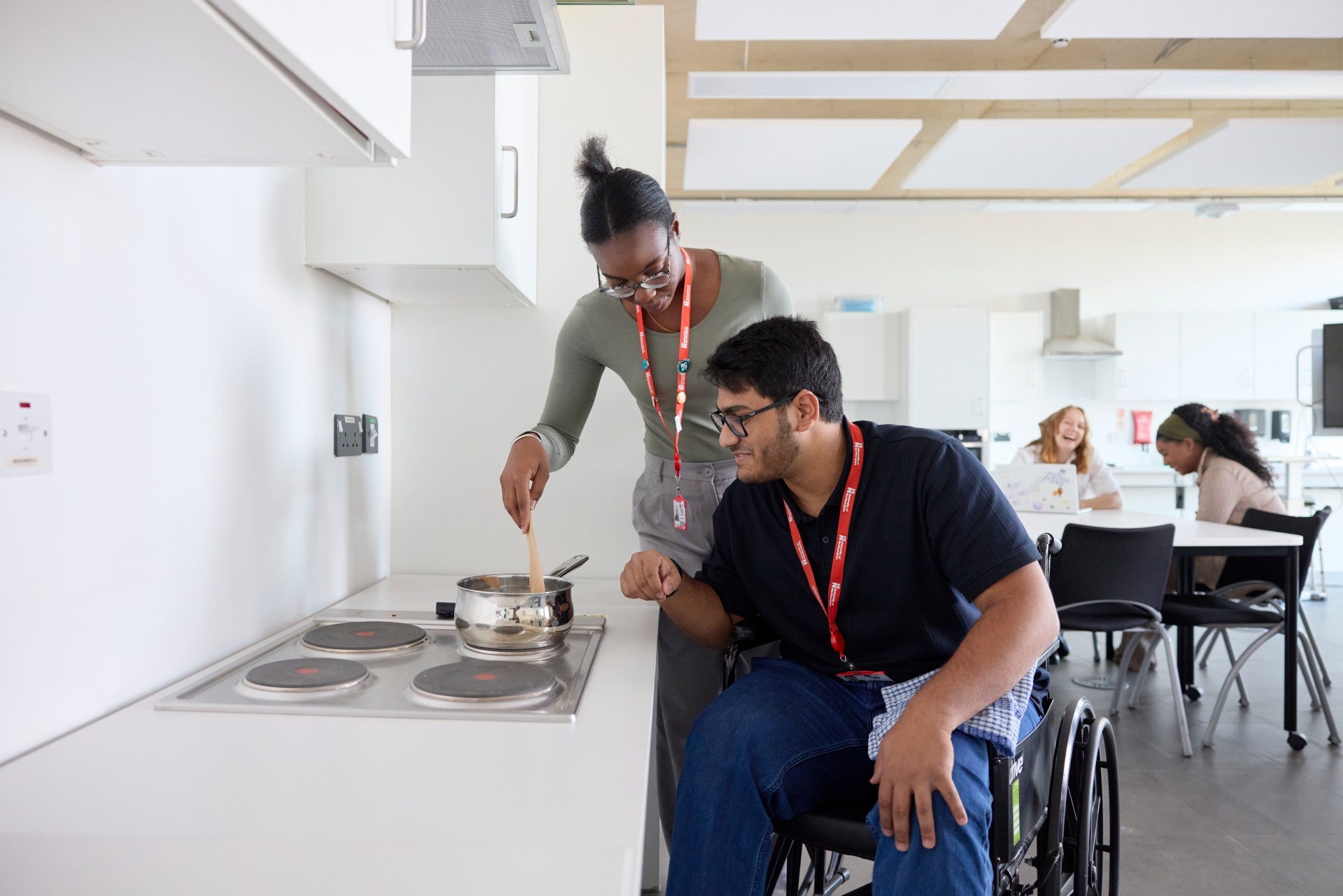
A therapist assisting a patient to cook a meal stirring a pan on the hob.
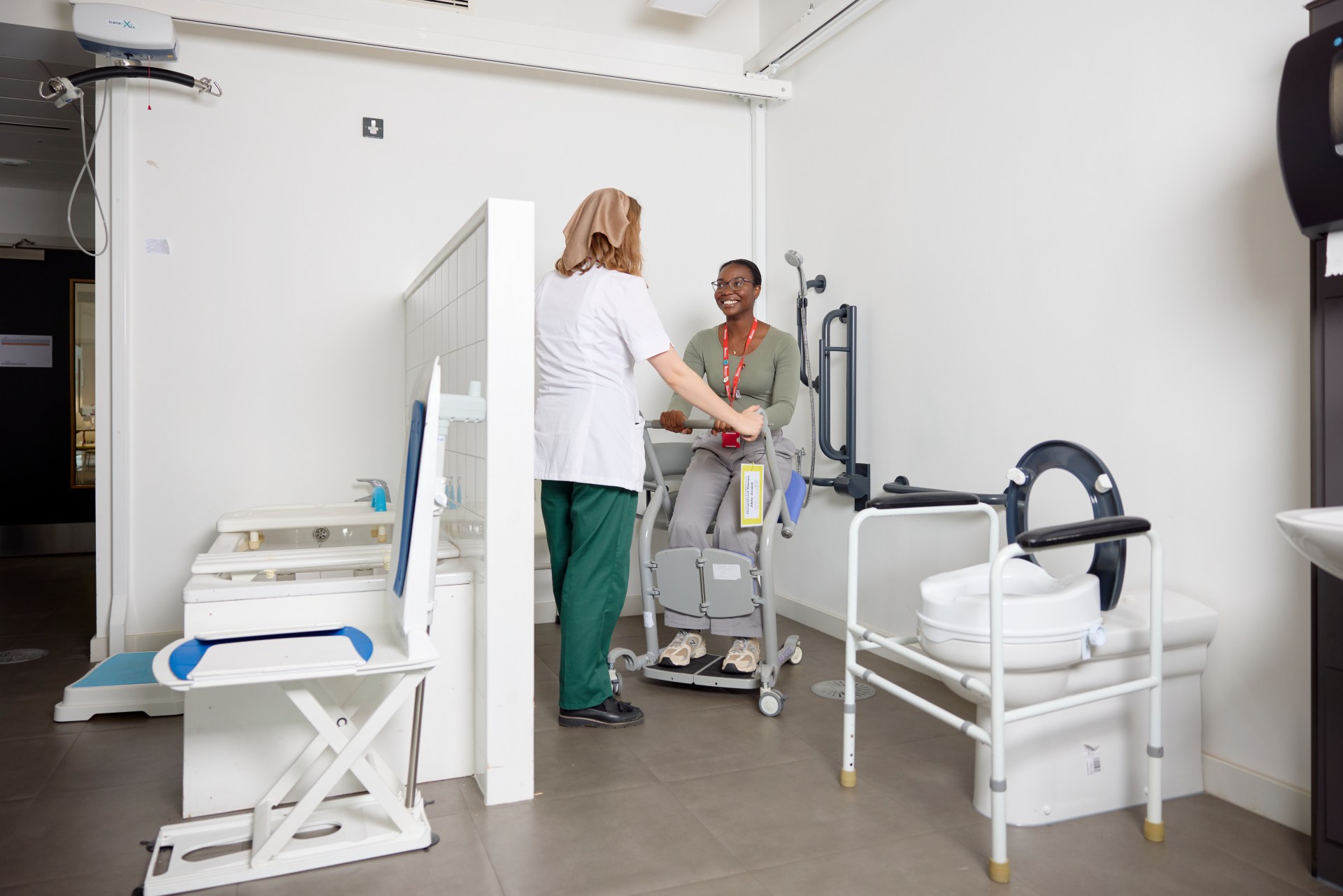
A healthcare worker assists a patient in standing up using a frame to support them.
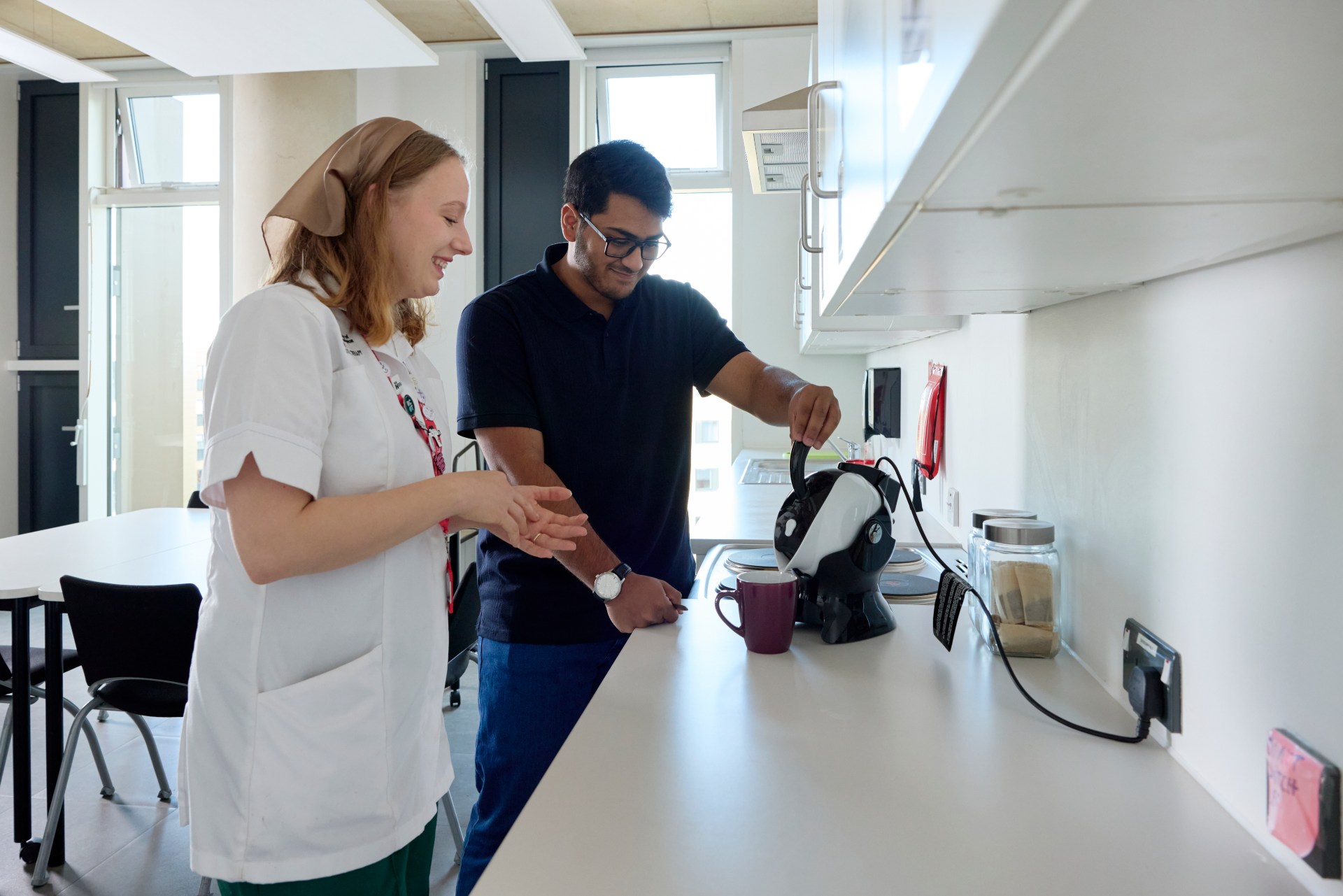
A person pouring a cup of tea from a kettle optimised to support people with impairments.
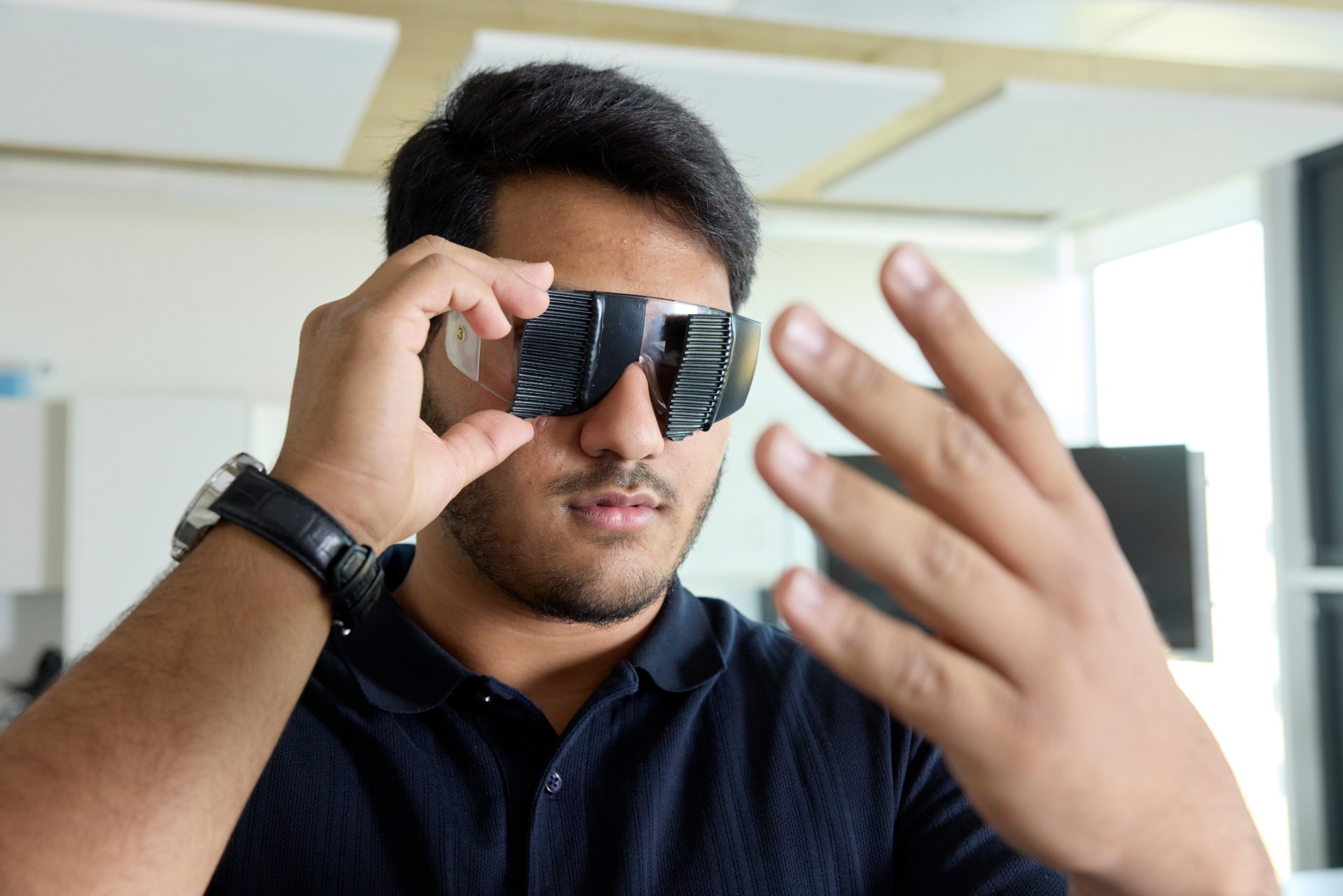
A student trying on goggles that emulate different fields of vision.
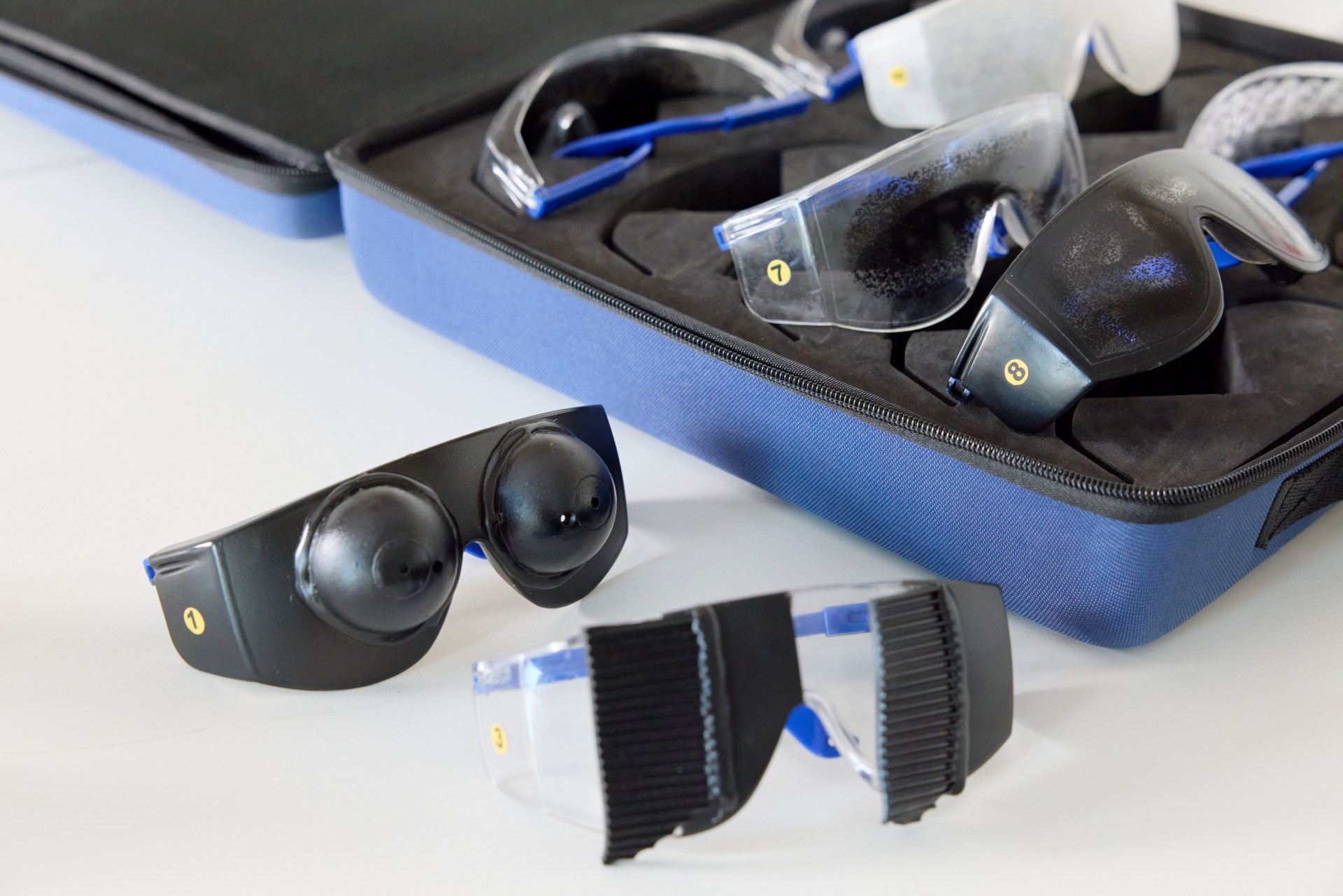
A variety of field of vision goggles used by occupational therapists.

Occupational students discussing case study approaches during a seminar.
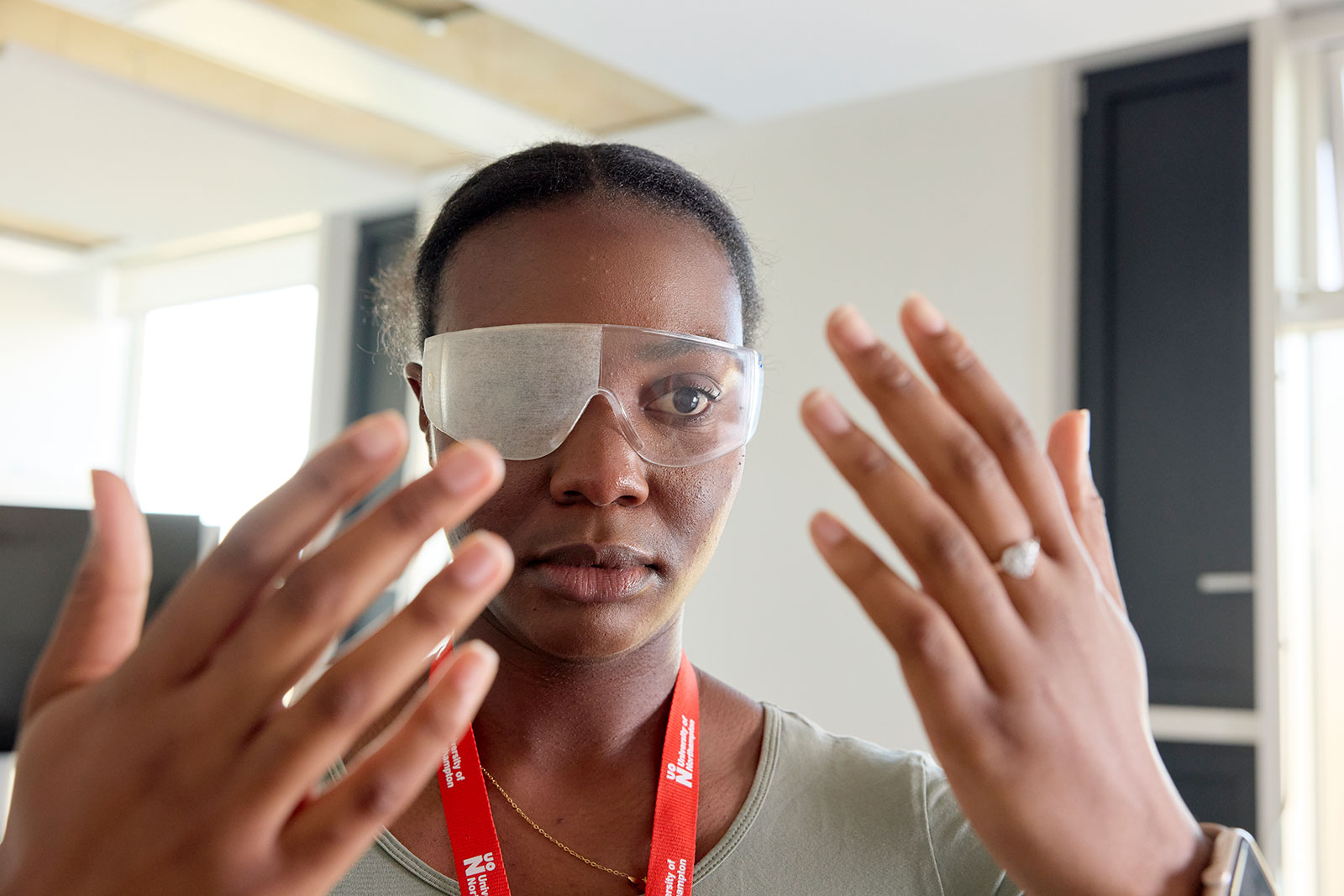
Close up of student wearing simulation glasses
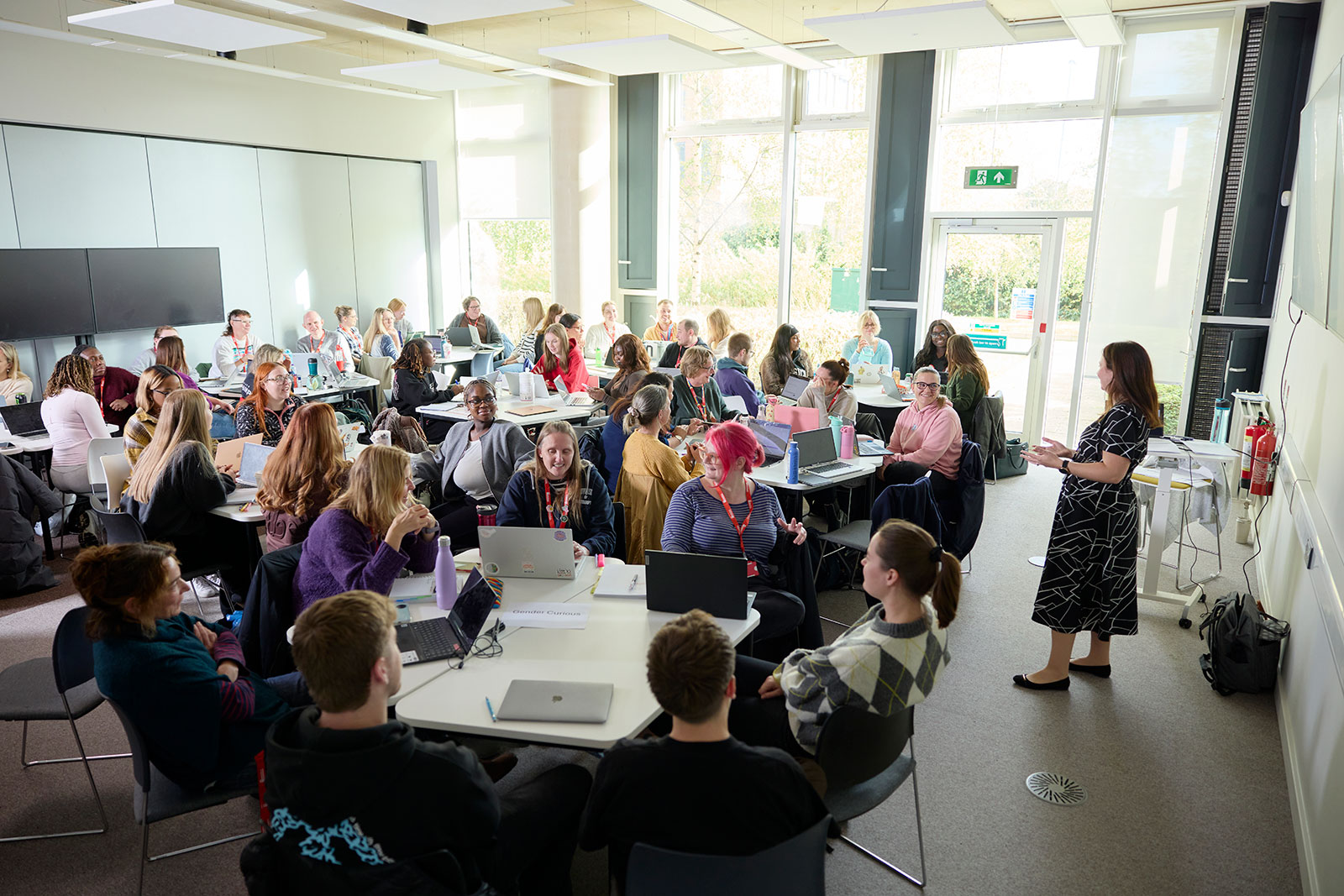
Large group classroom with fill tables of approximately 40 people sitting at tables
Entry Requirements
You will need one of the following qualifications (or equivalents):
- Three A Levels at BBC or above (in subjects other than General Studies)
- BTEC: 18 units; or Cambridge Technical graded DMM
- Merit at T Level
- Access to Higher Education course with 45 credits at Merit or above
- Open University minimum 60 credits.
- Please note that NVQs at any level are not accepted.
We welcome applications from students with a mix of A levels and BTEC/Cambridge Technical qualifications.
All Occupational Therapy BSc applicants must have:
- You will need to have five GCSEs including Maths and English at Grade C/4 or above
You will need to provide evidence of successful recent study at degree entry level. We will also consider other recognised professional courses that are not listed above, please contact our Admissions Team to discuss this on an individual basis. Each application is considered on its own merit so if you are unsure if you have the skills, knowledge, or qualifications to apply, please contact us.
All offers of a place on the occupational therapy university programme are subject to:
- successful Occupational Health Screening,
- satisfactory Disclosure and Barring Service (DBS) report, and
- successful interview by the University.
Occupational Health Clearance:
All healthcare students are required to undertake a standard Occupational Health Clearance which will assess your health and immunisation record and assess your fitness for the programme you have chosen. Courses such as midwifery, dental nursing and paramedic science also require an enhanced Occupational Health clearance and appropriate immunisation to undertake exposed prone procedures (EPP). Without the enhanced occupational health clearance your ability to attend some clinical placements/activities in Trust areas may be limited or refused, causing delays with course progression and employment.
Further information for healthcare students can be seen through the following link (appendix 1) Green Book: Chapter 12 Immunisation of healthcare and laboratory staff.
For more information on how to make an application, please visit our How to Apply page.
If you are an International student and would like information on making an application, please see our How to Apply page.
All International and EU students applying for an occupational therapy course with us must meet the following minimum English language requirements:
- IELTS 7.0 (or equivalent) with a minimum of 6.5 in all bands
for study at undergraduate level
For information regarding English language requirements at the University, please see our IELTS page.
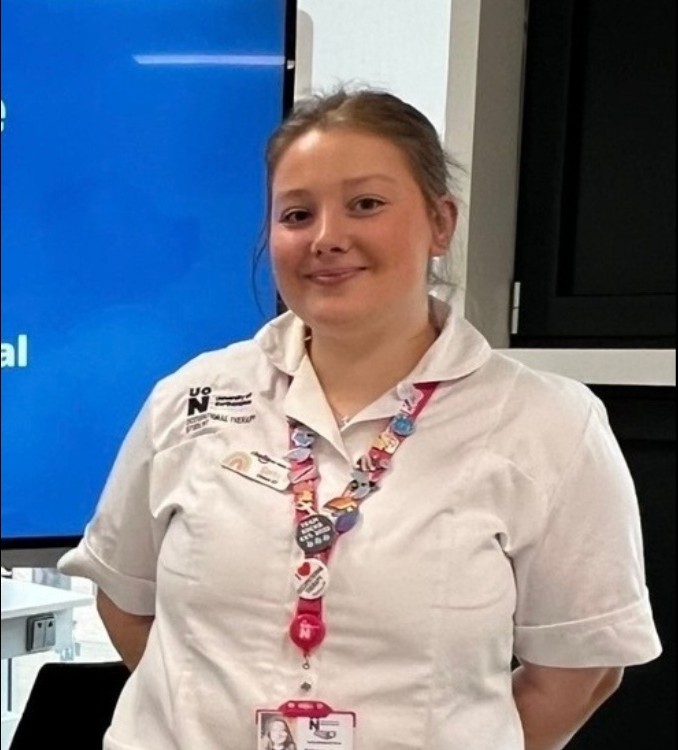
Sofia's story
“My overall career goal is to become a skilled and compassionate occupational therapist to support individuals to improve their independence and quality of life. I aspire to work in a setting where I can make a real difference.”
What You'll Learn
The University of Northampton’s Occupational Therapy degree equips you with the knowledge and skills that you will require for professional practice through combining the study of occupational and human sciences with hands-on learning in a practical setting.
We were one of the first Occupational Therapy courses to be established in Britain. We have strong connections in the local area and offer a wide range of exciting local, national and international practical placement opportunities.
You will have an opportunity to engage in professional practice within a variety of health and social care settings across public, private, voluntary and independent sectors. The range of placements in traditional and non-traditional settings enables you to develop and advance your skills in assessment and intervention with clients. You will be engaging with the evidence base for current practice throughout the Occupational Therapy course.
The first year will provide you with a foundation of knowledge; occupational therapy theory, anatomy and physiology, exploring health and well being of individuals. Alongside this you will learn core occupational therapy skills and complete your first practice placement.
The purpose of this module is to introduce students to the meaning and purpose of occupation and models of occupation. Students will develop their understanding of person centred practice and occupation theory.
The purpose of this module is to enable students to understand and explore the anatomical and psychological components of the human body and mind which may contribute to everyday functional activity. Students will develop an understanding of how individuals at different life-stages function within their environments.
The purpose of this module is to enable students to explore how daily life is affected by a range of conditions that impact health and wellbeing. Students will develop an understanding of how individuals will participate in occupations in relation to the disease process.
The purpose of this module is to develop a range of core skills essential to Occupational Therapy practice with a framework of a model of occupation. Students explore these skills through practical workshops within the occupational therapy specialist facilities.
The purpose of this module is to understand the occupational therapy process and its components. Students will build on developing core skills and applying theory to practice through the use of case studies.
The purpose of this module is to enable the student to engage in occupational therapy practice. The module will provide the student with opportunity to develop knowledge, core skills and behaviours required for professional practice.
Please note the modules shown here relate to the academic year 26/27. The modules relating to the academic year 27/28 will be available from June 2027.
This degree in Occupational Therapy is delivered in three formats:
- Full-time route
- Full-time Extended route
- Apprenticeships
All the programmes are accredited by the Health and Care Professions Council and the Royal College of Occupational Therapy.
All of the University of Northampton’s Occupational Therapy BSc graduates gain an academic degree which will then allow you to apply for registration with the Health and Care Professions Council (HCPC) to obtain a licence to practice and become a member of the Royal College of Occupational Therapists.
You will be taught by qualified Occupational Therapists who also have additional teaching qualifications, Masters or PhD qualifications. Our teaching staff have a variety of clinical backgrounds and expertise from acute/community/forensic mental health, acute physical, hand therapy, neuro rehab, community social service, primary care, learning disabilities, and paediatrics.
- The Full-Time BSc Occupational Therapy degree is approximately 20 hours of direct contact plus 15 dedicated study hours per week across standard university semesters.
- The Full-Time Extended BSc Occupational Therapy course is approximately 14 hours of direct contact plus additional study hours per week, extended over 45 weeks of the year.
- The Degree Apprenticeship includes work based learning and 7 hours direct contact plus additional study hours per week, extended over 45 weeks.
Studying the BSc Occupational Therapist degree offers you many opportunities including:
- Short Overseas Exchange: during Stage two you will have the option to take part in a student exchange programme where you can spend one week studying on the Occupational Therapy degree programme at a university in Finland. This is an excellent cultural professional exchange experience. Please note that you will have to pay for flights and accommodation.
- You are encouraged to participate in extracurricular activities during your studies such as Naidex; an annual equipment exhibition, RCOT conference or the OT Show or the many activities/courses on campus such as social entrepreneurship activities. You will be invited to take part in Heath Roadshows to promote the profession and the university, Open days and Applicant Visit Days to contribute to the recruitment and joining of successive student cohorts.
The World Federation of Occupational Therapists stipulate that occupational therapy students need to complete 1,000 hours of assessed practice. You will complete four placements across the programme that will meet this requirement.
Placements are available in a variety of settings and we work closely with the students to provide a range of practice opportunities.
At the University of Northampton, everything we do, from funded trips to paid internships, is to give you everything you need to make a difference when you leave.
If you join our full-time Occupational Therapy degree at the University of Northampton, you will receive a laptop when your course begins*. The laptops are built to a bespoke custom specification ideal for use in the seminar room, collaborative group work or studying at home.
Whatever your ambitions, we’re here to help you to achieve them. We’ll support you to identify the skills you’re learning during your occupational therapy course, find your strengths and secure practical experience so that when it comes to applying for jobs or further study you’ll feel confident in standing out from the crowd. We’ve created the Northampton Employability Promise because we are so confident that if you focus on your studies and complete one of our awards you’ll be highly employable by the time you graduate. Putting you in a great position to secure employment or continue your studies.
To check out the full list of perks, visit our Student Perks page or dedicated International Perks page.
* UK fee payers only (see Terms and Conditions for further details)
What is the difference between the different routes?
We have 3 routes in the BSc (Hons) Occupational Therapy:
- Full-time (FT): students are available for teaching and self-directed study Monday to Friday for traditional university terms. Placements are full time.
- Full-time Extended (FTE): students are in university 2 full days per week, with an additional day needed for independent study. Therefore, FTE students are required to attend for more weeks of the year in order to complete all of the modules. Teaching continues into June/July for FTE students. Placements are part time (22.5 hrs) in the first 2 years, and full time in the final year.
- Apprenticeship: students are in full time employment or being recruited to an apprentice post the health and social care sector. Students are nominated for the degree by their employer, they attend university one day per week, complete work-based learning tasks and complete full time placements.
Some modules are completed with FT, FTE and apprenticeship students together. All routes are completed within 3 years.
How will I be taught on the Occupational Therapy degree?Our occupational therapy degree incorporates a range of learning and teaching methods to engage you in active learning. This includes technology enhanced learning through online workbooks, activities and interactive discussions: classroom based learning through seminars, skills workshops, tutorials and practice–based learning. You will be a collaborator in learning with your tutors, peers and practice educators. We are working with local partners in strategy development and are encouraging of social entrepreneurship with resources and expertise within the staff team.
Successful completion of the BSc Occupational Therapy degree will allow you to apply for registration with the Health and Care Professions Council (HCPC). In addition, it will also give you an opportunity to obtain a licence to practice and become a member of the Royal College of Occupational Therapists.
How will I be assessed on the Occupational Therapy course?A diverse range of assessments are included in the course to ensure academic and professional competence and to prepare you for the role of an Occupational Therapist. This includes written assignments, multiple choice question tests, poster presentations, group work, reflective essays, case studies, OCSE’s, Blogs and placement assessment. You may work together in pairs/small groups for some assignments.
Support is provided by tutors for all module assignments in the form of assessment tutorials and marking criteria.
What extra curricular course events or activities are there?There are opportunities throughout the course to get involved in events and activities. We have excellent links with local organisations for volunteering. We have a strong Occupational Therapy community, the student Occupational Therapy Society arrange regular activities, we participate in National OT Week and various events throughout the year.
Student Finance Queries?
Get all the info you need ahead of time, before you can apply for funding in Spring on our fees and funding pages.

Fees and Funding
2026/27 Tuition Fees
- Full Time: £9,790
UON will adjust fees annually for UK (Home) Students up to the maximum allowable fee cap set by the Secretary of State for Education.
When assessing an applicant’s eligibility to pay home fees, we use the guidance provided by the UK Council for International Student Affairs (UKCISA) which sets out the regulations that have been decided by the UK Government Department of Education.
- Full Time New Students: £18,000
- Full Time Continuing Students: £17,300
Tuition fees quoted for International Students apply only to the 2026/27 academic year. These fees may increase in future years in line with Consumer Price Index (CPI) inflation to reflect rising delivery costs. Any annual increase will be capped at a maximum of 5% of the previous year’s tuition fee. Updated tuition fees will be published on the UON website at least three months before the start of the next academic year.
Additional Information
- For placements, Occupational Therapy students may incur additional accommodation and travel costs.
- You will be provided with a uniform (three tops and three pairs of trousers). Additional uniform items can be purchased at cost.
- You will need to wear black leather shoes and black socks.
- We have a wide range of books and journals accessible in our library, either in hardback or e-books or via our electronic databases.
- You will participate in some activities where a small cost may be incurred such as craft, art, cooking material to a maximum of £25 a year.
- You are also required to complete a recognised (level two) food hygiene course You will be able to complete this course online at an approximate cost of £10-£20.
- Travel costs to and from placements, and extra costs associated with placements, may be incurred throughout your studies depending on where you are based.
Students, studying nursing, midwifery and many of the allied health professions courses from September 2020, may be eligible for a payment of at least £5,000 a year which they will not need to pay back. They may be able to apply for Financial support through the NHS Learning Support Fund (NHS LSF) which offers eligible students additional support while studying for their degree. This is in addition to the Student Loan from the Student Loans Company.
Financial contribution towards your travel, and expenses in relation to your practice learning opportunities, may be available to you from the NHS Learning Support Fund. Details, including eligibility criteria, can be found on the NHS website.
As this funding is provided by the Department for Health & Social Care (UK Government) please check the NHS LSF website for full details, any changes and updates.
For more information about possible funding options, please visit our Fees and Funding pages.
Fees quoted relate to study occupational therapy in the Academic Year 25/26 only and may be subject to inflationary increases in future years.
- UK Full Time: £9,535
- International Full Time: £16,700
Staff

Deborah Hewson
Senior Lecturer in Occupational Therapy

Catherine Gibbins
Senior Lecturer in Occupational Therapy

Nicola Cumbleton
Senior Lecturer in Occupational Therapy

Jane Campion
Senior Lecturer in Occupational Therapy

Jenny Devers
Senior Lecturer in Occupational Therapy

Rachel Murrill
Senior Lecturer in Occupational Therapy

Michael Adams
Senior Lecturer in Occupational Therapy

Brightlin Dhas
Senior Lecturer in Occupational Therapy
Terry Brown
Senior Lecturer in Occupational Therapy

Kimberley Feehily
Lecturer in Occupational Therapy
Kate Brereton
Lecturer in Occupational Therapy

Rox Talbot
Lecturer in Occupational Therapy
Chloe Reid
Lecturer in Occupational Therapy
Steve Macdonald
Senior Lecturer in Occupational Therapy
Careers and Employability
Occupational Therapists work in diverse areas of practice. Opportunities are available in the UK and abroad with a wide range of career options; the National Health Service, Social Services, private practice, special education, the prison service and in the voluntary sector.
The University of Northampton’s BSc OT degree is structured to provide you with support. The final year of the course is designed to enable you to prepare for applying for your first job within the field of Occupational Therapy.
Master’s Opportunities
Our postgraduate and Master’s courses are a great way to enhance the skills you have already learnt. Benefit from our 20% alumni discount on postgraduate fees.
Facilities
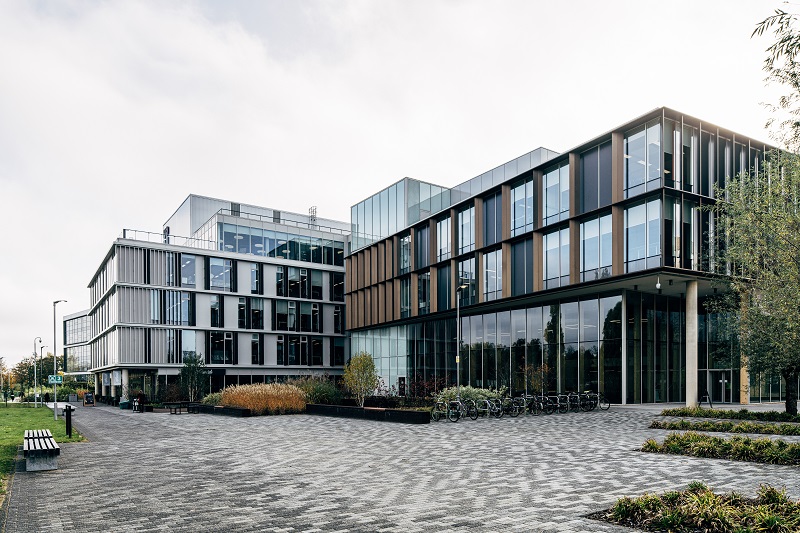
Learning Hub Building
The Learning Hub is at the heart of the campus and home to the student information desk.
View Facility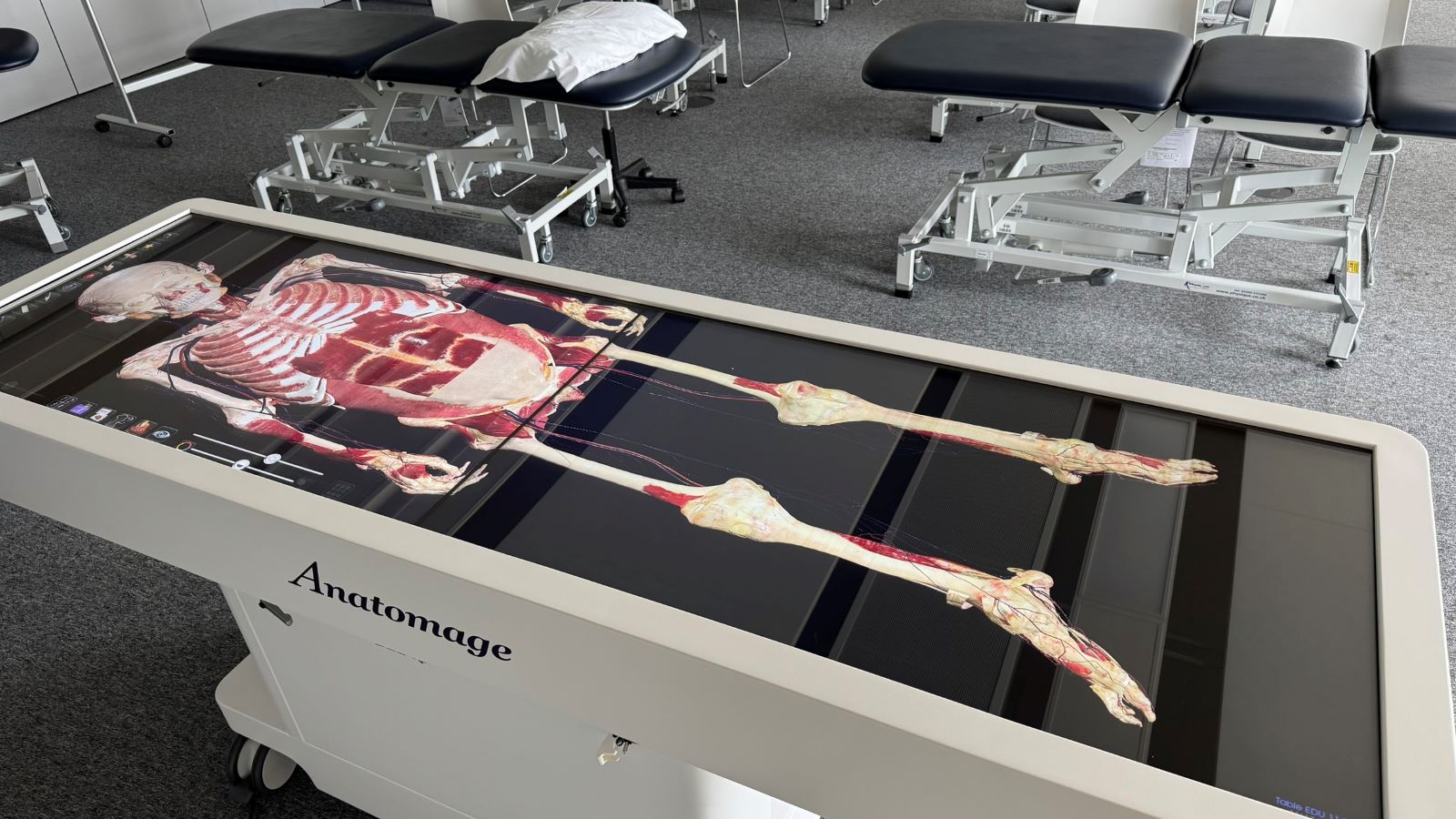
Anatomage Table
A 3D interactive digital dissection desk for students on Health Professions and Sport courses.
View Facility