

Samantha Weeks
Senior Lecturer in Education (CYF)
To ensure we guide you through the correct application process, we just need you to answer a few quick questions.
Already applied?
Log in to view updates.
This course offers two separate application routes, depending on whether the application is submitted by the student or an international agent.
Please select your desired length of study from the available options.
This course includes a placement option. Please indicate whether you’d like to apply with or without a placement.
Please select where you would like to study.
All the available academic years are displayed below.
All the available start months for the selected academic year are listed below.
Please review the information below carefully before continuing.
If you need to make any changes, click the < Back button to return to the previous step.

UCAS Code
BA: X300
BA with Foundation: X310
Duration
3 years full time
4 years full time (with foundation)
4-6 years part time
BCC - BBC at A Level
DMM at BTEC
Full Time: £9,790
Part Time: £1,630 per 20 credit module
Integrated Foundation Year: £5,760
Updated 20/03/2026
The BA Education Studies degree opens up a wide range of careers, ideal if you know you want to work in education but you are not sure yet which path to take.
You will explore a range of disciplines including sociology, psychology, philosophy, history and politics and you will discover the transformative power of education. You will be able to experience education in action during your time on placements throughout the course and our optional overseas trips will help you get an international perspective. All of these experiences will help you to uncover how external influences like beliefs, culture, and the surrounding environment can impact how children and adults learn, shaping their attitudes, knowledge and skills.
Based on overall student positivity – National Student Survey 2025
For Satisfied with Teaching for Education
NSS Calculations are based on Office for Students (OfS) data from the average positivity score. Guardian Data from the 2026 Education subject league table.
*See eligibility criteria, terms and conditions apply
A typical offer for our BA degree in education would be:
We welcome applications from students with a mix of A levels and BTEC/Cambridge Technical qualifications.
We are also able to welcome applications for September 2025 through clearing.
For this education studies degree, we welcome international applications and applications from students with a range of non-traditional educational or professional qualifications. We also welcome mature students and students who have undertaken access courses.
Applicants are expected to hold GCSE grade C/4 in English or equivalent. GCSE Mathematics and GCSE Science are desirable. (Please note that for students who wish to progress onto a Primary PGCE after their Honours degree it is necessary to hold GCSE grade C/4 in Maths and Science)
Please note that all education studies students who enrol on the course will be required to complete:
For information on how to apply to study with us, please see our How to Apply page.
The University of Northampton now offers on a range of our courses an alternative route to study – the integrated foundation year (IFY).
Admission to this foundation programme is normally:
However, we would also like to hear from you if you have professional or industry experience instead, a range of other qualifications or self-developed subject knowledge that relates to the programme you wish to study.
All International and EU students applying for an education course at the University of Northampton must meet the following minimum English language requirements:
For information regarding English language requirements at the University, please see our IELTS page.
For information on how to apply to study with us as an International student, please see our How to apply for International Study page.
Open Days give you the best experience and insight to courses, people and facilities that interest you. Make your choice easier and come meet us.
Book NowThis educational studies degree has been designed to contribute towards achieving the following United Nations Sustainable Development Goal: SDG4 Quality Education.
If you are curious about education, keen to learn more and not sure yet where in the vast world of education you see yourself in the future – our education studies course could be the perfect option for you.
BA Education Studies is a multi-disciplinary programme and is designed to explore the field of education from a range of perspectives including international education. From the very beginning we encourage a thoughtful, reflective and rigorous approach to challenging assumptions. You are encouraged to become critical thinkers questioning the very basis of education, able to critique policy, compare differing approaches and ultimately reflect on your own development as an educationalist. You will be well equipped for a range of careers working with children, young people, families and beyond.
Year one of this education degree provides a solid foundation by exploring a broader understanding of education including a basis in child development, and an exploration of what schools are, and could be. You will have the opportunity to apply this by observing practice during your placement towards the end of year one.
School: Past, Present and Future enables students to synthesise their previous school experiences with recent and contemporary education changes to develop a proposal for an improved School System in England, to reflect upon academic performance, and so enhance their graduate employability.
The module supports the transition into Higher Education, providing opportunities for personal, professional and academic development. Students will explore the concept of Education Studies and provides opportunities for discussion and exploration of key themes and phenomena.
This module develops students appreciation of what six subject disciplines can offer to the study of education, and their contribution to education systems to nurture a multi-disciplinary approach to educational issues, problems and concerns.
The purpose of this module is to examine changing constructs and identities of the nature of childhood through time, from Medieval to Modern eras, including living memory and their own recent and current experiences.
The purpose of this module is to encourage students to interrogate how the curriculum might support or undermine presence, participation and achievement. Students will be enabled to develop their understanding of disruptive and inclusive curricula and why and how these matter in the context of a diverse society.
The purpose of this work based learning module is to to support the application of theoretical perspectives of Education Studies in an educational setting and provide opportunities for the development of reflective professional practice and employability skills. Work based learning opportunities will be broad and could include, for example, setting based, virtual reality or online. There will be opportunities for students to arrange their own placements in consultation with the Partnership Tutor
This module enables students to develop their understanding of a range of key theories of child development and explore their relevance for learning and the design of education programmes and policy in diverse contexts.
Educational Inequalities enables students to synthesise issues inherent to Educational Inequalities with their previous education experiences to create an education autobiographical narrative, and reflect upon engagement with the concepts of inclusion and exclusion whilst enhancing their graduate employability.
Please note the modules shown here relate to the academic year 25/26. The modules relating to the academic year 26/27 will be available from June 2026.
At the University of Northampton, everything we do, from funded trips to paid internships, is to give you everything you need to make a difference when you leave.
If you join our full-time Education Studies degree at Northampton, you will receive a laptop when your course begins*. The laptops are built to a bespoke custom specification ideal for use in the seminar room, collaborative group work or studying at home.
Whatever your ambitions, we’re here to help you achieve them. We’ll support you to identify the skills you’re learning during your course, find your strengths and secure practical experience so that when it comes to applying for jobs in education or further study you’ll feel confident in standing out from the crowd. We’ve created the Northampton Employment Promise because we are so confident that if you focus on your studies and complete one of our awards you’ll be highly employable by the time you graduate. Putting you in a great position to secure employment or continue your studies.
To check out the full list of perks, visit our Student Perks page or dedicated International Perks page.
* UK fee payers only (see Terms and Conditions for further details)
Our optional overseas study trips provide you with the opportunity to experience different perspectives first hand and this invariably teaches us about our own perspectives. Each year has an overseas opportunity (dependent on numbers).
Previously in Year One we have offered a study trip to the Netherlands to experience the University of Han in Nijmegen, this trip looks at learning and development from a European perspective. In Year Two we have offered the opportunity to travel to Atlanta, USA where our study tour has a focus on diversity, civil and human rights – this week can also be included as part of your placement in this year. Then in the final year there have been opportunities to join a study trip to Sweden with a focus on the child in society. This trip is a wonderful opportunity to enrich the learning throughout your degree and acts as a springboard towards your next step.
The Integrated Foundation Year (IFY) for this educational studies degree offers a new and exciting route into studying for a BA degree, attracting ambitious and driven students who are willing to learn and advance.
If you have non-standard qualifications or do not quite meet the admissions requirements for BA Education Studies, we can offer you a fantastic opportunity to study a four year programme which includes an Integrated Foundation Year. The Integrated Foundation Year will help you develop the theoretical/practical and academic skills you need, in order to successfully progress to the full award.
Our four-year courses will enable you to successfully follow the degree pathway of your choice while gaining essential study skills. The foundation year of your chosen degree will be studied on a full-time basis and is aimed at supporting the transition to higher education. Years two, three and four are then studied as a standard degree programme.
Work-based learning opportunities are embedded throughout the Education Studies degree.
In Year One, you will have 4 weeks of placement. The first week is arranged as a skills development week and this takes place on campus. This week enables you to feel fully prepared and ready to then spend the remaining three weeks in your placement setting of choice. The focus of this placement is learning and development, it takes place at the end of the first year, so you can apply all of your theoretical learning from the first year to your observations of learning and development.
In Year Two, you have four weeks of placement: By Year Two you already have a successful placement under your belt. In this placement there is some flexibility about how the four weeks are completed, this can include a week overseas and it can also be stretched out over a period of 6 to 7 weeks, timetable dependent. The focus in Year Two is on diversity and difference and you will reflect on inclusion in your placement setting. Assessment is via a reflective report where you apply theory to practice.
In Year Three, you have two weeks of placement: These two weeks happen in the first half of the final year to enable you to spend the latter part of the year focused on your own research. This placement focuses on empowering change, social inequality and creating solutions. This is a powerful conclusion to your work-based learning and provides an excellent step from which to move into the next step in your career.
Examples of work-based learning settings:
This programme is not limited by a focus on a specific age range. You will benefit from the opportunity to deepen your knowledge and understanding of education in its broadest sense. There are opportunities to learn about and apply this learning during placements with very young children, primary and/or secondary aged children, families, young people and continuing into adult education – we believe passionately that education is relevant throughout the lifespan and can be found almost anywhere. You will be able to choose the age range and type of education setting that you wish to focus on, and you will be supported finding placements to fit your needs and interests.
One of our current Education Studies students, Millie, has recently completed her first year placement, take a look at her story and see how inspiring these opportunities can be and how they can provide the first crucial steps in your career.
The amount of on-campus teaching for the education studies degree varies from module to module, as does how it is delivered. Generally, you will have the most time face-to-face with the lecturer in your first year. Some modules for this education studies degree in the second year will be taught off-campus on trips and visits and final year study is often based on tutorials and individual time with the lecturer rather than formal lectures.
There are no exams for Education Studies. Instead, assessments take the form of essays, portfolios, presentations, analysis and reflection.
There are lots of options available to you, especially in the Education sector. This could be in school settings, government / local authorities or international settings too. If you would like to become a teacher after studying this course, we can support you into postgraduate study.
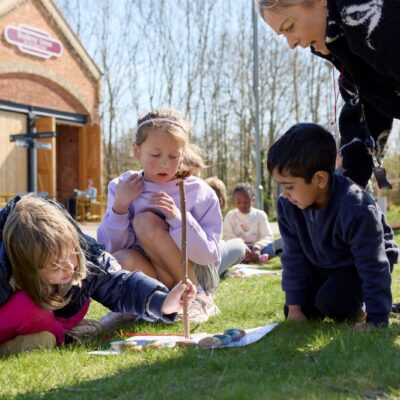
Yes we teach you the theoretical and the experiential elements of the education studies. For example, we visit forest schools so that you get to experience that. Visits to museums and art galleries are also part of the course. Placements have been designed to enable students to look closely at education in action, so look at and find the theory that we have been learning about in practice. What is important is that students learn about the theory and research (which we do within the various modules), recognise what this looks like in reality (achieved through the placements) and then are able to reflect upon that (students reflect on their experiences during and afterwards).
To provide you with a broad perspective on education in various contexts and settings, you will have the opportunity to visit numerous institutions across the UK. These experiences will enable you to immerse yourself in different environments, reflect on them, and explore a wide range of potential professions that might be the perfect fit for you. All compulsory visits are inclusive of your course fees.
Past visits have included local museums and heritage sites, forest schools, prisons, the Houses of Parliament, local schools, therapeutic outreach provisions, alternative provisions, the Museum of Childhood, and the Fitzwilliam Museum in Cambridge.
“The placement enabled me to see how transformational it can be to put even the smallest effort into caring for an individual person’s needs and watch them flourish because they have been seen and valued for the first time in their education.”
UON will adjust fees annually for UK (Home) Students up to the maximum allowable fee cap set by the Secretary of State for Education.
When assessing an applicant’s eligibility to pay home fees, we use the guidance provided by the UK Council for International Student Affairs (UKCISA) which sets out the regulations that have been decided by the UK Government Department of Education.
Tuition fees quoted for International Students apply only to the 2026/27 academic year. These fees may increase in future years in line with Consumer Price Index (CPI) inflation to reflect rising delivery costs. Any annual increase will be capped at a maximum of 5% of the previous year’s tuition fee. Updated tuition fees will be published on the UON website at least three months before the start of the next academic year.
The cost of essential trips for your educational studies degree are covered by your tuition fees, and this will include all of the trips within England (museums, prison, schools, APP etc.). During the programme you will also have the opportunity to join optional overseas study trips. Previously, these optional trips have included visiting one of our European partner universities (HAN University in the Netherlands), a trip to Atlanta and Sweden. Typically the trip to the Netherlands costs in the region of £300; Atlanta £1000 and Sweden £500. Students normally allow an additional £100-£250 for their expenses.
For information on the scholarships available to you for the education degree, please see our scholarships page.
For more information about possible funding options, please visit our Fees and Funding pages.
Fees quoted relate to study in the Academic Year 2025/26 only and may be subject to inflationary increases in future years. UON will adjust UK fees annually in line with Government Policy.
Senior Lecturer in Education (CYF)
Senior Lecturer in Education (CYF)
Senior Lecturer in Education (CYF)
Senior Lecturer in Education (CYF)
Senior Lecturer in Education (CYF)
Senior Lecturer in Education (CYF)
If you complete your education studies degree with us and apply for our PGCE Primary Education (5-11) (QTS) programme at the University of Northampton during your final undergraduate year, you are guaranteed an interview.
Terms and conditions apply:
Our postgraduate courses are a great way to enhance the skills you have already learnt on the BA in Education Studies. Benefit from our 20% alumni discount on Master’s and postgraduate fees to give you a CV that will catch the eye of employers:
This degree prepares you for a wide range of careers. There are many roles within schools and colleges that our students move into. In addition, some students with an Education Studies degree are inspired to move into social work, mental health and therapeutic sectors, youth work and supporting refugees. Here are some examples of roles that our graduates are involved with: