level:UG;top_up:false;international:true;foundation:true;clearing:true;full_time:true;part_time:true;start_month:September;location:Waterside
Games Programming BSc (Hons)
Key Facts
-
UCAS Code
BSc: I610
BSc with Foundation: I611 -
Duration
Full Time: 3 years
Full Time Foundation: 4 years
Part Time: 4 years
-
BCC at A-Level or,
DMM at BTEC -
Full Time: £9,790
Part Time: £1,630 (per 20 credits)
Integrated Foundation Year: £9,790
Get in touch
UK STUDENTS ENQUIRIES
study@northampton.ac.uk
0300 303 2772
INTERNATIONAL STUDENTS ENQUIRIES
Updated 10/08/2026
Our Games Programming degree is designed in such a way as to provide students with all the knowledge and skills required to have a successful career in the Computer Games industry. The Computer Games industry has developed throughout the decades of its existence, and now has a reputation of being one of the most competitive industries around todat. Companies are constantly looking for highly creative people possessing a passion about creating computer games for gaming programmer jobs.
Our Games programming degree will enable you to develop the specialist knowledge and key skills needed to join this thriving industry. You’ll be joining a supportive and friendly community of highly motivated academic staff and games students who work hard to achieve their goals.
Highlights
- Opportunities to enter national game competitions on this BSc games programming course.
- Internship opportunities for this games programming degree.
- Put theory into practice in our state-of-the-art computer lab.
- Learn about the development of ideas, planning, problem-solving and the economics of designing video games from start to finish
- HP Laptop and software included with this game programming degree.* (*Terms and Conditions apply)
- Guaranteed paid internship with the Northampton Employability Promise.
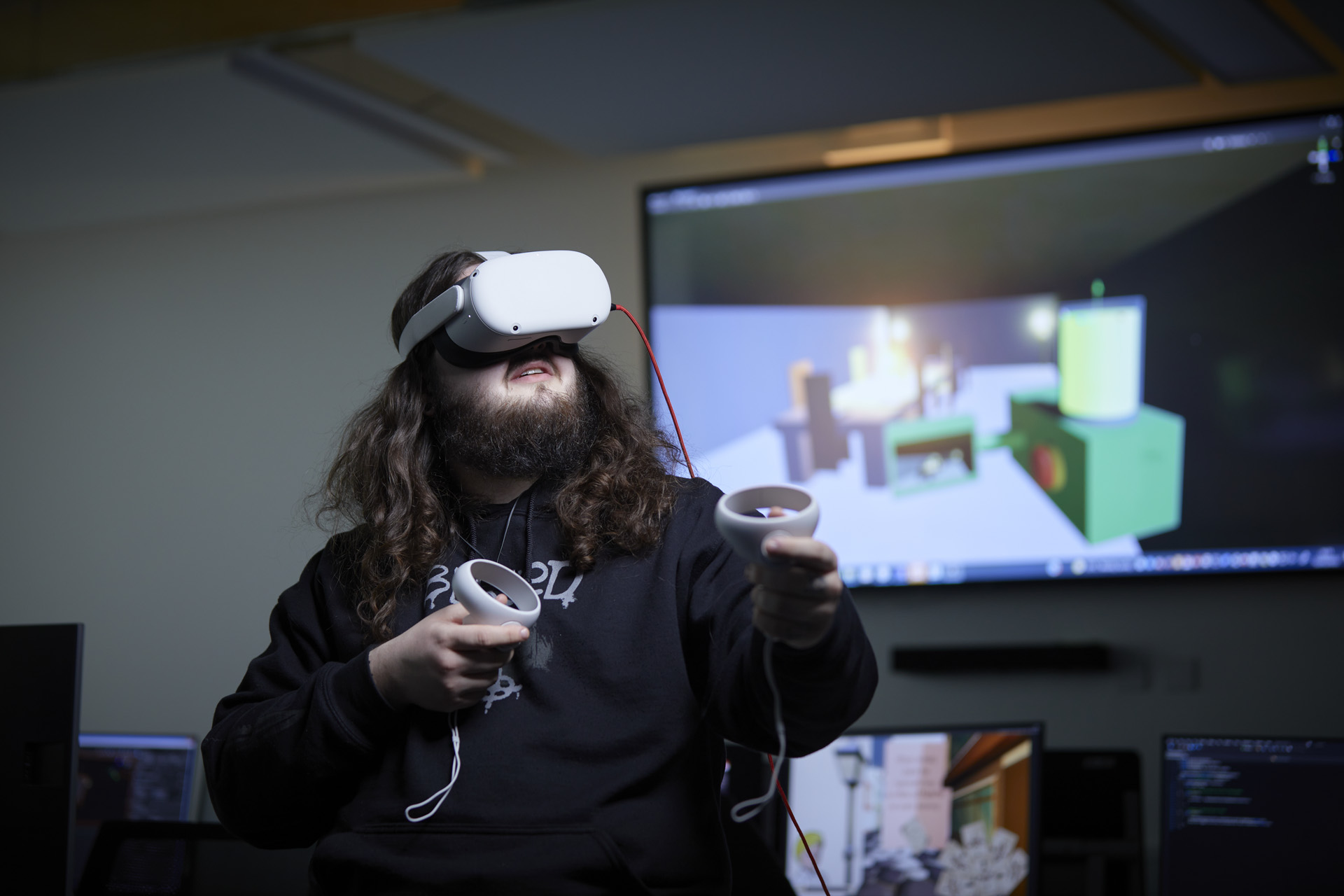
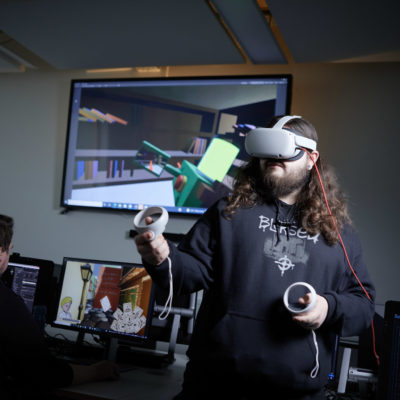
Student using a virtual reality headset, as part of their class work during Animation or Games.
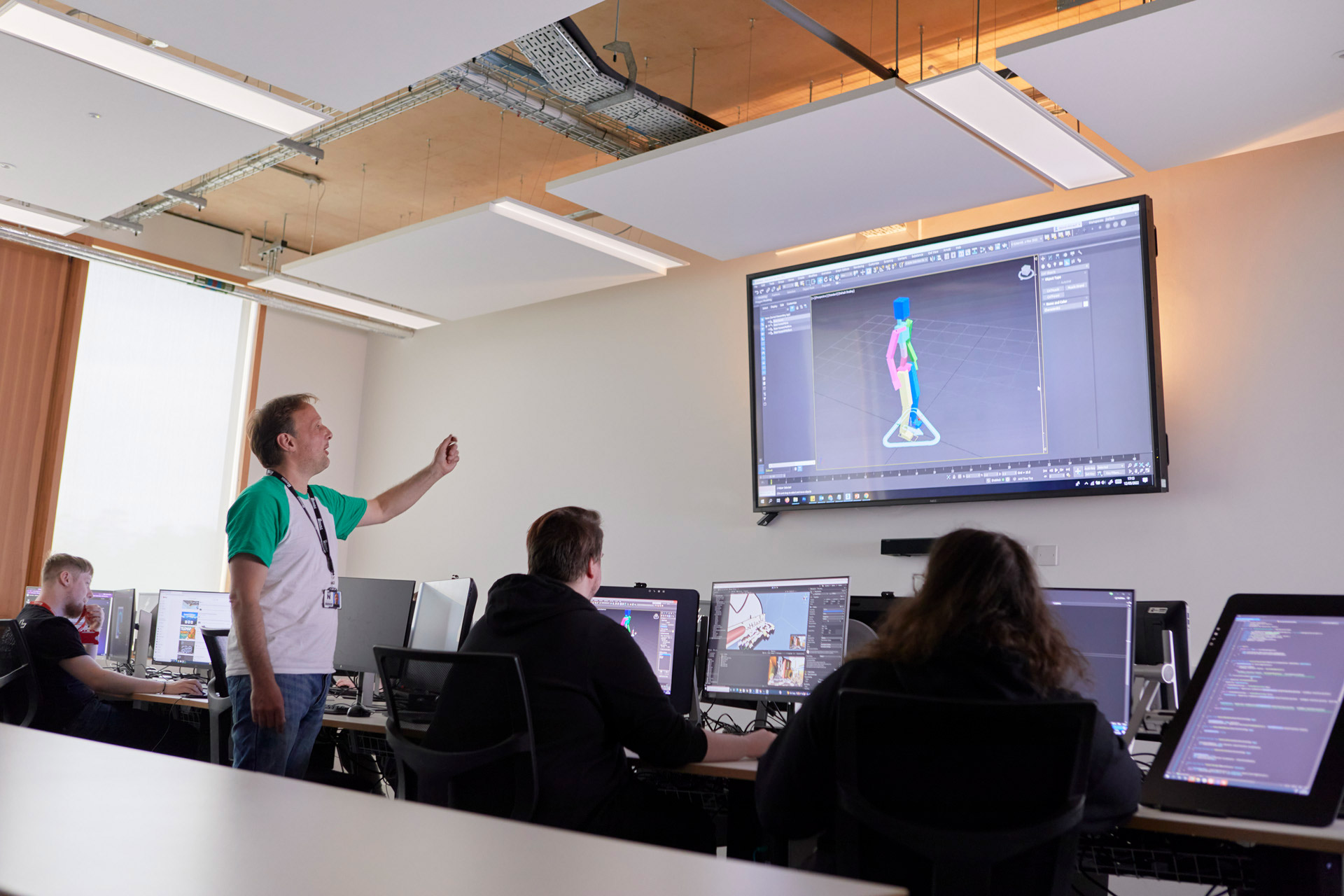
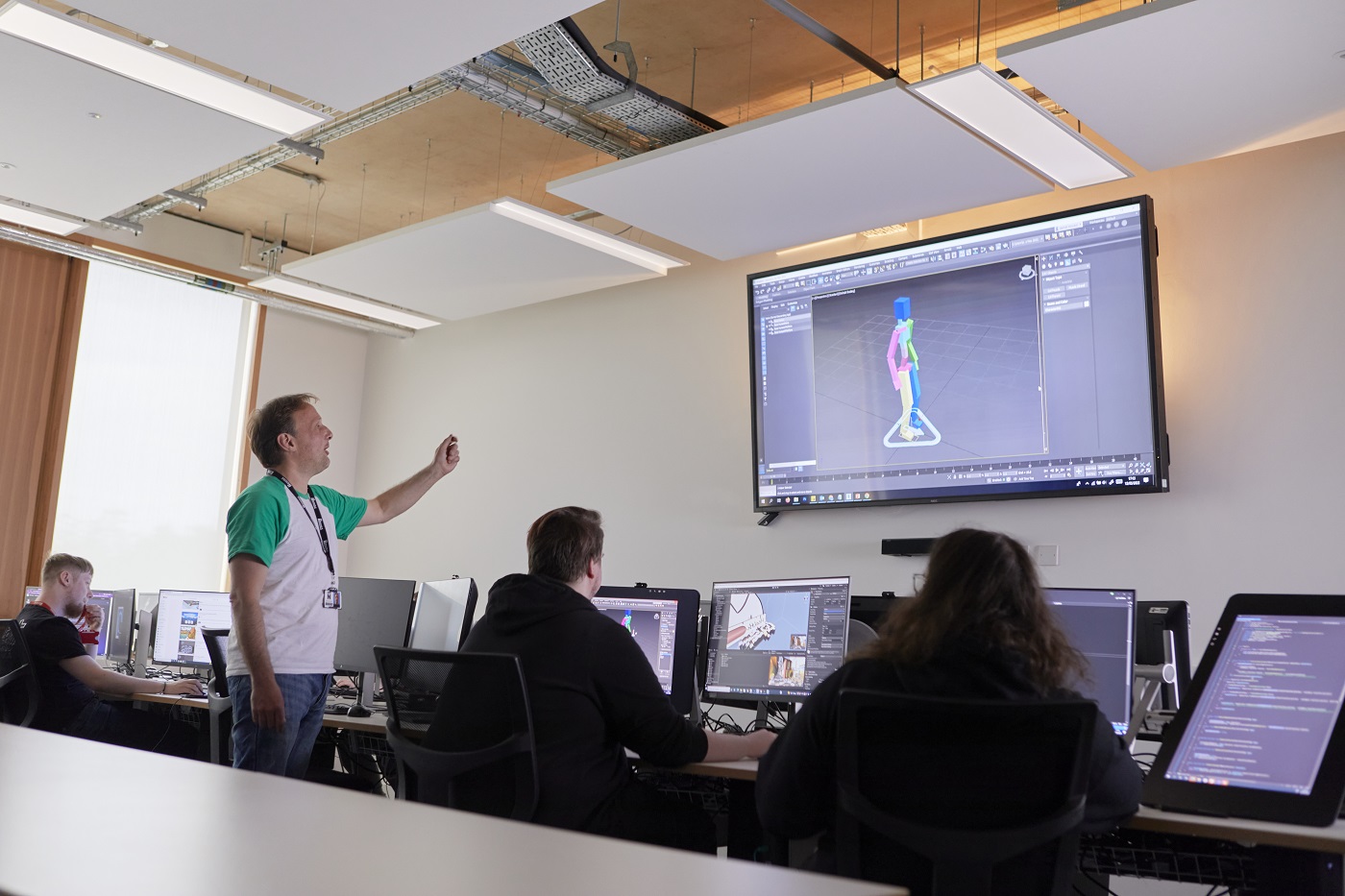
Class session, where academic is teaching class about animations with a visual demonstration.

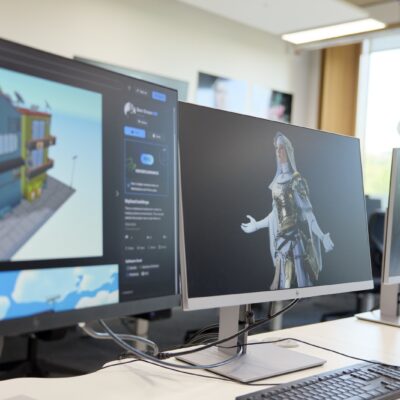
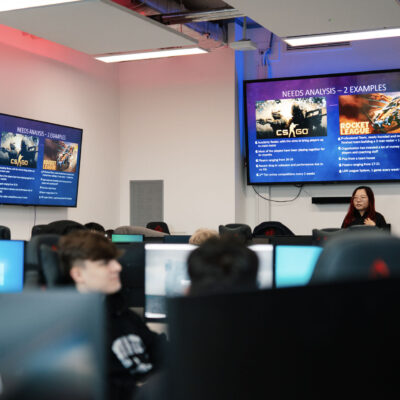
Example of the computer suites for Game and Animation courses.
Entry Requirements
A typical offer for this course would be:
- BCC at A-Level or,
- DMM at BTEC/Cambridge Technical or,
- Pass (C and above) at T Level
You will be expected to have achieved GCSE Mathematics (or equivalent) at grade C/4 or above. The University of Northampton welcomes international applicants and applications from students with a range of non-traditional educational or professional qualifications.
We welcome applications from students with a mix of A levels and BTEC/Cambridge Technical qualifications.
The University of Northampton now offers on a range of our courses an alternative route to study; the integrated foundation year (IFY). Admission to this foundation course is normally:
- DEE at A Level or,
- MPP at BTEC or,
- Pass (D or E) at T Level
However, we would also like to hear from you if you have professional or industry experience instead, a range of other qualifications or self-developed subject knowledge that relates to the course you wish to study.
All International and EU students applying for a course with us must meet the following minimum English language requirements:
- IELTS 6.0 (or equivalent) with a minimum of 5.5 in all bands
for study at undergraduate level
For information regarding English language requirements at the University, please see our IELTS page.
Dystopia Games
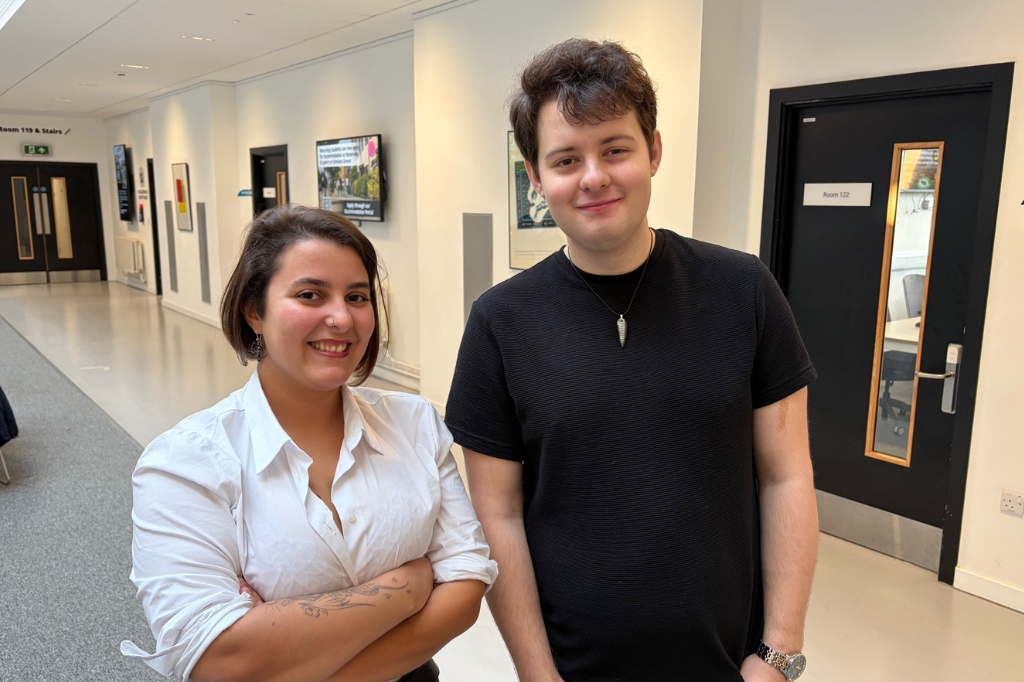
Two University of Northampton graduates have launched a new indie games studio, with ambitions to put their local town on the map for narrative-led game development. Elisa Pojaga and Samuel Waite have teamed-up to break into the UK games industry.
What You'll Learn
On our Gaming degree, you will focus on the programming and development of computer games starting from the foundation principles of computer games programming. We insist also on the principle of “theory put into practice”, and with the assistance of our brand new, state-of-the-art equipped, computer labs, you will have every opportunity to experience this principle materialising, gaining both the theoretical knowledge and the practical skills you need to develop first-rate computer games.
You will have an opportunity to fully explore other key computer games elements like development of ideas, planning, problem-solving and the economics of creating a complete computer game ready to be launched in the market.
You will also gain an in-depth understanding of Computer Science in general, this being the field of science that underpins computer software development in the entirety of its spectrum. The advantage of this is that after graduation you will be fully prepared and equipped with all the crucial knowledge required to succeed as a computer programmer of any other kind as well.
Compulsory Modules
This module introduces students to group working practices within the context of a computer game development project. The module encourages the development of key interpersonal skills needed for collaborative work, such as communication, problem solving, respect and consideration of others, and identifying roles and responsibilities within a multidisciplinary group project.
This module introduces students to the skills, principles and concepts necessary to develop 2D computer games. Students apply aspects of High-Level Programming Language (HLPL) and development platforms to develop 2D computer games.
This module introduces students to computer programming, and the concepts necessary to write a successful piece of code in a High-Level Programming Language (HLPL). Students develop essential skills to solve simple programming problems and are introduced to the principles underlying the design of High-Level Programming Languages.
The purpose of this module is for students to explore 2D game engine functionality and develop skills to manage and work with 2D objects, worlds and spaces. Students will engage with the important technical skills required for programming 2D computer games within a game engine.
In this module students apply the principles of database integrity to the design and development of database structures for computer games. Students apply data modelling techniques to establish, modify and maintain database integrity and data structures, using industry software and languages such as MySQL and Structured Query Language (SQL) PHP.
This module introduces the main principles of computer games architecture, enabling students to gain practical experience of software engineering. Students explore computer game design, architecture and management, and gain an overview of game development process.
Please note the modules shown here relate to the academic year 26/27. The modules relating to the academic year 27/28 will be available from June 2027.
At the University of Northampton, everything we do, from funded trips to paid internships, is to give you everything you need to make a difference when you leave.
If you join this full time degree at the University of Northampton, you will receive a laptop when your course begins*. The laptops are built to a bespoke custom specification ideal for use in the seminar room, collaborative group work or studying at home.
Whatever your ambitions in studying a games programming course, we’re here to help you achieve them. We’ll support you to identify the skills you’re learning during your game programming course, find your strengths and secure practical experience so that when it comes to applying for jobs or further study in games programming you’ll feel confident in standing out from the crowd. We’ve created the Northampton Employability Promise because we are so confident that if you focus on your studies and complete one of our awards you’ll be highly employable by the time you graduate. Putting you in a great position to secure employment or continue your studies.
To check out the full list of perks, visit our Student Perks page or dedicated International Perks page.
*UK fee payers only (see Terms and Conditions for further details).
The Integrated Foundation Year (IFY) offers a new and exciting route into studying for a degree at the University of Northampton, attracting ambitious and driven students who are willing to learn and advance.
If you have non-standard qualifications or do not quite meet the admissions requirements we can offer you a fantastic opportunity to study a four year programme which includes an Integrated Foundation Year. The Integrated Foundation Year will help you develop the theoretical/practical and academic skills you need, in order to successfully progress to the full award.
Our four-year courses will enable you to successfully follow the degree pathway of your choice while gaining essential study skills. The foundation year of your chosen degree will be studied on a full-time basis and is aimed at supporting the transition to higher education. Years two, three and four are then studied as a standard degree programme.
How will I learn on the Games Programming degree?
All of the teaching and learning materials that you will need for this games programming course will be available on NILE, our Virtual Learning Environment. All of the software you will be using on this course is free to download.
Are there any specialist facilities and features of the games programming course?- Strong industry links (Unity3D, UE4, Jagex, CinderUK, Evil27 Games) with internship opportunities
- Opportunities for entry to national games competitions (“Off the Map”, “Make Something Unreal”, “Dare to be Digital”, Aarvark Swift – “Search for a Star”)
- Opportunities for course trips to games companies, and national gaming events (EuroGamer, GamesCity)
- Dedicated Games Labs and Out of Hours Access Labs
- Up-to-date games programming/development software (Unity3D, Unreal Engine 4, Microsoft C#, Microsoft C++, Microsoft Visual Studio, Visual Studio Code)
- Yearly group projects, which allow for real life games development experience
If your ambition is to have a successful career within the games industry, a degree in games programming will provide you with invaluable skills that will make you employable in the sector after graduation.
Studying this type of degree allows students to build out their portfolios and gain exposure to the gaming industry first-hand through real-world internships.
Student Finance Queries?
Get all the info you need ahead of time, before you can apply for funding in Spring on our fees and funding pages.

Fees and Funding
2026/27 Tuition Fees
- Full Time: £9,790
- Part Time: £1,630 per 20 credit module
- Integrated Foundation Year: £9,790
UON will adjust fees annually for UK (Home) Students up to the maximum allowable fee cap set by the Secretary of State for Education.
When assessing an applicant’s eligibility to pay home fees, we use the guidance provided by the UK Council for International Student Affairs (UKCISA) which sets out the regulations that have been decided by the UK Government Department of Education.
- Full Time – New Students: £17,000
- Full Time – Continuing Students: £16,300
- Integrated Foundation Year: £17,000
Tuition fees quoted for International Students apply only to the 2026/27 academic year. These fees may increase in future years in line with Consumer Price Index (CPI) inflation to reflect rising delivery costs. Any annual increase will be capped at a maximum of 5% of the previous year’s tuition fee. Updated tuition fees will be published on the UON website at least three months before the start of the next academic year.
Additional Information
There are no additional costs for this course for students beginning their studies in September 2026. Should this change, applicants and students will be contacted by the university with details of the costs.
For information on the scholarships available to you, please see our scholarships page.
For more information about possible funding options, please visit our Fees and Funding pages.
- UK – Full Time: £9,535
- UK – Part Time: £1,585 per 20 credit module
- UK – Integrated Foundation Year: £9,535
- International – Full Time: £15,700
- International – Integrated Foundation Year: £15,700
Fees quoted relate to study in the Academic Year 2025/26 only and may be subject to inflationary increases in future years. UON will adjust UK fees annually in line with Government Policy.
Careers and Employability
This games programming course will give you all the skills and experience you need to find work in the broad field of games programming.
Master’s Opportunities
Our master’s courses are a great way to enhance the skills you have already learnt. Benefit from our 20% alumni discount on master’s fees to give you a CV that will catch the eye of employers.