

Michael Opoku Agyeman
Professor of Computer Engineering

UCAS Code
BEng: H600
BEng with Foundation: H601
Duration
Full Time: 3 Years
Full Time with Foundation: 4 Years
BBC at A-Level or,
DMM at BTEC
Full Time: £9,790
Integrated Foundation Year: £9,790
study@northampton.ac.uk
0300 303 2772
Updated 08/10/2026
The University of Northampton’s Electronics and Computer Engineering BEng (Hons) degree equips students with the theoretical knowledge, practical skills and competencies required to enter a range of Electronics and Computer Engineering related careers. The computer engineering degree goes through the exploration of software/hardware design concepts and implementation.
Throughout the computer engineering course, you will be able to explore and implement exciting software and hardware design concepts. You will also analyse and engage with emerging trends and innovations such as Internet of Things (IoT), Embedded Systems, electronic circuits, mobile application development. Further areas of focus for the electronics and computer engineering degree include programmable electronics, sensor development, basic robotics, hardware artificial intelligence and control devices.
For Satisfied with Teaching. The Times
The Times 2027 League Table for Computer Science.

Image shows aerial view of the Creative Hub; a modern, curved building surrounded by greenery, paths, and people sitting or walking near a river on a partly cloudy day.

Image shows the main entrance to the Learning Hub, which is a large, multi-storied building with many large windows, with ‘Learning Hub’ in large letters on the front. It is a sunny day, and several blurred people are walking outside.

Image shows a modern library interior with people reading at tables and seated on cushioned chairs in the Learning hub. Shelves filled with books are visible in the background under circular ceiling lights.
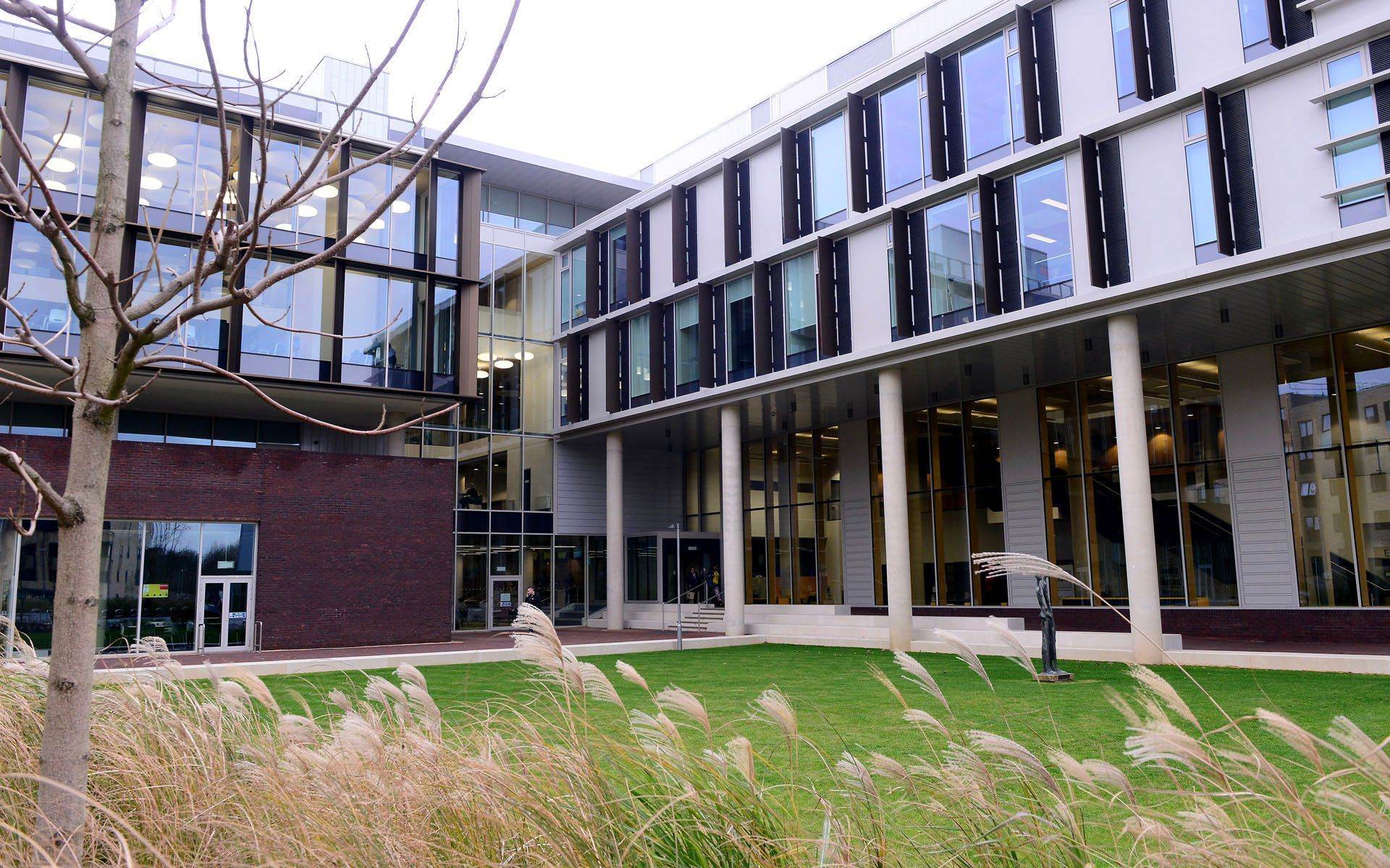
Image shows view of the lawn and courtyard outside the Learning Hub, featuring a bare tree, ornamental grasses, and an abstract sculpture. The building has several stories and features large windows.

Image shows the ground floor of the Learning Hub; it is a large, modern atrium with high ceilings, a large clock on the wall, turnstile gates, and an angular black staircase. A student carrying a backpack is walking through the space.

Image shows a large, modern lobby with high ceilings, circular light fixtures, and an upper floor visible. People are sitting on yellow seats and moving around. Stairs and a black staircase are also present.

Image shows external view of the Creative Hub, which is a large modern multi-story building with curved design, large windows, and white façade. In front of the building, people walk and sit on a landscaped plaza with trees and benches.

Image shows a study area on the ground floor of the Creative Hub; it has bright and modern with large windows, light fixtures on the ceiling, colourful chairs, and students seated at tables.
A typical offer for the Electronics and Computer Engineering BEng could be:
We look for applicants with A-Level Maths at grade C or above, or Engineering at BTEC or T Level.
Applicants will be expected to have achieved GCSE Mathematics (or equivalent) at grade C or above. We welcome international applicants and applications from students with a range of non-traditional educational or professional qualifications, and also applications from students with a mix of A levels and BTEC/Cambridge Technical qualifications.
For information on how to apply to study with us, please see our How to Apply page.
Admission to this foundation course is normally:
However, we would also like to hear from you if you have professional or industry experience instead, a range of other qualifications or self-developed subject knowledge that relates to the course you wish to study.
All International and EU students applying for a course with the University of Northampton must meet the following minimum English language requirements:
For information regarding English language requirements at the University, please see our IELTS page.
Open Days give you the best experience and insight to courses, people and facilities that interest you. Make your choice easier and come meet us.
Book NowOur BEng programme gives you the platform to critically analyse and apply knowledge of key principles, theories and concepts relating to Electronics and Computer Engineering. Each of these applications are coherent, detailed and informed by the academic discipline or area of professional practice.
On this electronics and computing engineering course, you will also develop and apply a range of problem-solving skills to real-world electronics and computer engineering scenarios. The development of these skills will aid you in strengthening your professional and academic career prospects.
This degree in computer engineering and electronics is carefully designed to provide you with the skillset of both electronics and computer engineering, exposing you to the multidimensional skillset required in both fields.
These modules cover the fundamental principles, programming, and practical skills needed to excel on this course. Mastering this skillset will enable you to move on to a more specialised range of modules offered during the second and third year of your course.
This purpose of this module is to: introduce students to the skills, principles and concepts necessary to solve problems in computing; to develop essential skills to enable the solution of these problems with the construction of appropriate algorithms and a computer program; introduce principles underlying the design of a high level programming language (HLPL); gain experience and confidence in the use of a HLPL to implement algorithms; implement HLPL programs using an appropriate programming language e.g. Java; introduce an object-oriented language initially as a non-object language.
This module provides knowledge of the hardware and software components that make up a computer system and overview the important concepts in preparation for future study of computer science.
The purpose of this module is to examine key factors which complement technical elements of engineering, understanding of which is regarded essential in todays industrial environment. Analysis of the key areas of quality, standards sustainability, project management and ethics form strong themes throughout the module.
This module aims to provide Engineering students with the fundamental knowledge and analytical techniques to build a firm foundation for the analysis, operation, problem solving and circuit simulation exploring both DC and AC electrical and electronics circuits.
This module aims to provide Engineering students with the fundamental knowledge and analytical techniques needed to enable them to study related engineering modules successfully and to analyse and solve practical problems through the application of mathematics and to develop analytical problem-solving skills in the context of engineering and engineering systems.
The purpose of this module is to develop students’ confidence in the use of electronic design tools in the simulation, design, manufacturing and testing of circuits for real-world applications.
Please note the modules shown here relate to the academic year 26/27. The modules relating to the academic year 27/28 will be available from June 2027.
At the University of Northampton, everything we do, from funded trips to paid internships, is to give you everything you need to make a difference when you leave.
If you join this full time computer engineering degree at Northampton, you will receive a laptop when your course begins*. The laptops are built to a bespoke custom specification ideal for use in the seminar room, collaborative group work or studying at home.
Whatever your ambitions, we’re here to help you to achieve them. We’ll support you to identify the skills you’re learning during your electronics and computer engineering course, find your strengths and secure practical experience so that when it comes to applying for jobs or further study you’ll feel confident in standing out from the crowd. We’ve created the Northampton Employability Promise because we are so confident that if you focus on your studies and complete our award, you’ll be highly employable by the time you graduate. Putting you in a great position to secure employment or continue your studies.
To check out the full list of perks, visit our Student Perks page or dedicated International Perks page.
*UK fee payers only (see Terms and Conditions for further details).
The Integrated Foundation Year (IFY) offers a new and exciting route into studying for a degree, attracting ambitious and driven students who are willing to learn and advance.
If you have non-standard qualifications or do not quite meet the admissions requirements for BEng Electronics and Computer Engineering, we can offer you a fantastic opportunity to study a four year programme which includes an Integrated Foundation Year. The Integrated Foundation Year will help you develop the theoretical/practical and academic skills you need, in order to successfully progress to the full award.
Our four-year courses will enable you to successfully follow the degree pathway of your choice while gaining essential study skills. The foundation year of your chosen degree will be studied on a full-time basis and is aimed at supporting the transition to higher education. Years two, three and four are then studied as a standard degree programme.
Get all the info you need ahead of time, before you can apply for funding in Spring on our fees and funding pages.
UON will adjust fees annually for UK (Home) Students up to the maximum allowable fee cap set by the Secretary of State for Education.
When assessing an applicant’s eligibility to pay home fees, we use the guidance provided by the UK Council for International Student Affairs (UKCISA) which sets out the regulations that have been decided by the UK Government Department of Education.
Tuition fees quoted for International Students apply only to the 2026/27 academic year. These fees may increase in future years in line with Consumer Price Index (CPI) inflation to reflect rising delivery costs. Any annual increase will be capped at a maximum of 5% of the previous year’s tuition fee. Updated tuition fees will be published on the UON website at least three months before the start of the next academic year.
For information on the scholarships available to you, please see our scholarships page.
For more information about possible funding options, please visit our Fees and Funding pages.
There are currently no additional costs anticipated for this Electronics and Computer Engineering course for 2026 entry.
Fees quoted relate to study in the Academic Year 2025/26 only and may be subject to inflationary increases in future years. UON will adjust UK fees annually in line with Government Policy.

Professor of Computer Engineering
Our specialist Electronics and Computer Engineering BEng (Hons) degree strategically targets the stat-of-the-art skillset demand in industry and academia for both Electronics Engineering and Computer Engineering.
This computer engineering programme provides you with the opportunity to develop the skills and knowledge required to work in a range of roles including full system design cycle, implementation, maintenance, and management of embedded systems. Other roles your skillset will lend itself to include IoT systems, edge devices, electronics and control circuits, computer systems, programmable systems, and mobile applications.
Our computer engineering degree graduates have gone onto working with employers such as:
Common computer engineering job roles include:
Some of our electronics and computer engineering graduates have also moved on to work in Higher Education as Research Assistants, Teaching Fellows, Graduate Teaching Assistants, Associate Lecturers and into funded PhD positions. Other graduates also work as freelancers or run their own companies e.g. as Mobile Application Developers and IT consultants.
The University of Northampton’s master’s courses are a great way to enhance the skills you have already learnt. Benefit from our 20% alumni discount on master’s fees to give you a CV that will catch the eye of employers.