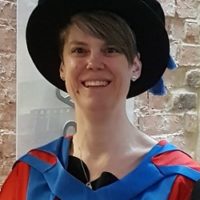
David Meechan
Senior Lecturer in Education (CYF)
To ensure we guide you through the correct application process, we just need you to answer a few quick questions.
Already applied?
Log in to view updates.
This course offers two separate application routes, depending on whether the application is submitted by the student or an international agent.
Please select your desired length of study from the available options.
This course includes a placement option. Please indicate whether you’d like to apply with or without a placement.
Please select where you would like to study.
All the available academic years are displayed below.
All the available start months for the selected academic year are listed below.
Please review the information below carefully before continuing.
If you need to make any changes, click the < Back button to return to the previous step.

Duration
Distance Learning Part Time UK: 2 Years
Distance Learning Full Time UK: 1 Year
Level
UndergraduateUG BA (Hons)
Distance Learning: £6,035
Distance Learning: £6,035
study@northampton.ac.uk
0300 303 2772
Updated 18/03/2026
The Early Years, Childhood and Family Studies Top Up programme provides a creative, inter-disciplinary community of learning and research. It is designed to critically apply theory to practice and evaluate current approaches to the socio-political context of early years, childhood (ages 0-25) and families.
This taught distance learning programme is facilitated by academics with professional backgrounds in early years, social work, health and working with young people.
The Early Years, Childhood and Family Studies Top Up course recognises the complex qualification and training routes for those working with children and families and aims to provide progression routes for those with a range of relevant Higher Education and occupational qualifications provided admissions criteria are met.
We will proactively support you to develop the study skills needed for Level 6 throughout the programme.
You will need to hold a Foundation Degree/ HND/Dip HE or a relevant Level 5 Higher Technical Qualification (HTQ) including apprenticeships in Early Years, working with children and families or closely related subject.
Applicants with a Level 5 Higher Technical Qualification (HTQ)/apprenticeship will need to:
In addition to general entry requirements, you will be expected to demonstrate your commitment to the programme by having previous experience of working in the early years, or with children, young people and families
All offers of a place on the Early Years Childhood Studies Degree will be made to applicants after completion of meeting all the entry requirements.
For more information on how to make an application, please visit our How to Apply page.
If you are an International student and would like information on making an application, please see our How to Apply page.
All International and EU students applying for a course with us must meet the following minimum English language requirements:
For information regarding English language requirements at the University, please see our IELTS page.
You will start the Early Years Top Up Degree by completing study skills aimed at revisiting or learning the academic skills required at Level 6. You will then study six modules that have been designed to support you and apply your studies around your area of interest and/or practice. All the modules, except the dissertation, have two assignments that have been devised to enable you to evidence your knowledge and skills in a variety of ways.
For those working in early years you may choose to complete the Early Childhood Graduate Practitioners Competencies. Successful students are awarded a certificate alongside their degree.
The purpose of this module is examine theory and practice of leadership and management in services for children and families in local, national and global contexts. Students reflect on professional roles in leading and supporting others.
The purpose of this module is to provide a framework for students to develop their understanding of research, enabling them to critique published research in relation to work with children and families. Students will build their own research capabilities prior to undertaking research for their dissertation.
This module will enable students to explore local, national and global perspectives of contemporary family life and its importance in children¿s development and wellbeing. They will also develop their understanding of the role of different communities in supporting and strengthening family life.
The purpose of this module is to support students to design and conduct a small-scale investigation into a topic/aspect of practice or policy of their own choosing within the broad area of services for children and families.
The purpose of this module is to allow students to evidence their knowledge, understanding and skills in order to achieve the Early Childhood Graduate Practitioner Competencies. Through evidencing high-level academic knowledge students by way of completion of a portfolio of evidence and a viva voce, the student will show that they can meet the competencies.
This module will provide students with the opportunity to explore current debates and controversies in childhood and youth including local, national, global and digital dimensions and comparisons. They will also develop their understanding of the professional roles in supporting the development and wellbeing of children and young people.
Please note the modules shown here relate to the academic year 25/26. The modules relating to the academic year 26/27 will be available from June 2026.
There are no exams, you are assessed though course work. These are two assessments per module and a dissertation
Our focus is on providing a high-quality supportive learning opportunities for students who have followed academic or technical pathways. You will be taught by a range of academics with professional backgrounds in early years, primary education, social work and health. They aim to provide a robust learning experience that will support students to continue on their lifelong learning journey and open up opportunities for themselves to apply for postgraduate professional programmes, such as teaching, social work and youth work or continue onto a Master’s programmes.
There is a strong focus on study skills which are embedded at the start of the programme to support all students to refresh or develop the skills required for success at Level 6.
Students with an Early Years background can complete the Early Childhood Graduate Practitioner Competences.
This is a distance learning programme that will involve two online taught twilight sessions per week for one year full time students, and one twilight session per week for part time students over two years. There will also be tasks to support application of learning to the work place.
When assessing an applicant’s eligibility to pay home fees, we use the guidance provided by the UK Council for International Student Affairs (UKCISA) which sets out the regulations that have been decided by the UK Government Department of Education.
Tuition fees quoted for International Students apply only to the 2026/27 academic year. These fees may increase in future years in line with Consumer Price Index (CPI) inflation to reflect rising delivery costs. Any annual increase will be capped at a maximum of 5% of the previous year’s tuition fee. Updated tuition fees will be published on the UON website at least three months before the start of the next academic year.
There are currently no additional costs anticipated for this course.
For more information about possible funding options, please visit our Fees and Funding pages.
Fees quoted relate to study in the Academic Year 25/26 only and may be subject to inflationary increases in future years.
Senior Lecturer in Education (CYF)
Senior Lecturer in Education (CYF)
Senior Lecturer in Education (CYF)
Senior Lecturer in Education (CYF)
Successful graduates of the Early Years, Childhood and Family Studies Top-Up could progress onto the following Master’s and postgraduate courses:
Upon completion of the Top Up Degree in Early Childhood Education graduates could go onto careers in the following fields: