
Christine Collymore
Senior Lecturer in Social Care

UCAS Code
L515
Duration
Full Time: 3 Years
Foundation: 4 Years
Part Time: 4 - 6 Years
BCC-CCC at A Level
MMM at BTEC
Full Time: £9,790
Part Time: £1,630 per 20 credit module
Integrated Foundation Year: £9,790
study@northampton.ac.uk
0300 303 2772
Updated 27/11/2026
This distinctive BA Health and Social Care Practice degree programme adopts a global perspective of current and emerging health and social care issues and approaches. You will explore challenges around inequalities, exploitation and oppression, evaluating current approaches and developing alternative, sustainable responses to identified needs.
Wellbeing is a recurring theme throughout the health and social care practice programme, promoting resilience of practitioners, individuals and communities. The health and social care degree has a strong emphasis on new technologies and approaches, taking a holistic and cross-cultural view underpinned by research.
We are accredited by, and work closely with, the Chartered Management Institute (CMI) which is the Charted Body for Management and Leadership. CMI work with business and education providers like ourselves to inspire people to become skilled, confident and successful managers and leaders.
During your studies, you can enjoy free CMI membership which extends to one year after graduation. As a member, you have access to a wide range of CMI resources and events which can help you with your studies to connect with potential employers and business professionals.

All applicants for the Degree in Health & Social Care Practice will need one of the following qualifications (or equivalents):
We welcome applications from students with a mix of A levels and BTEC/Cambridge Technical qualifications.
Minimum academic requirements are:
For more more information on how to make an application, please visit our How to Apply page.
Admission to this Foundation Framework is normally:
We welcome applications from students with a mix of A levels and BTEC/Cambridge Technical qualifications.
We welcome international applications and applications from students with a range of non-traditional educational or professional qualifications.
If you are an International student and would like information on making an application for the health and social care practice course, please see our How to Apply page.
Open Days give you the best experience and insight to courses, people and facilities that interest you. Make your choice easier and come meet us.
Book NowThe aim of this three-year health and social care practice degree is to move away from traditional Health and Social Care courses, to prepare students to meet the changing demands of a global Health and Social Care sector.
You will learn about new ways of working in Health and Social Care including the use of technology. You will also have the opportunity to undertake research into an area of Health and Social Care that is of particular interest to you.
You will focus on developing academic and professional skills, exploring current issues in health and social care as well as understanding how your role impacts on working with others. Throughout the course, you will be able to think about innovative ideas, social justice and the value of technology to support sustainable solutions.
This module will help you develop the academic, personal and professional skills needed for university study and future opportunities within your chosen field.
You will consider the different skills required in academic and professional settings and reflect on your own development. This will help you recognise your existing strengths and identify areas where you may need to develop further.
By examining the relationship between academic learning, personal development and professional expectations, you will gain a clearer understanding of how the skills developed during your course may be used in different contexts. The module will also support you to take greater responsibility for your learning and make informed decisions about your continuing development.
This module examines physical and psychological development across the human life span.
You will use different life stages as a structure for exploring how people develop and change over time. This will enable you to consider both physical and psychological development and understand that a person’s needs and experiences may change throughout life.
The module will give you a broader understanding of human development and provide useful context for studying the needs of different age groups, including children, young people and ageing populations.
The purpose of this module is to support individuals to gain and develop their academic study skills which are essential at undergraduate level and also prepare the student to recognise and develop the professional behaviours required for future employment
This module introduces different approaches to understanding mental health and wellbeing and considers how they may inform health and social care practice.
You will explore mental health from a holistic perspective by examining spiritual, psychological, social and physical approaches. This will help you understand that mental health and wellbeing may be influenced by several connected areas of a person’s life.
You will also be introduced to safeguarding practices and their importance when responding to concerns about an individual’s safety or wellbeing. By comparing different approaches, you will develop a broader understanding of mental health and learn to consider the needs and circumstances of the individual.
This module explores identity, wellbeing and reflective practice within a professional context. You will consider how your identity and values can influence the way you understand situations, interact with others and approach health and social care practice.
You will examine the relationship between identity and wellbeing and consider the difference between personal and professional values. Through reflection, you will develop greater awareness of how your experiences, beliefs and perspectives may affect your approach to practice.
The module will help you use reflection to examine your own thinking and actions. This is important when working with people whose identities, values and experiences may differ from your own. It will also support you to make more considered and informed professional decisions.
This module explores how individuals and agencies work together within contemporary health and social care practice.
You will examine different approaches to collaborative working and consider the relationship between effective partnership working and the development and delivery of services. This will help you understand why cooperation between people and organisations matters when responding to the needs of individuals and communities.
You will reflect on the association between individuals and agencies working together. The module will develop your understanding of shared working, professional relationships and effective service delivery.
Please note the modules shown here relate to the academic year 26/27. The modules relating to the academic year 27/28 will be available from June 2027.
We’re updating our courses to help you develop the skills and experience you’ll need for a changing world of work.
This may include more opportunities to work with students from other subjects and learn through a wider range of experiences. As this course is being refreshed, some information on this page may change before you start your studies.
We’ll make sure you have the latest information before you begin your course.
Find out more about our Curriculum Redesign.
On the degree in health and social care practice, you will have the opportunity to undertake 100 hours work-related experience. This can be anything from a traditional placement with a Health and Social Care provider, to a project to develop good practice in Health and Social Care.
At the University of Northampton, everything we do, from funded trips to paid internships, is to give you everything you need to make a difference when you leave.
If you join our full-time Health and Social Care Practice course at Northampton, you will receive a laptop when your course begins*. The laptops are built to a bespoke custom specification ideal for use in the seminar room, collaborative group work or studying at home.
Whatever your ambitions, we’re here to help you to achieve them. We’ll support you to identify the skills you’re learning during your health and social care course, find your strengths and secure practical experience so that when it comes to applying for jobs or further study you’ll feel confident in standing out from the crowd. We’ve created the Northampton Employability Promise because we are so confident that if you focus on your studies and complete one of our awards you’ll be highly employable by the time you graduate. Putting you in a great position to secure employment or continue your studies.
To check out the full list of perks for the degree in health and social care practice, visit our Student Perks page or dedicated International Perks page.
* UK fee payers only (see Terms and Conditions for further details)
The Integrated Foundation Year (IFY) offers a new and exciting route into studying for a health and social care degree, attracting ambitious and driven students who are willing to learn and advance.
If you have non-standard qualifications or do not quite meet the admissions requirements for the degree in health and social care practice, we can offer you a fantastic opportunity to study a four year programme which includes an Integrated Foundation Year. The Integrated Foundation Year will help you develop the theoretical/practical and academic skills you need, in order to successfully progress to the full award.
Our four-year courses will enable you to successfully follow the degree pathway of your choice while gaining essential study skills. The foundation year of your chosen degree will be studied on a full-time basis and is aimed at supporting the transition to higher education. Years two, three and four are then studied as a standard degree programme.
No, however this health and social care university course course will allow you to have a wider choice of employment careers within the health and social care sector such as public health, commissioning, project management or humanitarian areas.
What is the difference between social care and social work?While both social care and social work share the goal of supporting individuals and communities, social work is a more specialised and professionalised field with a broader focus on addressing systemic issues. Social care, on the other hand, often involves more direct, day-to-day support and assistance for individuals with specific needs. In practice, these roles may overlap, and professionals in both fields often collaborate to provide comprehensive care and support.
We are willing to look at a range of options, however the student may be expected to cover/contribute to the costs of travel and accommodation.
Will I need to have a Disclosure Barring Service (DBS) check for the work related experience?The need will depend on the service provider requirements and will not generally be needed for university led projects.
What is the purpose of the work related experience?The work related experience will enable you to undertake practical activities to develop your skills and knowledge that are important for future career development and evidence to employers of your capabilities.
Will I be able to do this course part-time?You can undertake this health and social care course part-time and it can be completed in four years or more depending on the number of modules undertaken each year.
Can I do further postgraduate study after this health and social care course?On a successful completion of this undergraduate health & social care uni programme, you can apply for Master’s courses, such as MA Social Work.
Who can I contact for further information?For more information, or to register your interest, please contact the Health and Social Care Practice Programme Leader Christine Collymore.
Get all the info you need ahead of time, before you can apply for funding in Spring on our fees and funding pages.
UON will adjust fees annually for UK (Home) Students up to the maximum allowable fee cap set by the Secretary of State for Education.
When assessing an applicant’s eligibility to pay home fees, we use the guidance provided by the UK Council for International Student Affairs (UKCISA) which sets out the regulations that have been decided by the UK Government Department of Education.
Tuition fees quoted for International Students apply only to the 2026/27 academic year. These fees may increase in future years in line with Consumer Price Index (CPI) inflation to reflect rising delivery costs. Any annual increase will be capped at a maximum of 5% of the previous year’s tuition fee. Updated tuition fees will be published on the UON website at least three months before the start of the next academic year.
Travel costs to and from placements, and extra costs associated with placements, may be incurred throughout your studies depending on where you are based.
For information on the scholarships available to you, please see our scholarships page.
For more information about possible funding options, please visit our Fees and Funding pages.
Fees quoted relate to study in the Academic Year 2025/26 only and may be subject to inflationary increases in future years. UON will adjust UK fees annually in line with Government Policy.

Senior Lecturer in Social Care

Senior Lecturer in Health & Social Care

Senior Lecturer in Health & Social Care

Senior Lecturer in Health & Social Care
The Health and Social Care Practice degree will prepare you for employment in the field of health and social care and working with diverse communities. These opportunities are in a wide range of voluntary, statutory and private sector organisations.
There are opportunities to work in these types of roles: Conflict and Humanitarian advocacy adviser, Educator, Project manager, Digital interaction adviser, Communications officer, Policy and advocacy officer, Homeless prevention officer, Fundraising lead, Partnership manager, Engagement adviser, public engagement adviser, Team/Executive assistant.
If you are passionate about working in any of these areas, then this is the health and social care degree for you – human rights, social justice, partnership working, technology, mental and physical health services, Human Resources, learning and development, project management, administration.
Successful completion of this health and social care practice course could lead on to one of our postgraduate programmes. Our Master’s courses are a great way to enhance the skills you have already learnt. Benefit from our 20% alumni discount on postgraduate fees.

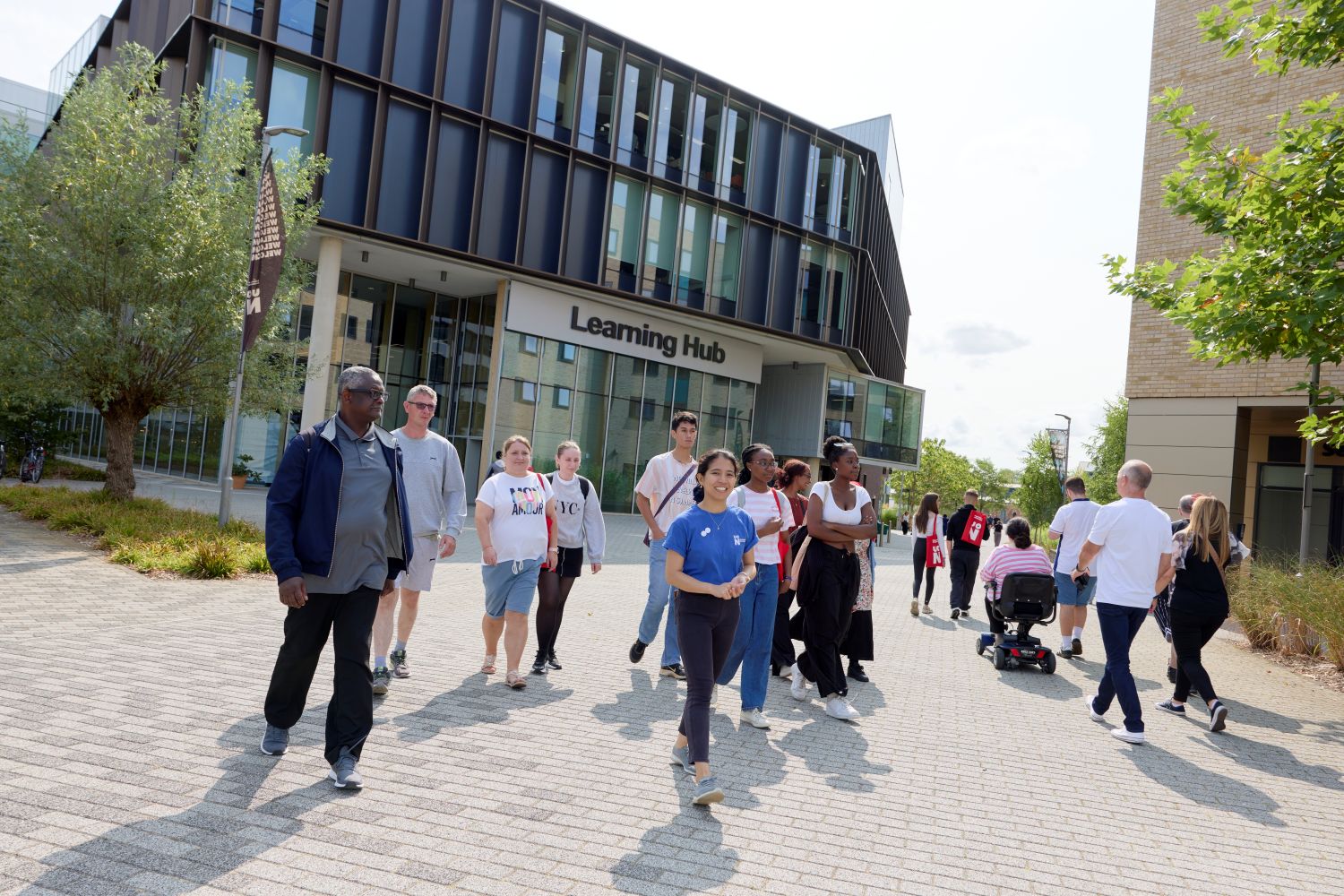
The Learning Hub is at the heart of the campus and home to the student information desk.
View Facility