How to apply as an Associate Student
At the University of Northampton, it is possible to register as an associate student without enrolling on a full degree programme.
Many of the modules that make up our courses, for both undergraduate (level 4, 5 and 6) or postgraduate (level 7), can be taken as single study module as part of the Associate student route of study.
This gives you the opportunity to study at university level without the commitment of a full degree programme and to choose modules to suit your own development needs, further your interests in a particular area and career progression.
Available modules can be found in all facilities.
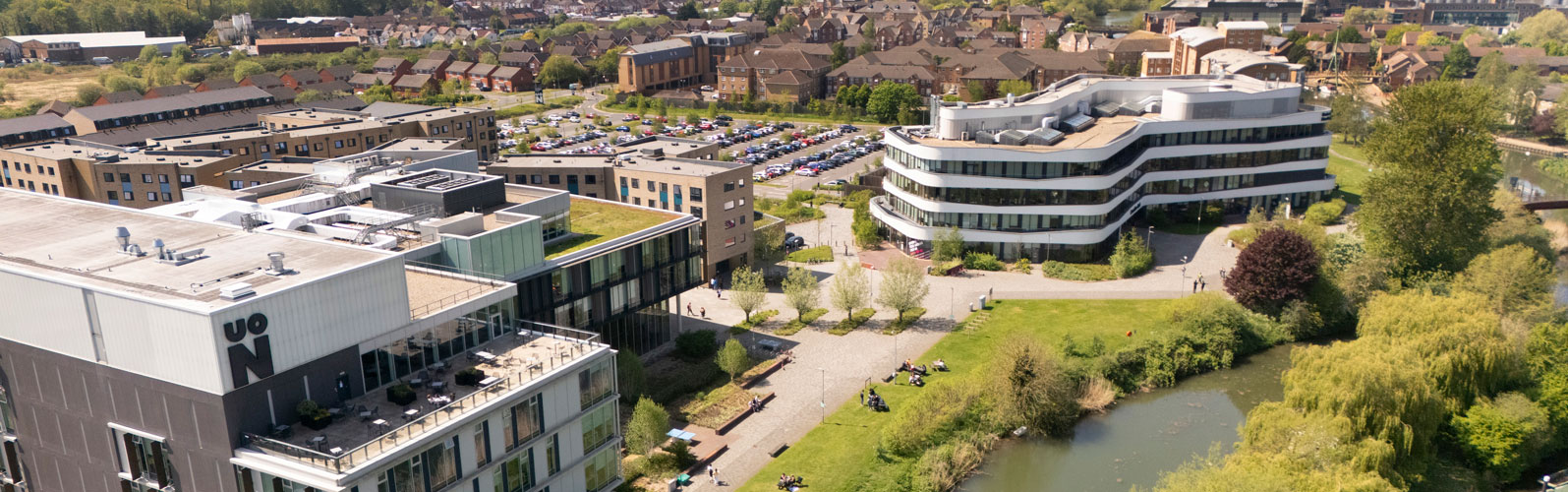
You will be classed as an associate student for the time you are here. Modules are either taught at our Waterside Campus or via Distance Learning.
This page takes you through how you can apply and outlines the information and documents you will need to provide.
Associate programme structure
Studying as an Associate student is an opportunity for you to show you can study at university level and therefore after completion of your chosen modules, you can then normally go onto complete the full programme, if you wish to continue with your studies.
If you are interested in using your module credits to contribute to an award, please note that there are rules regarding the Recognition of Prior Learning for each course, so please make sure to discuss this with our Admissions team, Admissions tutor or Programme lead of the full programme you would like to apply for.
Associate study is available throughout the year, usually during September, January, and May. The start date of your chosen module will be linked to your registration period.
You will be registered for the length of the module. Associate students can study a maximum of two modules which are normally between 20-40 credits in value. Modules can be studied at both Undergraduate and Postgraduate level, subject to tutor approval.
University credit may be awarded, providing the module, all assignments and/or exams are completed. If you are looking to use your associate studies to gain entry onto a full programme, then you must complete the required assessments to be awarded the module and university credit.
Associate programme entry requirements
Whilst applicants studying at an associate level generally do not meet the standard entry requirements of the full programme they wish to study; they are expected to have obtained a certain level of study or work experience to help them with their studies.
If your first language is not English, you must provide evidence of your English language proficiency. The evidence required depends on the level of study you are looking at joining and the full programme the module is associated with.
Undergraduate modules
If you are considering taking these as an Associate student, we would expect applicants to have studied to an education level 3 or have relevant work experience in the area they are looking to study.
All requests to study as an Associate student are subject to Admissions tutor approval as sometimes this is not a suitable option for all candidates.
Postgraduate modules
If you are considering taking these as an Associate student, we would expect applicants to have studied to an education level 4 or higher or have relevant work experience in the area they are looking to study which would be equivalent to level 4 study.
As these are advanced academic modules, if you are considering taking these as an associate student and have no prior university level study in these subjects, you are strongly advised to undertake an Undergraduate module first.
All requests to study as an associate student are subject to Admissions tutor approval as sometimes this is not a suitable option for all candidates.
How to apply for Associate level
You can apply directly to the University for your module and will need to submit the following documents with your application:
- personal statement, which should contain the module code and title that you wish to study
- photocopies or scans of your highest qualification
- evidence of English language ability (where English is not the first language)
- change of name document if your application and certificates are in different names
- passport
To apply, please click on the relevant link below:
Faculty of Education, Arts, Science, and Technology (Part Time)
Faculty of Education, Arts, Science, and Technology (Distance Learning)
Faculty of Business and Law (Part Time)
Faculty of Business and Law (Distance Learning)
Faculty of Health, Sport, and Behavioural Sciences (Part Time)
Faculty of Health, Sport, and Behavioural Sciences (Distance Learning)
To apply, please click on the relevant link below:
Faculty of Education, Arts, Science, and Technology (Part Time)
Faculty of Education, Arts, Science, and Technology (Distance Learning)
Faculty of Business and Law (Part Time)
Faculty of Business and Law (Distance Learning)
Faculty of Health, Sport, and Behavioural Sciences (Part Time)
Faculty of Health, Sport, and Behavioural Sciences (Distance Learning)
If you hold a Biomedical Science degree that is not accredited by the Institute of Biomedical Science (IBMS) and wish to become a Health and Care Professions Council (HCPC) registered Biomedical Scientist, you may be required to undertake additional study.
To achieve HCPC registration, graduates must normally meet two requirements:
- An IBMS-accredited Biomedical Science degree (or equivalent academic standard recognised by the IBMS).
- Completion of the IBMS Registration Portfolio, which assesses professional competence in the workplace.
Do I need top-up modules?
Graduates from non-accredited Biomedical Science degrees should first apply directly to the IBMS for a degree assessment via their Degree assessment service. The IBMS will compare your academic qualifications against its required standards and identify any areas of study that need to be completed.
Following the assessment, the IBMS will issue:
- An Outcome Letter
- An Assessment Review
These documents will confirm whether you are required to undertake any supplementary study (“top-up” modules).
Applying for top-up modules at the University of Northampton
The University is approved by the IBMS to offer standalone Biomedical Science modules to support students who have been identified by the IBMS as requiring additional study.
When applying, you should attach your IBMS Outcome Letter and Assessment Review. These documents will be reviewed to identify which modules are required to meet your individual academic requirements.
The University will use the outcome of the IBMS assessment to determine the most appropriate modules for you.
Please apply online: September 2026
Before you apply
If you have not yet had your degree assessed by the IBMS, you should complete this process before applying for top-up modules.
Once you have received your IBMS assessment outcome, we will be happy to discuss the options available and guide you through the application process.
Further information
If you would like to discuss this with the Course Leader, please email Dani Jex Danielle.Jex@northampton.ac.uk
There is no funding, and the students would be liable for the module fees themselves. You would need to contact our Finance department directly to find out the specific cost of the module you wish to study, they can be emailed at income@northampton.ac.uk.
We would also recommend that you contact Student Finance UK if you are looking to join a full programme at some point as studying as an Associate student may have funding implications with Student Finance.
Please visit the funding page for more details on how to fund your study.
Further Information
We also offer the opportunity within our Health CPD programmes that modules can be taken as either standalone modules both at undergraduate (level 5 and 6) or postgraduate (level 7) or full degree courses at undergraduate or postgraduate level. Which is different from our Associated student study routes.
More detailed information about the specific CPD programmes which are available for study can be found on our Continuing Professional Development page.
If you would like to discuss your options to study CPD or postgraduate programmes with our post-registration healthcare academics, please book onto a Virtual Clinic.