Energy, Waste and Water
Energy
As a young University, our smart building allowed us to open with environmentally friendly energy resources from the start.
Our Biomass boiler provides us with heat and hot water by burning sustainably sourced wood chips, dramatically reducing our consumption of gas at Waterside and therefore lowering our Carbon Footprint.
We have lights on sensors, LED lighting, and dedicated software in the IT and AV department which monitors usage of digital screens. The space booking system is connected to the meeting room screens and will automatically switch on and off around meeting times scheduled in via the space bookings. When screens are in idle mode, they are running at 20%. The only lights that remain on are fire exit lights, which is a legal requirement.
We run an annual Switch Off Campaign for staff and residential students when going away for the holidays. This encourages them to turn off any plug sockets, radiators and ensure windows are not left open, especially during the Christmas break.
Waste
We are committed to reducing our waste tonnage year on year. The only item we send to landfill is the bio-ash from our biomass boiler and everything else is either recycled, sent to anaerobic digestion or energy from waste. Our Environment Advisors make annual Duty of Care visits to our waste sites so we can see its journey and ensure it is being managed correctly. Our Waste Management Policy and Waste Management Plan (PDF, 313 KB) focuses on the reduction and prevention of waste at source crucial for achieving carbon reduction goals and ultimately reaching Net Zero emissions targets.
We are actively engaging with staff, students and visitors to encourage them to follow the waste hierarchy:
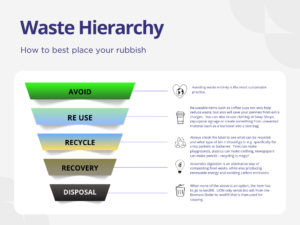
Long Description: Waste Hierarchy chart, contents detailed in the paragraph below.
- Avoid: The prevention of waste and responsible consumption of resources is considered across all University departments.
- Reuse / Donate: On-site Children’s Air Ambulance clothing banks encourage our students and staff to donate unwanted clothing items. Items not accepted by the clothing banks can be collected by Anglo-Doorstep Collections. Previous re-use initiatives include work with the Phoenix resource centre through the donation of desks, chairs, IT equipment for use here in the UK and in Djibouti. Our Single Use Plastic and Disposable Item Policy is created to encourage the use of re-useable items i.e. re-usable cups and water bottles. See our maps for locations of water coolers across campus.
- Recycle: From take away cups and food waste to vapes and batteries, a selection of recycling bins across the estate allow for a wide variety of items to be recycled.
- Dispose: For waste that cannot be recycled and as a last resort our remaining municipal waste is taken for EFW processing.
Our goal is to reduce the volume of waste produced across all residential and non-residential buildings through educating staff and students on responsible consumption and the importance of waste reduction, responsible waste management practices and the positive impact these practices have on the environment.
Awareness and behavioural change campaigns play an important part in educating our staff and student community in the correct way to dispose of waste, we do this by supporting national campaigns and various waste reduction projects.
1. Is it waste? Can it be re-used or re-purposed?
If yes, can it be donated? Unwanted clothing can be placed in our Children’s Air Ambulance Clothing Banks at Waterside, St Johns and Scholars Green Halls.
If you have unwanted electrical or household items, they can also be collected by Anglo-Doorstep Collections. Use the UON Anglo-Doorstep Collection link to book a collection and a donation will be made to the Children Air Ambulance. This can be used by students living on or off campus.
2. Can it be recycled? Yes
Most materials can be recycled at UON, All bins are colour coded the same across all buildings.
Recycling: Orange Label
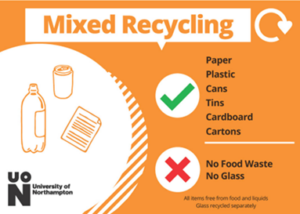
Long description: Mixed Recycling poster. Accepted: Paper, plastic, cans, tins, cardboard, cartons. Unacceptable: No food waste, No glass.
Yes please (just make sure it is clean and dry!):
- Drinks cans,
- Tins,
- Lids from bottles and jars
- Plastic Bottles,
- Envelopes,
- Paper, card,
- Old notebooks (spine removed)
- Plastic food trays
- Pizza boxes (no grease/grease liner removed)
No thanks:
- Glass
- Food
- White Takeaway Cartons (Vegware)
- Greasy pizza boxes
- Takeaway cups
Take Away Cups can be recycled in the specially designed cup recycling bins, these are located all across campus.
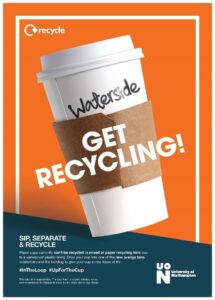
Long description: Waterside: Get Recycling, poster of a paper cup. Text reads: Sip, separate and recycle. Paper cups currently can’t be recycled in mixed paper recycling bins due to a waterproof plastic lining. Drop your cup into one of the new orange bins located around the building to give your cup a new lease of life.
Glass: Blue Label
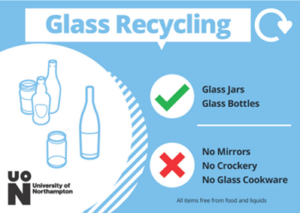
Long description: Glass recycling image, which is blue. Accepted items: Glass jars and glass bottles. Unacceptable items: No mirrors, No Crockery, No Glass Cookware.
Yes please (just make sure it is clean and dry!):
- Jars (lid removed)
- Bottles (top removed and placed in the orange recycling bin)
No thanks:
- Food
- White Takeaway Cartons (Vegware)
- Takeaway cups
- Mirrors,
- Drinking glasses,
- Cups, plates, crockery
If you have a broken glass or bottle etc to be disposed of, please wrap it in a bag or paper and place in the general waste bin (black bin).
Food Waste: Green Label

Long description: Food Waste poster, which is green. Accepted items: Raw and cooked food, fruit and vegetables peelings, meat and fish, tea bags. Unacceptable items: No food packaging and no liquids.
Food waste: Think about what you are throwing away! Can you eat it the next day? Can you make another dish with leftovers? – not only will you reduce waste, but you will also save some money.
Always try to minimize your food waste, throwing away food costs money so plan your meals and get creative, try new recipes to use up your leftovers.
Yes please (just make sure it is clean and dry!):
- All food waste, raw and cooked
- Egg shells
- Tea bags
- Coffee grinds
No thanks:
- Liquids
- Food or drink packaging
- Compostable cutlery
- Plants
3. Can it be recycled? No
If the answer is No and you have exhausted all options of recycling and re-use then as a last resort you can put it in the Black labelled bin for non-recyclable waste.
Non-Recyclable Waste: Black Bin Label

Long description: Non-recyclable waste. Acceptable waste: Non-recyclable materials, contaminated waste. Unacceptable: No glass, no recyclable mater, no food waste, no liquids, no batteries and toners.
Yes please – If you have to:
- White Takeaway Cartons (Vegware)
- Compostable Cutlery
- Greasy pizza boxes
No thanks:
- Drinks cans,
- Tins,
- Lids from bottles and jars
- Plastic Bottles,
- Envelopes,
- Paper, card,
- Old notebooks
- (spine removed)
- Plastic food trays
- Pizza boxes ( no grease / grease liner removed)
- Glass Jars
- Glass Bottles
- Food waste, raw and cooked
- Egg shells
- Tea bags
- Coffee grinds
Clothing and home donations
Please donate your preloved items to keep them in the circular economy and support the Children’s Air Ambulance.
We accept:
- Clothes
- Paired Shows
- Linen – curtains, bedding (not duvets and pillows)
- Accessories – belts, hats, scarfs, gloves, jewellery
Campus Clothing banks
We have three external banks:
- Car Park 1, Waterside campus NN1 5PH
- Car Park 4, Waterside Campus NN4 8RR
- Scholars Green, Halls of Residence NN2 7AG
And two internal banks:
- St John’s, Halls of Residence NN1 1DH
- Scholars Green, Halls of Residence, NN2 7AG
Unwanted and unopened food, non-perishable foot items or toiletries? You can donate them to the campus pantry too.
Household items
- Bric-a-brac, linen, curtains (not duvets and pillows)
- Kitchenware and small electrical items (working and broken)
- Books (both good and poor quality)
We have three collection box locations for these items:
- The Launderette, Waterside Campus
- Scholars Green, Halls of Residence (foyer areas of each building)
- St John’s, Halls of Residence (reception area)
Living off campus
You can organise a free collection from Anglo Doorstep Collections. Visit The Anglo Door Step Collections website.
Water
Our cleaning staff use i-mops which use significantly less water than standard mopping and lowers environmental impact by 75% when compared to typical scrubber dryers. On average, the standard mopping method uses 40L a day, compared to 18L use by i-mops. The B-Corp business, i-team, collaborate with Made Blue, where the amount of water saved by their clients (UON), is matched as clean drinking water and donated to developing countries. They do this by building wells to hold X number of litres.
Water used for window cleaning comes from the mains supply and is then filtered through a purification process and used to clean all windows on each building across the estate. Wastewater from the purification process should be diverted into a separate tank where it can then be reused for the Grounds team for plant and tree watering.
We are currently exploring a pilot study in Halls with water saving shower heads donated to us by Anglian Water. We aim to have this project underway by September 2026.
See our maps for locations of water coolers across campus.
If you see any issues across our sites such as a leaking tap or broken bin, please report it to Facilities Helpdesk via email Helpdesk@1stdegreefacilities.co.uk
To keep up with projects and initiatives follow us on Instagram @uon_sustainable.
United Nations Sustainable Development Goals
We use the United Nations Sustainable Development Goals (SDGs) as a framework to guide our activity. Our resource management policies and projects are linked to the following SDGs:
Goal 7: Affordable and Clean Energy
Goal 12: Responsible Consumption and Production

Find out more about our impact on the SDGs