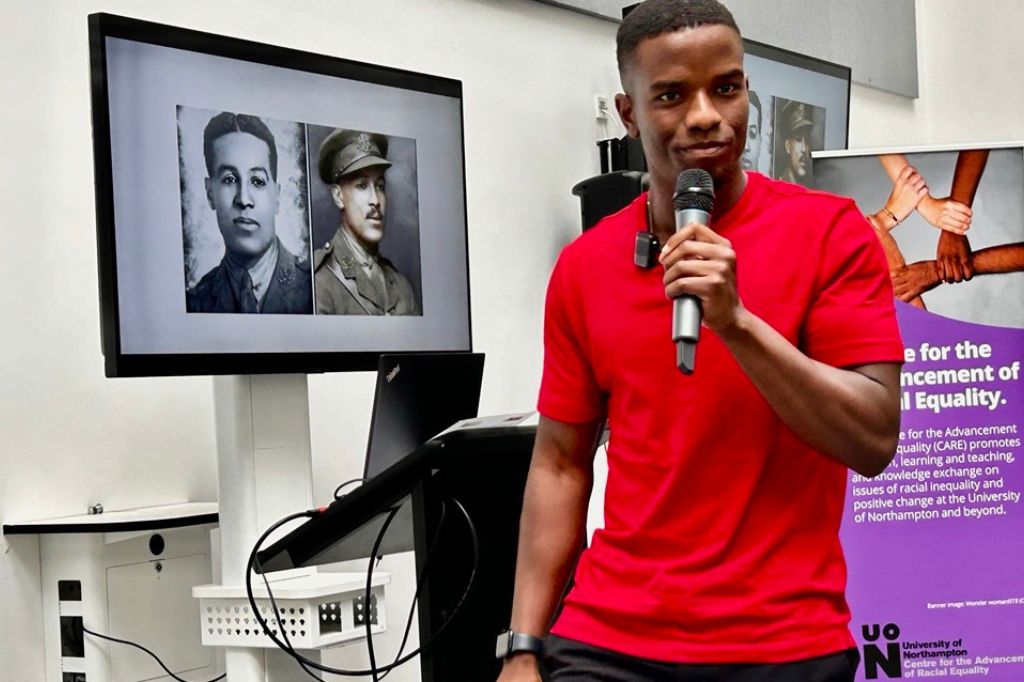
How collaboration, education and leadership can help advance racial equality was the focus when academics, students, and community leaders came together at the University of Northampton for the two-day racial justice conference last week.
Co-hosted by the University’s Centre for the Advancement of Racial Equality (CARE) and the Global Ethnic Majority (GEM) Staff Network, the conference which took place on Wednesday 1 and Thursday 2 July was entitled Race in Action: Power, Partnership and Change.
The Conference featured keynote speeches, research presentations and workshops focused on anti-racism, leadership, education and community engagement.
Opening the event, Dr Emel Thomas, Senior Lecturer in Education and CARE Co-Lead, reflected on increasing divisions within society and called on delegates to embrace dialogue and cooperation.
She said: “People have been encouraged to choose sides, to retreat into familiar groups and define ourselves more by what separates us, than by what unites us.
“But through this conference, we’re hoping you think about something different. That you choose partnership over division, and curiosity over assumption, and action over complacency.”
One of the conference’s keynote speakers, leadership and personal development specialist Ollie Wanjohi, drew inspiration from the story of Northampton sporting pioneer Walter Tull.
Tull became one of the first Black professional footballers in Britain, playing for Tottenham Hotspur and Northampton Town, before volunteering to serve in the First World War. Despite widespread racial prejudice and regulations that prevented Black men from leading white troops, he became the British Army’s first Black commissioned officer to lead soldiers into combat.
Drawing lessons from Tull’s life, Wanjohi encouraged delegates not to be limited by the expectations of others.
He said: “If someone like Walter could achieve all that he did during a time when society refused to recognise his humanity, then what does that say about all we’re capable of?
“Our backgrounds don’t disqualify us. Obstacles don’t erase our potential. The only thing that will, is being passive in life.”
The second day of the conference featured an address from His Excellency Dr Alex Otti, Governor of Abia State, Nigeria, who spoke about racial harmony, equality, meritocracy and the importance of building bridges between communities.
Witnessed by members of the Northampton Nigerian community who filled the lecture hall alongside UON academics and students, Dr Otti argued that discrimination based on race, birthplace or background is fundamentally unjust and that education, dialogue and strong institutions remain the most effective tools for combating prejudice and inequality.
He urged delegates to focus on shared humanity rather than differences and warned against those who seek to exploit racial divisions for personal or political gain.
Speaking about the University’s role in promoting inclusion, he added: “Through your culture of openness, you are actively redefining the place of education in building a fair and just society, where everyone is offered the room to dream and to thrive.”
The conference also featured contributions from a range of academics, practitioners and community leaders, including Professor Gurnam Singh of the University of Warwick, Yvette Thomas MBE, Buckinghamshire Council’s Head of Education Achievement, and Emmanuel Gotora, Assistant Director at Citizens UK. University of Northampton researchers presented work on decolonising the curriculum, support for Global Ethnic Majority staff, and the experiences of Black women in prison.
Founded to advance research, learning, teaching and knowledge exchange relating to race, ethnicity and racial inequality, CARE works with researchers, policymakers, activists and community organisations to promote greater understanding of racism and support collaborative action for positive social change. Find out more about CARE on the UON website.