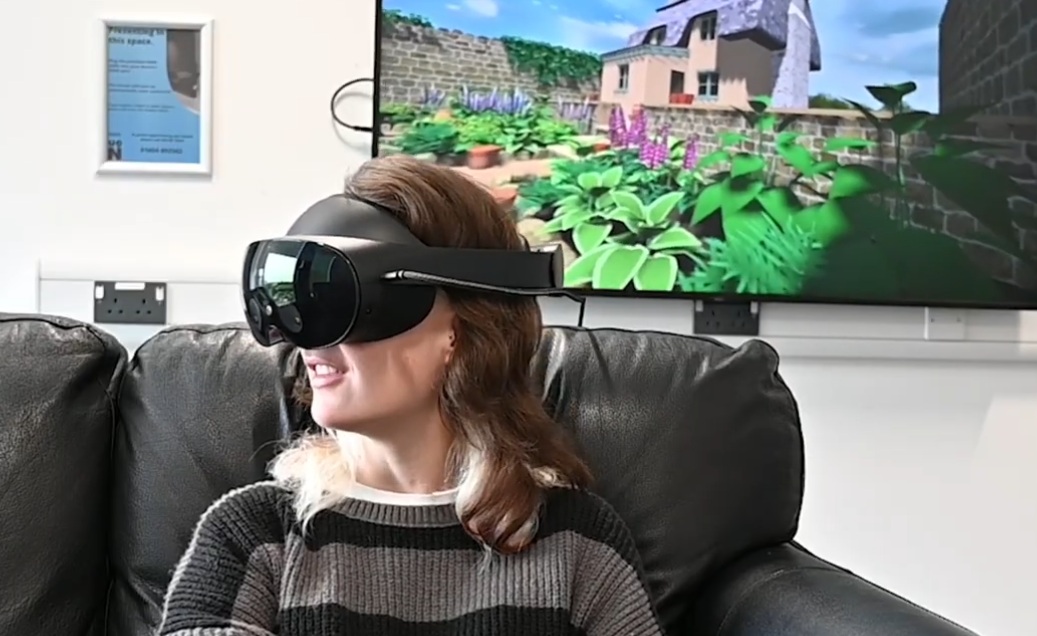
A groundbreaking new therapy using virtual reality (VR) and artificial intelligence (AI) could soon help people overcome debilitating phobias and trauma – all without leaving their homes.
The innovative therapy treatment has been developed at the University of Northampton by a team of researchers, including Professor Mu Mu (Human-Centred Data Intelligence), Andrew Debus (Senior Lecturer in Games Design), David Nicholls (Senior Lecturer in Games Programming), Murtada Dohan (Associate Lecturer in Computing), and Olive Chan (Clinical Psychologist).
The brainchild of the team is to transform therapy which utilises Eye Movement Desensitization and Reprocessing (EMDR) – an already well-established treatment for trauma – into a fully immersive digital experience.
The research team began developing the prototype in early 2024 with the goal to offer patients a faster, more accessible and cost-effective way to receive EMDR therapy, especially for those on long NHS waiting lists or in underserved communities.
Traditional EMDR therapy, often used to treat Post Traumatic Stress Disorder (PTSD), anxiety, and phobias, typically involves working with a trained therapist via weekly in-person sessions. This innovation would allow the treatment to be delivered using VR headsets, enabling patients to undergo therapy sessions at home, multiple times a week, while being supported remotely by qualified NHS professionals.
“We imagine a future where patients simply put on a VR headset in their own surroundings and are guided step-by-step through proven EMDR treatment protocols,” explains Dr Mu. “This not only increases access, but it also removes some of the stress and stigma that can come with face-to-face therapy.”
“As well as basing the therapy on a process called ‘Gamification’ (essentially integrating game design elements and principles into non-game contexts to enhance usability), we included a Light Stream Exercise technique to help ground feelings and bodily sensations for users,” explains Andy Debus.
To evaluate its effectiveness, a clinical study was undertaken in partnership with St Andrew’s Healthcare, in which a total of 17 participants with a range of intense phobias took part in the VR-based EMDR therapy over the course of 85 sessions, with striking results:
- According to the IAPT Phobia Scale, scores indicated an improvement in 76% of participants.
- On the Severity Measure for Specific Phobia Ratings, 94% of participants reporter improvement across symptom domains such as thoughts feelings and behaviour.
- One standout case involved midwifery student, Saffron, who entered the VR therapy with an intense fear of needles and blood. After completing the VR therapy, she confidently returned to clinical placement and successfully “delivered multiple babies.” A video on her experience is available to watch below.
These results build on earlier feasibility and safety studies, which showed strong promise. The research team also worked closely with peer support workers and individuals with military-related PTSD to shape the experience and ensure it was both therapeutic and useful.
“The feedback we’ve received so far – especially from people with lived experience – has been incredibly encouraging,” said Professor Mu.
The therapy is being developed as part of the University’s Centre for Advanced and Smart Technologies, which focuses on using digital innovation to improve lives locally and globally. The research was recently soft launched at Merged Futures, a major tech innovation showcase hosted at the University of Northampton in June 2025.
Head of Research and Development at St Andrew’s Healthcare, Dr Kieran Breen, said: “Working alongside the University of Northampton on this project has shown us just how transformative digital therapy can be. Many of the people we support live with intense, life‑limiting phobias, and seeing them make real progress through VR‑based EMDR has been incredibly encouraging. This technology has the potential to remove barriers, reduce waiting times, and give patients more control over their recovery.
“What stood out most in this study was the confidence people gained in such a short space of time. For some participants, these phobias had shaped their lives for years. To watch them engage with the VR therapy and then go on to face situations they once avoided entirely was remarkable. It’s a powerful reminder of what’s possible when innovation and compassionate care come together. At St Andrew’s, the use of digital technology, including VR, is a key pillar of our research strategy and we are committed to using this novel approach in the treatment of people with complex mental health conditions.”
Research will continue to advance the therapy, with plans already in motion to expand clinical trials, explore partnerships with the NHS for wider rollout, and establishing a spin-out company to commercialise the therapy platform to target both healthcare institutions and direct-to-consumer markets.
“The potential here cannot be overstated,” said Professor Mu. “Right now, people are waiting more than a year to access EMDR therapy through the NHS. With this technology, we could reduce waiting times dramatically and help patients reach treatment and recovery faster, all from the comfort and safety of their own homes.”
Find out more about studying Games Design or Artificial Intelligence and Data Science at the University of Northampton.