History of leathermaking and education in Northampton
The history of leathermaking in Northampton dates back to the late Saxon period and the prominence of the craft has made the town renowned for footwear and leather manufacture as well as leather education worldwide. The University of Northampton is one of the the only universities in Europe to offer a degree in Leather Technology, continuing to educate the leathermakers of the future.
1213
King John purchased a pair of riding boots for the sum of nine pence
1224
Henry III demanded hides, both white and tanned, from Northampton while he was besieging Bedford
1247
Record of a tanner, a parchment maker and Tanner Street
1356
Probable existence of a Guild of Tanners and Shoemakers. Mention of well-organised dispute against butchers over hide prices
1470 – 1550
The Western Tannery was in operation at The Green. This tannery can be viewed as complex production on a relatively large scale – early factory based manufacture.
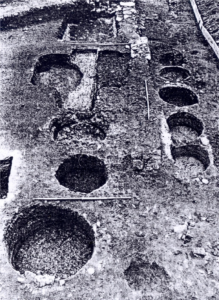
The Western Tannery comprised 36-37 pits. Some had clay linings for retentions of solutions, on top of which traces of oak staves could be reorganised. Traces of lime and ash – used for alkali swelling of the skins for softening – were identified.
Bone evidence suggests that cattle and horses, as well as sheepskins were being processed at this tannery. It was not usual trade-practice to tan hides and sheepskins at the same tannery as they require different methods of processing.
1504
Reference to The Green / St. Peters Street tanneries
1525
15 tanners, 1 fellmonger recorded
1564
Apprentice lists show: Cordwainers 3, Tanners 2, Curriers 1
1642-1645
Northampton tannery and shoemakers provided leather boots for Oliver Cromwell’s New Model Army
1800s
Mechanisation began the shift in boot and shoe making from a well-organised home-based craft towards efficient footwear manufacture
1879
The Grammar School is split into Classic and Commercial (technical) schools
1887
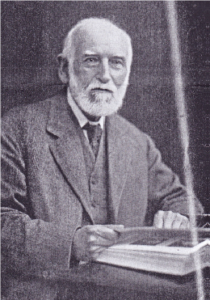
Beeby Thompson established the original tanning school as part of the commercial part of the Grammar School. Records show a tanning class operated with 15 students.
1900s
Northampton tanners and footwear manufacturers provide essential footwear during the First and Second World Wars
1911
The Grammar School is divided into two Schools: Northampton Technical School and the Grammar School (now Northampton School for Boys)
1920
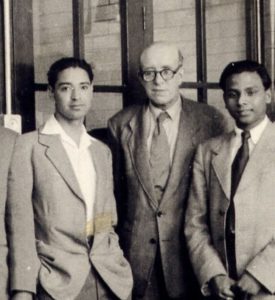 Tanning and Boot and Shoe departments relocated in an adjacent tannery fitted with model equipment in St. Michael’s Road. David Woodroffe (centre in photo) became first Principal of Tanning and Footwear.
1932
Tanning and Boot and Shoe departments relocated in the New Technical College at St. George’s Avenue (now Avenue Campus)
1960
42 known tanneries and leather dressers located in Northampton
1979
The Leather Department and The National Leathersellers’ College merge and relocate to the newly inaugurated Park Campus and become the British School of Leather Technology (BSLT). The specialist building was funded by The Worshipful Company of Leathersellers.
1999
Nene College designated as University College Northampton
2005
University College Northampton became The University of Northampton
2009
The British School of Leather Technology is rebranded as The Institute for Creative Leather Technologies (ICLT)
2019
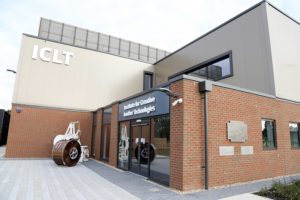
Institute for Creative Leather Technologies (ICLT) moves to Waterside Campus
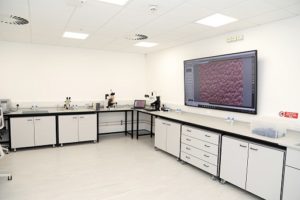
2021
ICLT continues to provide services to the national and international market in leather education, training, research, problem solving, environmental matters, fashion and specialised footwear.
Find out more about the Institute for Creative Leather Technologies (ICLT) on our hub.
This page includes research and text by R.P. Daniels