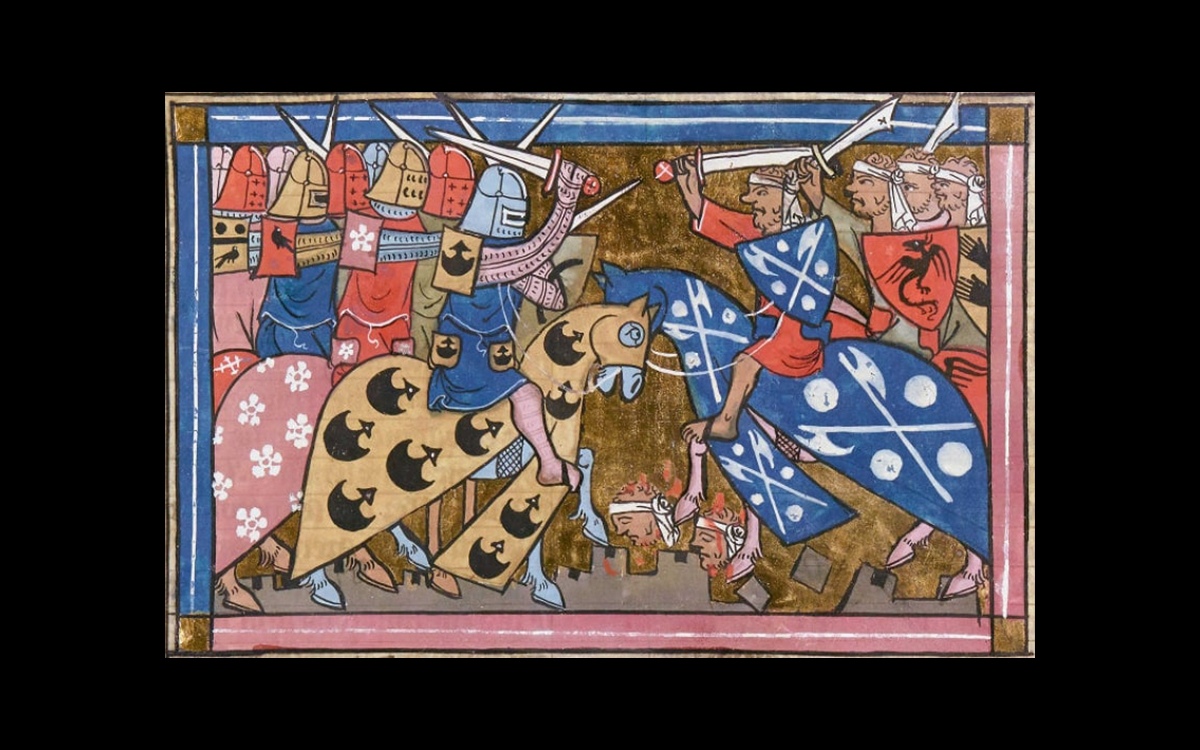
The Crusades, as we know them, ended nearly 800 years ago. For most people, that would be definitive. But the far right is anything but definitive, and echoing the Alexandrian Crusade of 1365, the sacred flame of Christian crusade militantism is being rekindled, at least in rhetorical form, in the online social media space.
My use of the term ‘Sacred Flame’ here is deliberate. Within fascism studies, the sacred flame has been a noted rhetorical tool within neo-Nazi, fascist and far-right circles. It refers to the idea that fascist ideology burns brightly and fiercely but is fragile and capable of being snuffed out. Richard Thurlow has written on the phrase’s origin in 1938, when it was used in a speech delivered by Oswald Mosley to his Blackshirts. Thurlow utilises it as a metaphor for Mosley’s failed post-war career in politics and his refusal to go out.
And it is this idea that resonates so heavily with the neo-crusader (and even neo-Cromwellian) rhetoric of this new wave of online far-right youths. While wartime fascism, particularly German Nazism, had a complex relationship with the church, crusade motifs and the far right are hardly a new revelation. Christofascism has been a term used since the 1970s and is used to analyse movements such as Romania’s Iron Guard.
Historically, in Britain far right fringe groups have often utilised crusader visuals for materials. Some have been named after St George, who is both the patron Saint of England and someone whose garb and veneration are heavily tied up with the crusades and chivalry. More recently, Ariel Koch has analysed the growing connections between crusader rhetoric and imagery within the online political space through far right street groups and their use of sites such as Facebook.
Previous to the rise of neo-crusader content on short-form content such as TikTok or Instagram Reels, the most notable online occurrences were within the gaming space. Games such as Paradox Interactive’s Crusader Kings had notable outcroppings of far-right rhetoric. This included terms such as ‘Kebab’ becoming slurs against Muslims and most notably the Phrase ‘Deus Vult’, often associated with being the battle cry of the Crusades, leaving the context of the game and increasingly became a part of the dialogue surrounding political discussions within the games’ forums.
What appears to have happened is that, as tends to happen on the internet, such terms to help shape an ‘in-group’ began to reach the mainstream algorithm of social media services. With short-form content often prioritising a low-information, high-impact style of content creation, it appears that the striking terminology and visuals of crusade media could quickly become the de facto means by which to spread the desired message.
In terms of content, these videos often fall within two categories. The first is that of ‘edits’, in which pre-existing content or media surrounding the crusades is edited to change its context to that of some form of call against what could be termed ‘woke ideology’, or as an attack on Islam and Muslims living within the West. Within that, there is even an antisemitic trend in which a Christian Crusade is presented as an alternative outcome to the latest developments of the Israel-Palestine conflict following the attacks of 7 October 2023. This is particularly notable as such proposals stands directly in opposition to the Muslim population of Palestine, the Jewish population of Israel and the pro-Palestine adherents of Western left-wing ideology, thus targeting the major factions that the contemporary far right opposes.
A second category is that of content created from scratch to promote this ideology. This typically borrows the style of popular content creators or the style of certain categories. An example of this would be an ‘edutainment’ video that explains how Christians should use crusader/Latin language to oppose a rise in Islamic culture, even suggesting using the term ‘Deus Vult’ as a Christian alternative to the Arabic term, Inshallah, obscuring the context of the term. This style would also include videos that promote hardness as a remedy for ‘woke ideology’, often created by conventionally attractive or eccentric white men parading in European cities while extolling the virtues of the West. While less prevalent, possible due to the de-anonymising nature of the content, such posts also stand to make their creators into pseudo-celebrities on the far-right fringe, much as longer form content previously did for men linked to the alt-right movement of the later 2010s.
As mentioned towards the start of this blog, we are now seeing a further branching of this form of content into other ideologies, such as neo-Cromwellians, often created in response to the seeming softening of the religious views of the monarchy under King Charles III – clip of the King greeting a crowd in Arabic has become the prime ‘evidence’ for this. As with much of the far right’s co-opting of media formats such as memes, combined with an ever more volatile political situation in Britain, Europe and the West, content like this is only destined to become more popular. What is perhaps most interesting about this phenomenon is that it is an example of the political right taking the format of a media source whose engagement has been dominated previously by the left instead of vice versa.
The political right has often been at the forefront of alternate media usage, especially in America. Yet short-form individual and grassroots political content have always been associated more with the left, with far-right online agitators taking great joy in highlighting this. Yet given the far right’s seeming adaptation to the format, this may be beginning to change.