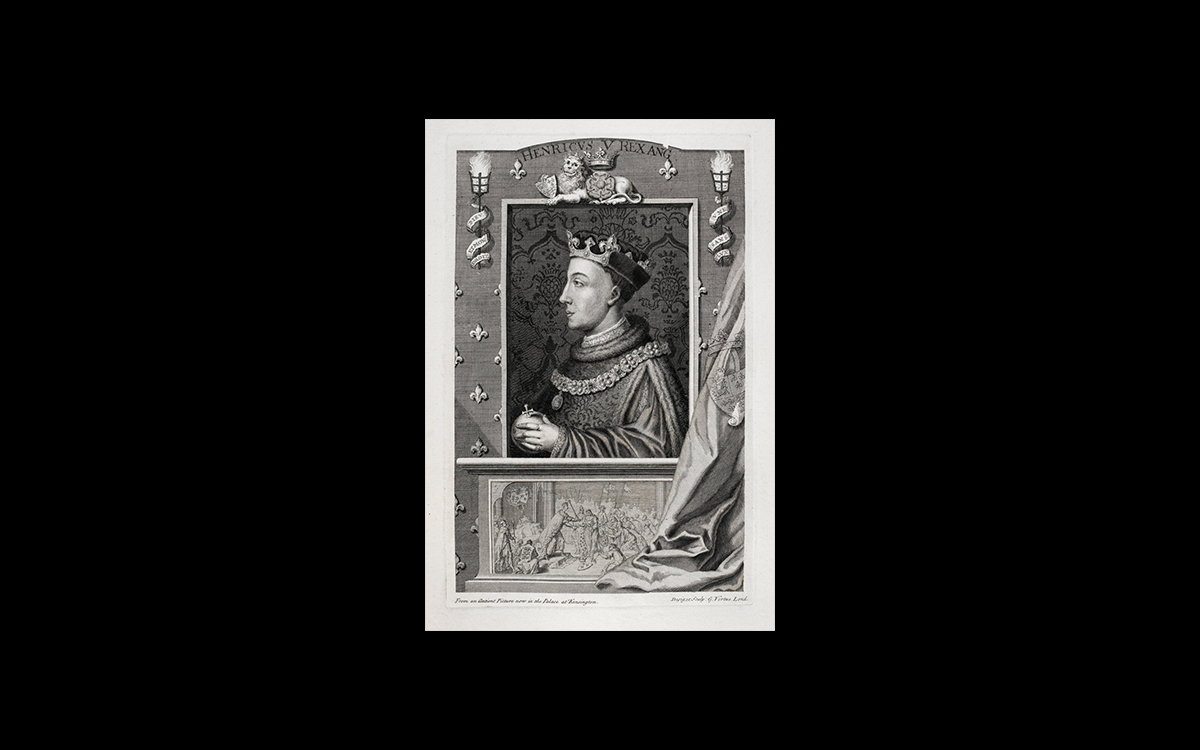
A few years ago, my colleague (and Searchlight archivist) Dr Dan Jones sent me some scans of items I might find interesting. One of them was a scan from the fascist magazine Spearhead, founded in 1964 and for many years which served as the official voice of the National Front. It was an entry in the publication’s Great Briton series, which began in 1966 simplistic, chest-thumping summary of various English heroes of the past, written by someone using the penname ‘Pendragon’. The item that caught my eye was about King Henry V, who as well as being a monarch reigning in my period of specialism (the fifteenth century) has also become a perennial English hero. The way Henry V’s campaign in France was imagined by Spearhead was rather different to how I teach the Hundred Years War in my classroom. “He regarded France as the natural field of English expansion”, wrote Pendragon, in language evocative of the Nazi ideology of lebensraum.
This source amongst others became part of a new module I was designing, titled Medieval Chivalry and its Afterlives. Teaching that course, and delving further into the Searchlight Archive, inspired me to write a research proposal. This spring I was delighted to receive a British Academy/Leverhulme Trust Small Research Grant for my project ‘Medievalism, gender and politicised nostalgia in the British extreme right, 1962 – 1982’.
In this project, I am undertaking a systematic analysis of archival materials related to the inner workings of the British extreme right in a significant period of change for this political movement (1962 – 1982), and I am to establish the political, social and emotional reasons for their nostalgia for the medieval past. Building on my existing expertise in gender history, I will particularly focus on how the nostalgic functions of medievalism were instrumentalised as means of recruitment and radicalisation that targeted white boys and men with emotional appeals to their gendered and ethnic identities, and will thus have significant implications for understanding contemporary radicalisation as well as radicalisation in the recent past. Undertaking the research for, and the outcomes of, this project will inform the development of a larger scale research project that will look at medievalism in the British extreme right in a longer-term context, from the early 1960s through to the contemporary moment.
A great deal of the funding for this project has been earmarked for research support. As the majority of the Searchlight Archive is not digitised and some of the material is not catalogued, the largest part of the Research Assistant’s role will be to undertake a preliminary survey of the materials to provide a substantial dataset for further analysis. This will involve logging, taking notes and photographs using the software Tropy and sorting the data to the open-source repository, Figshare. I am delighted that I have been able to employ Dr Siobhan Hyland, a recent graduate of the University of Northampton and an expert in the far right. Siobhan has spent a number of hours this summer capturing images in the archive and filing them for my analysis, and she will be writing a bit about this process soon. I’m excited to see how the project develops over the coming year!
As part of the project, I will also be running two workshop events in 2026 – an academic conference on nostalgia and political extremism that will probably take place in June, and a practitioner-focused event that will probably be in the autumn. I will share details with you as soon as I have them. I have also launched a new research group called MATER (Medievalists Against the Extreme Right, and yes, I am proud of the acronym!), which anyone working within medieval studies (broadly defined) and with an interest in resisting far right capture of our field is welcome to join.