A language expressing distrust, concern and fear of migrants is a regular feature of news reporting, while many older and newer political parties, left and right, in Britain and elsewhere, have all sought to capitalise on the emotive agendas such narratives generate. Does the nation have control of its borders? Is there a growing and dangerous ‘other’ in the country? And do politicians ‘get it’? Some politicians in the UK today even advocate forced repatriation of some migrants.
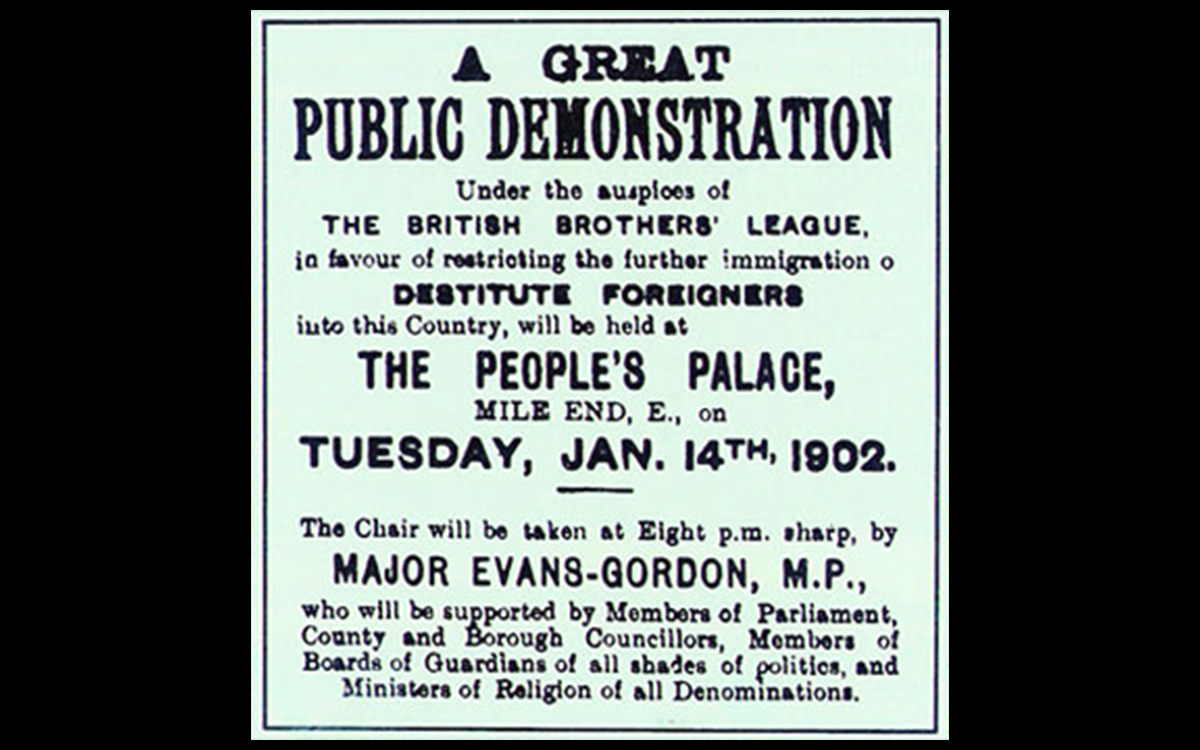
Such anxieties around migration are nothing new. This politics has a long history in groups including the British Union of Fascists and the National Front, as well as many more respected organisations. One of the first groups that can be related to the modern British far right is the British Brothers’ League, which epitomised wider fears over migration to Britain before and after the First World War.
The British Brothers’ League was steeped in a patriotism defined against a migrant other, namely Jewish people – often described as ‘aliens’ – fleeing from persecution in Russia. Founded in 1901 by Captain William Stanley Shaw, the British Brothers’ League was a vehicle for the antisemitism of ideologues such as Arnold White, and was given mainstream acceptance by politicians such as Sir William Evans-Gordon. By the 1930s, its concerns were developed by Mosley’s British Union of Fascists, which in turn influenced later generations of fascist and far-right activism in Britain.
As for Arnold White, he wrote vehemently on the threat of Jewish people to British interests, part of a wider concern with national decline. White also developed an interest in eugenics politics as a solution to overcome what he saw as the degeneration of the race. Evans-Gordon, meanwhile, developed his career as a Conservative MP for Stepney by campaigning against ‘aliens’. He helped to develop the Aliens Act of 1905, a milestone in British anti-immigration legislation.
The politics of figures such as White and Evans-Gorden was deeply marked by worry and unease about what they saw as uncertain outcomes. In other words, these figures developed a politics of anxiety. This was an anxiety also found in media narratives of the era, developed by a range of newspapers that discussed concern over migration, and related issues such as concern over the future of Britain’s empire and place in the world.
Anxiety is a powerful emotion, and one often found in a range of radicalised cultures. Evoking anxiety in audiences provokes interest and engagement with a problem. It also often leads to an enlarged sense of threats and, therefore, a need to learn and find new solutions. Anxiety relates to other emotions, such as fear, a more focused emotion based on a clearly identified danger.
As such, then as now, anxieties over migration provoke the need to develop radical ways to ‘solve’ a ‘problem’, framed around overcoming a powerful emotion. They typically point to the need for securitised solutions, a focus on migrants as threats, and an increased sense that mainstream politicians are unable to grapple with the problem.
Migration has many consequences, positive and problematic, but debates that frame migration in anxious ways alone play to fears that extreme right agendas are seeking to exploit and use to their advantage.