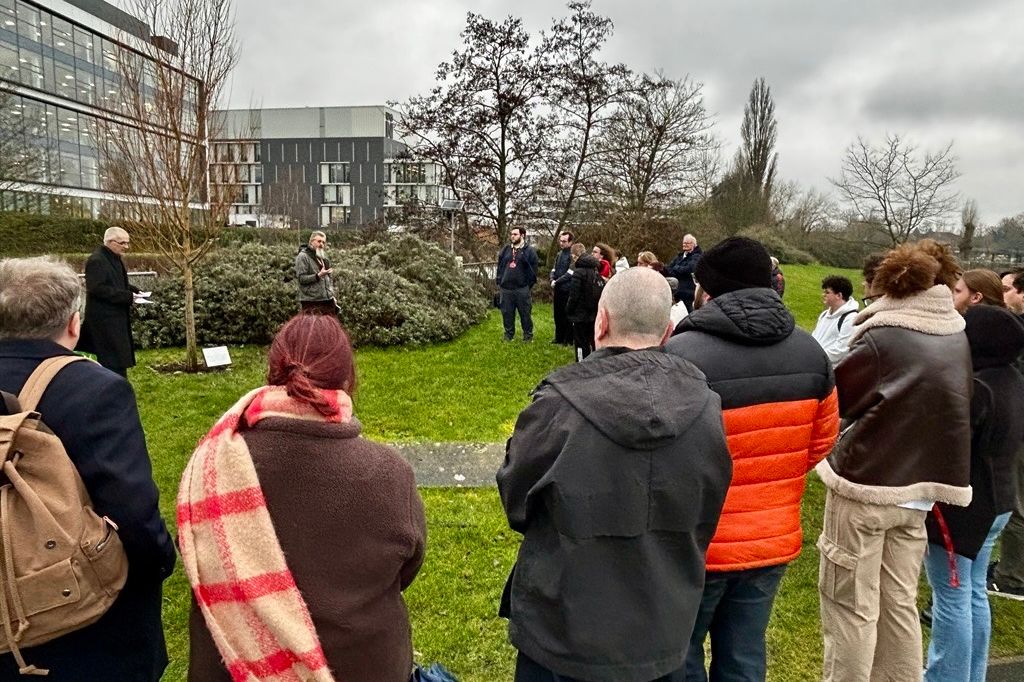
Challenging hatred and extremism in all its forms was the focus as staff, students, alumni and community members gathered for Holocaust Memorial Day at University of Northampton (UON) this week.
The event at the University’s Waterside Campus on Monday 4 February featured a programme of speeches, talks, and discussion, culminating in a stone‑laying ceremony at the University’s memorial tree.
As he introduced the speakers, host Professor Paul Jackson, Professor in the History of Radicalism and Extremism, remembered the late Gerry Gable, UON Honorary Doctor and founder of the Searchlight Archive which has been housed at the University since 2013 and has supported hundreds of researchers examining the far right and political extremism.
He added: “This year is really a year to remember Gerry, he was a very generous man with his time, phone calls would last for hours. But he has been really important in tackling racism in the last few decades, he is someone who should be remembered and we are very proud about his association with the University.”
Professor Anne‑Marie Kilday, UON Vice Chancellor and Chief Executive, then spoke of the importance of ensuring the lessons of the Holocaust remain central to the University’s values of inclusion and equality.
“As a historian, it is important to take time to consider the history of the Holocaust and its ongoing relevance to our lives today,” she said. “The extremes of the Nazi genocide targeted not only Jewish people, but Roma communities, Black people, LGBTQ+ people, and those deemed to have the ‘wrong’ politics. This day is a time to reflect on all communities affected.”
Professor Kilday also highlighted the University’s adoption of the International Holocaust Remembrance Alliance (IHRA) definition of antisemitism, and reflected on the significance of the Searchlight Archive.
Pro Chancellor Morcea Walker MBE shared a powerful reading of the traditional ‘Statements of Commitment,’ used nationally at Holocaust Memorial Day events, challenging attendees to consider how they can uphold justice, remembrance and tolerance in their own lives.
She said: “We recognise that humanity is still scarred by the belief that race, religion, disability or sexuality make some lives worth less than others. We have a shared responsibility to fight these evils.”
The keynote address was delivered by Dr Manny Barot, a University of Northampton PhD graduate, former police officer and former Director of Professional Studies at the National Holocaust Centre.
Drawing on decades of work with Holocaust survivors, counter‑terrorism professionals and individuals involved in far‑right extremism, Dr Barot offered a deeply personal and emotional talk on compassion, listening, and the power of education to resist hatred.
He shared memories of working closely with survivors such as Paul Oppenheimer and Ruth Barnett, whose stories shaped his understanding of both the Holocaust and modern extremism.
He recalled one Holocaust survivor saying to him: “Don’t remember the Holocaust for old time’s sake. Remember it because you care for the future.”
Dr Barot also reflected on his experiences transforming the life of a violent neo‑Nazi he had been asked to work with during his policing career. By choosing to listen, he said, he discovered the childhood trauma, bullying and isolation that had shaped the man’s path into extremism.
“When someone really listens, people change.” Speaking to the students and researchers present, he said. “You are the resistance. Academia matters because it teaches us to think things through. Hate won’t win—love always wins.”
The event also showcased the research of University of Northampton scholars and postgraduate students working in the fields of extremism and political violence.
Rachel Moss and Siobhan Hyland delivered an overview of their research into the far right online, followed by short presentations from PhD researchers Paul Sillett, William Hatfield and Billy Mann, who spoke about why studying extremism remains vital today.
Their contributions highlighted both the historical legacies of fascism and the contemporary challenges posed by misinformation, toxic masculinity, and online radicalisation.
The afternoon concluded with a walk to the University’s memorial tree, where Reverend Dr Stuart Mousir‑Harrison led a stone‑laying ceremony—a symbolic act to honour the victims of the Holocaust and all subsequent genocides. As the names of major genocides were read aloud, those gathered responded with the words ‘never again.’