Our risks to equality of opportunity
We identified seven key risks to equality of opportunity through data analysis from the Office for Students’ APP dashboard, the National Student Survey, and internal sources. Collaborating with our County Head of 6th Form Network, APP Steering Group, APP Operations Group, and student representatives ensured these risks are realistic. Addressing them will help us support every student’s success.
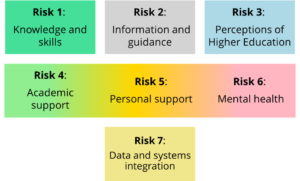
Figure: A diagram illustrating various risks, each represented by a coloured box with black text.
(Image long-description: Top Row: 1. Green Box: Heading: “Risk 1:” Description: “Knowledge and skills”. 2. Gray Box: Heading: “Risk 2:” Description: “Information and guidance”. 3. Light Blue Box: Heading: “Risk 3:” Description: “Perceptions of Higher Education”. Middle Row (with a gradient background to illustrate interconnected risks): 1. Gradient from Light Green to Yellow Box: Heading: “Risk 4:” Description: “Academic support” 2. Gradient from Yellow to Light Orange Box: Heading: “Risk 5:” Description: “Personal support” 3. Gradient from Light Orange to Light Pink Box: Heading: “Risk 6:” Description: “Mental health”. Bottom Row: 1. Light Yellow Box: Heading: “Risk 7:” Description: “Data and systems integration”)
Students may lack equal opportunities to develop the necessary knowledge and skills for Higher Education. In Northamptonshire, school attainment levels are below national averages, with significant gender differences. Male students, in particular, face knowledge and skills gaps, this manifests in lower application rates to HE and less frequent use of academic support while at university. Addressing these issues early on in collaboration with our school partners is crucial for ensuring equal opportunities for all students.
Students may not have equal opportunities to receive crucial information and guidance on Higher Education. In response to government cuts, we partnered with the South East Midlands Careers Hub to develop a careers programme serving 35% of local schools. Male, Global Ethnic Majority (GEM), and the most disadvantaged students face significant exposure to this risk due to a lack of appropriate career information and guidance in schools, resulting in a need for targeted interventions at university. COVID-19 has exacerbated these issues, highlighting the importance of improving our information and guidance offering to our school partners.
Our applicant data suggests that there may be a difference in the way male and female students perceive the academic portfolio offer at UON, resulting in different application rates which varies across our faculties and subjects. To address misconceptions in the understanding of Higher Education our Widening Access Team collaborate with faculty colleagues, partner schools and our Aspire Higher Uni Connect partners, to reduce the differences in participation between the most and least represented groups, particularly working to improve perceptions of Higher Education.
Some students may not receive the personalised academic support they need affecting their success. We aim to create a barrier-free academic support model for all. Belonging is a crucial part of this model for success and as such we will embed our PAT policy consistently across UON. Data has identified that GEM, male students and students with disabilities face more barriers to academic support and we aim to greenlight our academic support sessions to these students and address their barriers.
Internal data highlights that foundation year, male and some GEM students access personal support less than their peers. Our offer incorporates student support teams, our Integrated Learner Support (ILS) model, and a Personal Academic Tutor (PAT) provision. These systems working effectively alongside a robust financial support offer is vital support that ensures students continue their studies, especially students from low-income backgrounds. Therefore, raising the profile and enhancing the accessibility of these systems for students across UON is key.
We’ve spotted a connection between risks to accessing academic support, personal support and mental health and believe they all interlink.
Poor mental health is increasingly affecting students in Higher Education. Our Mental Health and Counselling Team saw a 127% rise in transition support requests in 2022/23. There are barriers to our GEM and male students accessing personal and academic support due to being unaware of support services. This is a priority for us to address.
Over 50% of students have reported a mental health concern, with 44% saying it impacts their studies. We are determined to address this issue to ensure equality of opportunity.
In developing our APP, we recognised that siloed local databases can hinder our ability to provide consistent experiences, offer timely student support and conduct insightful data analysis. This fragmentation may affect our PAT and ILS policies, making it hard to offer joined-up support. Students can face cumbersome processes, especially those with disabilities having to re-tell their stories.
We understand that staff need timely data to better support students, but disconnected systems slow decision-making and increase errors, impacting the student experience and support that can be offered. Therefore, data and systems integration is a risk that we will mitigate as a priority.