June was a busy month for making the case for simulation pedagogy, and I found myself making it three times over, in three different rooms, to three different audiences, with three different perspectives. Looking back at the three presentations together, a single thread runs through all of them, one I have been saying for a while now but which June finally gave me the evidence to back up properly: the medium differs, but the architecture does not.
At the UON Learning & Teaching Conference, the focus was Operation Nexus+, our live, multi-agency simulation run at Silverstone Circuit, now in its second year. This year we had the evaluation data to go with the experience, and it makes a strong case on its own terms. Students rated the importance of real-life learning at 9.32 out of 10 before they even started, and confidence rose by an average of 0.80 points afterwards, with not a single student reporting lower confidence than they walked in with. Ninety-two percent said they would do it again. What struck staff and students alike was that the cognitive demand was genuinely high (rated High across the board) and yet ten of thirteen students still rated their own success as High or Very High. That combination, high challenge and high self-rated success, is exactly the kind of desirable difficulty that good live simulation design is supposed to produce, and it was reassuring to see it show up so clearly in the numbers backing up the experience we had in the room. Communication under pressure turned out to be the standout, unanticipated gain across all seven skill dimensions we tracked, and the inclusion picture mattered just as much: the structured roles and authentic context that make Nexus+ work for everyone are the same features the literature identifies as particularly enabling for neurodiverse students. This is not an inclusion strand bolted onto the design. It is what good simulation design produces as standard.
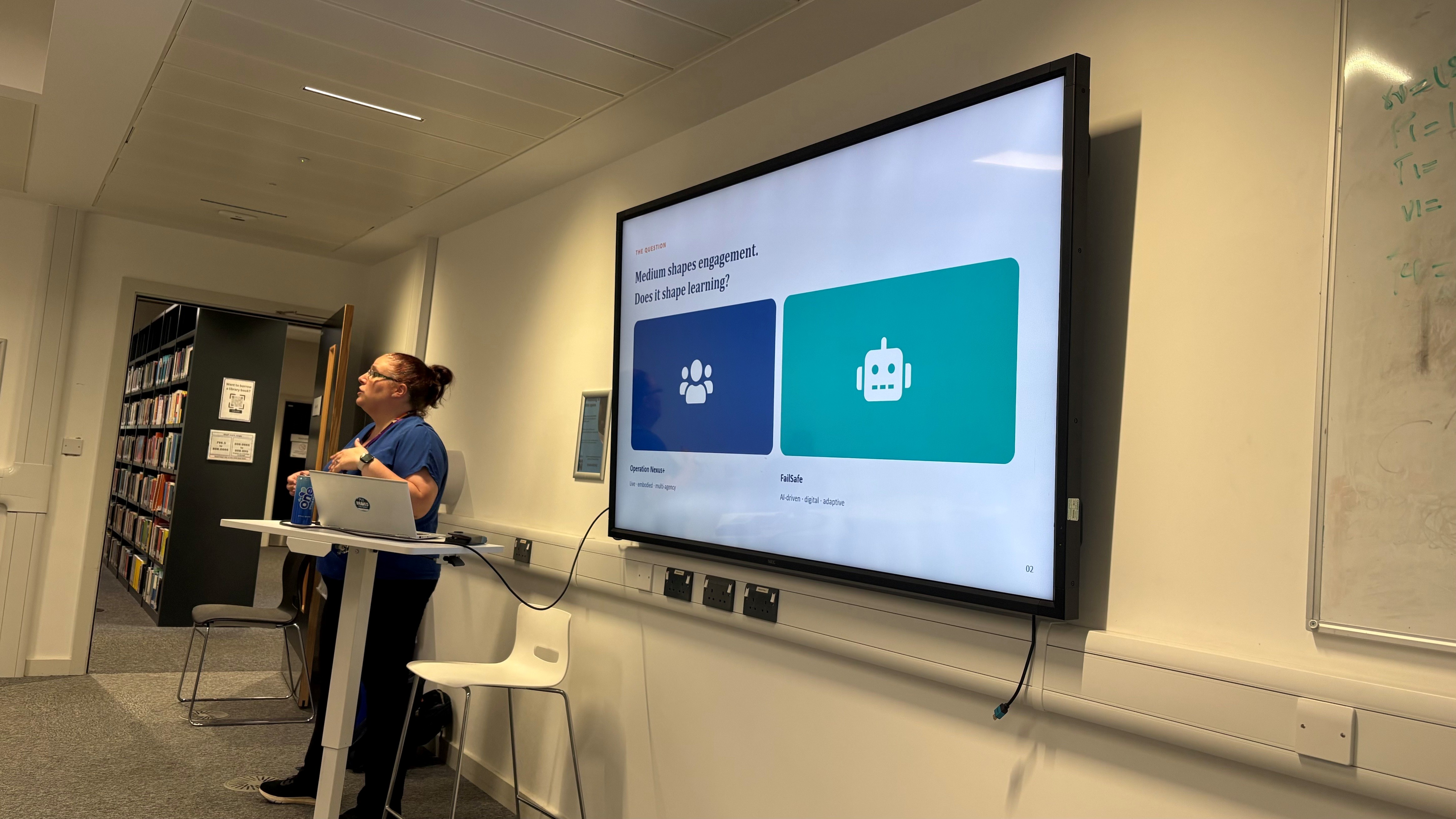
A few weeks later, at the TPEA conference, I made a different but related argument, this time putting Operation Nexus+ alongside FailSafe, an AI-driven digital simulation that I have been involved in via my PhD research, side by side. On paper they could not look more different: one is live, embodied, and run in real time at a racing circuit; the other is screen-based, asynchronous, and shaped by branching logic rather than a facilitator in the room. But when you map the two designs against each other, stage by stage, they turn out to share an identical five-part architecture: deliberate failure built into the scenario, escalating complexity layered in as it unfolds, and a structured debrief at the end, whatever form that debrief takes. What changes is not the architecture but the facilitation demands. Live facilitation is improvisational and bound by venue, staffing, and cohort size. AI-driven facilitation is authored in advance, consistent and repeatable, but loses the live “room” dynamic that gives the in-person version its intensity. Neither is the better option. They are the same pedagogic approach, made through different mechanisms, and recognising that matters for how we plan, resource, and scale simulation across a faculty rather than treating live and digital as two separate conversations.
The third room was UON’s own Annual Research Conference, where the focus shifted from teaching outcomes to knowledge exchange, through the Protecting People, Strengthening Places project. PPSP exists to help the region prepare for Martyn’s Law, working with West and North Northamptonshire Councils, Northamptonshire Police, and a wide network of venues, BIDs, and event organisers, UON included, since our own campus falls under the Enhanced Tier. The project is built on knowledge co-production rather than knowledge transfer: the framework belongs to the region, not just to the university, and that distinction has shaped everything about how partners have engaged with it. The Re-ACT simulation, a live, multi-agency exercise testing the framework against a marauding threat scenario, was the practical proof point, run at the Learning Hub with students, staff, and external partners all filling real operational roles. It is the same logic as Nexus+ and FailSafe again: build in a realistic failure point, escalate the complexity, debrief properly, and let the gap between what the plan says and what people actually do under pressure surface itself. The vital element here is that those gaps are now informing the next iteration of response planning across the University.
Put the three together and the pattern is clear. Whether the simulation is live at Silverstone, digital through FailSafe, or a regional safety exercise in our own Learning Hub, the underlying architecture, deliberate failure, escalating complexity, and structured debrief, holds. The medium changes who can take part, how it scales, and what it feels like in the room. It does not change what the simulation is actually asking a participant to do, or why it works.
If you are working on simulation pedagogy in any discipline and want to compare notes, get in touch about joining SIMPACT, our cross-institutional Community of Practice, now open to external members.