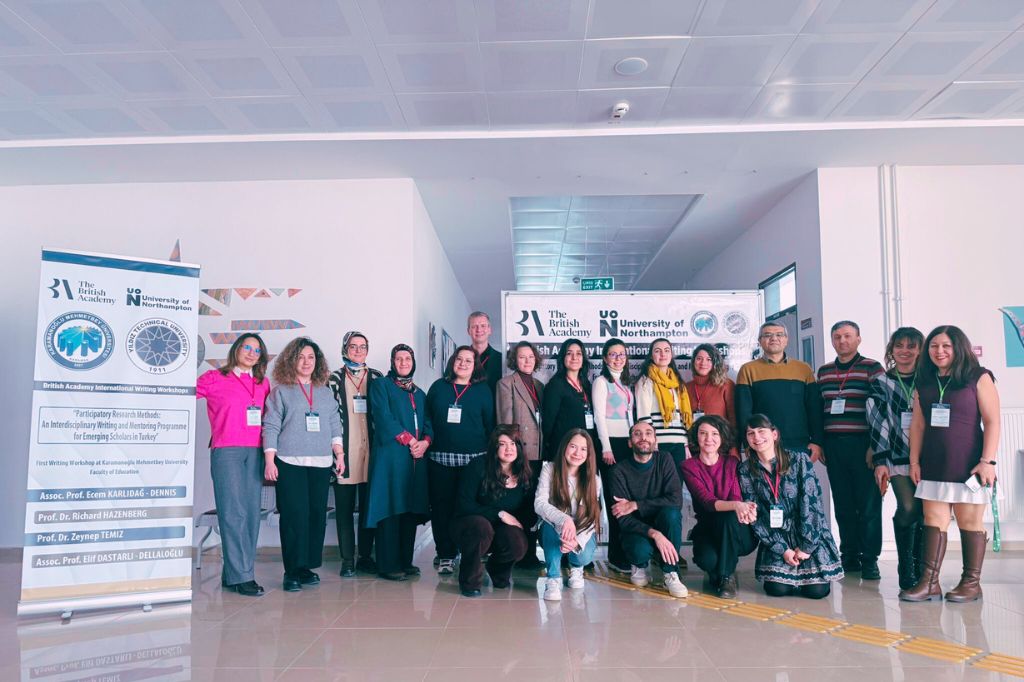
A project to transform the academic writing skills of Early Career Researchers (ECRs) in Turkey – empowering them to publish in higher‑ranked international journals and raising global visibility for important research – is being led by University of Northampton (UON).
Funded by the British Academy, the project is being delivered by UON’s Institute for Social Innovation and Impact (ISII) in collaboration with Lancaster University, Yildiz Technical University in Istanbul, and Karaman Mehmetbey University.
In February, the project team – including Professor Richard Hazenberg and Dr Ecem Karlıdag‑Dennis from Northampton – travelled to the Turkish city of Karaman to deliver the first phase of a hands‑on participatory writing workshop for 15 researchers from universities across the country.
Unlike traditional academic training, which often relies on lecture‑style content delivered over a few days before external experts return home, this programme provided real‑time writing practice, intensive mentoring, collaborative editing, and ongoing monthly guidance right through to journal submission.
“We didn’t want to parachute in, run a few sessions on how to write a paper, and disappear,” said Professor Hazenberg. “That model just leaves people isolated afterwards. This project is about genuine collaboration and long-term impact. Each of us is mentoring several scholars, meeting monthly, reviewing drafts, and then working intensively with them again in June to get their papers over the line and published in academic journals.”
The Turkish ECRs are already producing high‑quality, community‑embedded research – often working with refugee communities, grassroots organisations, or groups experiencing social exclusion. But, as Dr Karlidag-Dennis explained, many ECRs face institutional pressure to publish in highly ranked international journals, where conventions of academic writing differ significantly.
Dr Karlidag-Dennis said the project is mutually beneficial, improving the impact of Turkish research while exposing the team to new ideas and methodologies, adding: “Their research is brilliant. But without support navigating the publication model used by European and US journals, many find their work isn’t reaching the audiences it deserves.”
“And we’re learning just as much from their approaches to co‑produced and participatory research, and we’re already considering how to adopt some of their methods in our own projects. It’s very much knowledge transfer in both directions.”
Although the British Academy funding covers travel and local partner time, Northampton’s academic staff are contributing much of their involvement in their own time.
“Research mentorship is an area that we are very passionate about,” said Professor Hazenberg. “I benefited hugely from mentorship early in my own career. Now it’s my responsibility to pay that forward. There’s enormous personal satisfaction in supporting others to achieve their goals.”
The University of Northampton team will also publish its own research analysing the workshop process and exploring how collaborative writing models support ECR development internationally.
The ISII evaluates and measures the social impact of social innovations in the UK and around the world, as well as exploring the financing of, and policy support for, social innovation. Find out more on the UON website.