Research Impact
Impact is change – what has changed because of what you did?
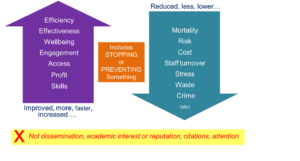
Long description: A diagram that highlights what can be improved by impact or alternatively reduced by impact, improved includes; Efficiency, Effectiveness, Wellbeing, Engagement, Access, Profit and Skills. Reduced includes; Morality, Risk, Cost, Staff turnover, Stress, Waste and Crime.
Improved, more, faster, increased:
- Efficiency
- Effectiveness
- Wellbeing
- Engagement
- Access
- Profit
- Skills
Includes: stopping or preventing something
Reduced, less, lower:
- Mortality
- Risk
- Cost
- Staff turnover
- Stress
- Waste
- Crime
- Etc…
Not dissemination, academic interest or reputation citations, attention.
Research Impact is:
An effect on, change or benefit to the economy, society, culture, public policy or services, health, the environment or quality of life.
Impact includes an effect, change or benefit on:
- Processes: the activity, attitude, awareness, behaviour, capacity, policy, opportunity, performance, practice, or understanding;
- People: an audience, families, beneficiary, community, constituency, or individuals;
- Places: any organisation or geographic location whether locally, regionally, nationally or internationally
What is research impact: REF2021 Definition
- “assess the ‘reach and significance’ of impacts on the economy, society, culture, public policy or services, health, the environment or quality of life that were underpinned by excellent research conducted in the submitted unit.”
- “the impact would not have occurred or been significantly reduced without the contribution of the research.”
What is research impact: Academic Impact
“The demonstrable contribution that excellent research makes to academic advances, across and within disciplines, including significant advances in understanding, methods, theory and application.” RCUK
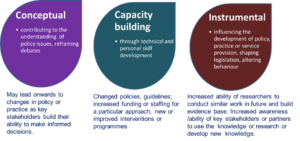
Long description: A diagram that shows 3 types of Impact; Conceptual, contributing to the understanding of policy issues, refraining debates. May lead onwards to changes in policy or practice as key stakeholders build their ability to make informed decisions. Capacity building, through technical and personal skill development. Changed policies, guidelines; increased funding or staffing for a particular approach; new or improved interventions or programmes. Instrumental, influencing the development of policy, practice or service provision, shaping legislation, altering behaviour. Increased ability of researchers to conduct similar work in future and build evidence base. Increased awareness/ability of key stakeholders or partners to use the knowledge or research or develop new knowledge.
Conceptual
- Contributing to the understanding of policy issues, reframing debates
May lead onwards to changes in policy or practice as key stakeholders build their ability to make informed decisions.
Capacity building
- Through technical and personal skill development
Changed policies, guidelines; increased funding or staffing for a particular approach; new or improved interventions or programmes.
Instrumental
- influencing the development of policy, practice or service provision, shaping legislation, altering behaviour
Increased ability of researchers to conduct similar work in future and build evidence base. Increased awareness/ability of key stakeholders or partners to use the knowledge or research or develop new knowledge
Source: ukri.org
Research Outputs
Findings, e.g:
Journal articles, book chapters, reports, interventions, ‘products’
Knowledge Mobilisation
Activities to connect e.g: Public engagement, social media, seminars, workshops, schools – outreach.
Research Impact
The demonstrable (can be evidenced) benefits of research in the real world.
- What? (Goals/Questions)
- What question/issue do you intend to address?
- What are your research goals?
- What type of impact do you want to have?
- What resources/conditions will your research/goal/impact rely on for success?
- What are the barriers?
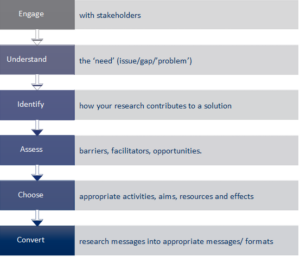
Long description: Diagram that shows how to generate Impact. Engage with stakeholders. Understand the need (issue/gap/problem). Identify how your research contributes to a solution. Assess barriers, facilitators, opportunities. Choose appropriate activities, aims, resources and effects. Convert research messages into appropriate messages/formats.
Generating Impact
Impact can be created at any stage of the research process.
Factor impact into the design of all research projects.
Often impact occurs after the completion of a project – factor this in, especially evidence collection.
Evidence can be stored in Pure in impacts (Keep at entry in progress until complete)
- Engage: with stakeholders
- Understand: the ‘need’ (issue/gap/’problem’)
- Identify: how your research contributes to a solution
- Assess: barriers, facilitators, opportunities
- Choose: appropriate activities, aims, resources, and effects
- Convert: research messages into appropriate messages/formats
Online resources/Tool kit
- ESRC Impact Toolkit
- Fast Track Impact
- Impact Literacy Workbook
- Becker Medical Library (Biological Sciences)