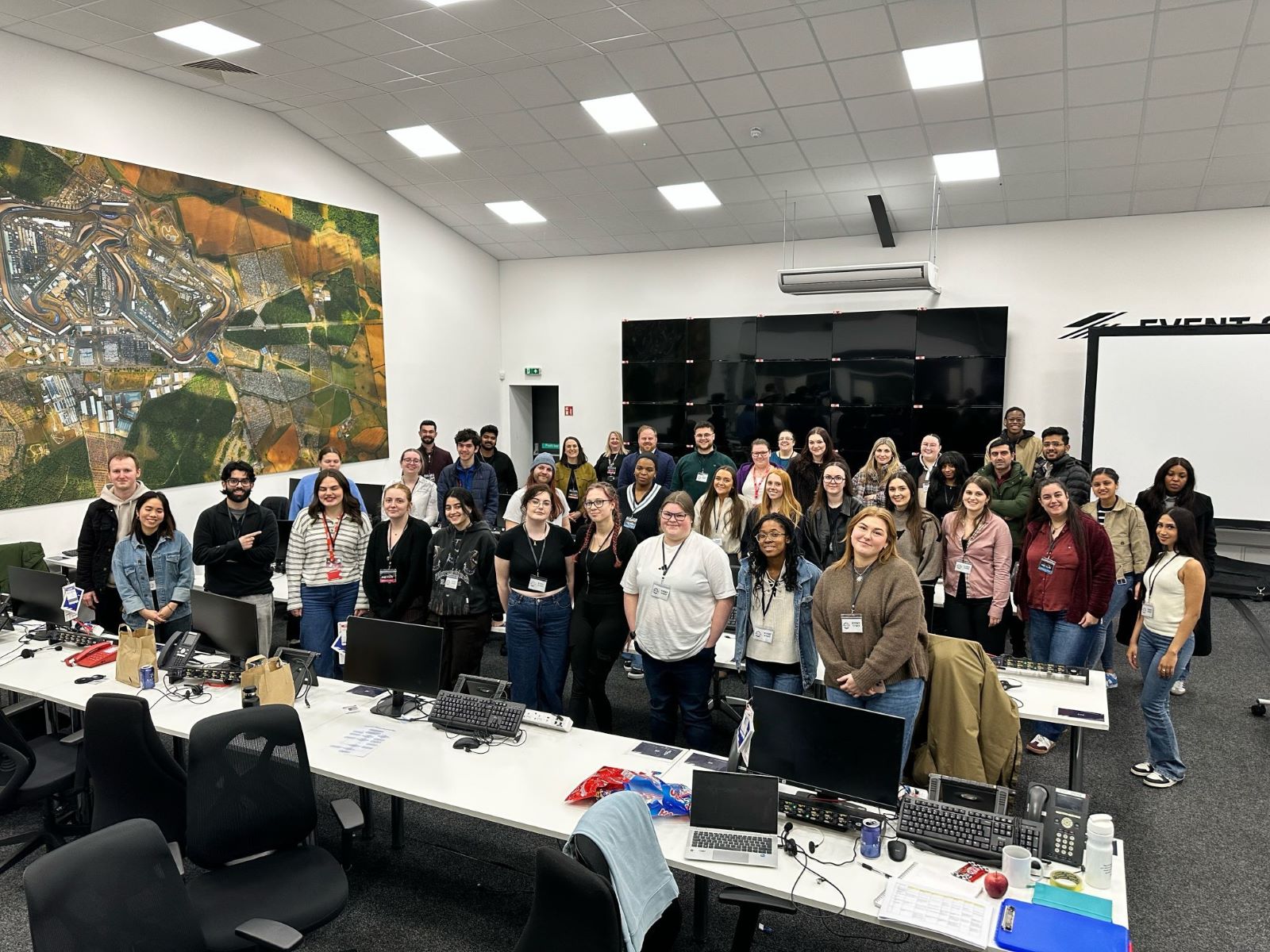
 Operation Nexus+ gives University of Northampton students the chance to find out how they can make decisions under pressure. Led by Dr Claire Drakeley, the project brings students from different courses together at Silverstone Circuit for a large-scale simulation of a major event.
The event itself is fictional, but the setting and professional expectations are deliberately realistic. Students take on operational roles and respond as the situation develops around them. They have to make decisions without knowing exactly what will happen next.
Behind the experience sits a network of digital tools that keeps information moving. Technology is not presented as the main attraction, yet the simulation could not work without it.
As Claire explains:
“The technology is not front and centre of Operation Nexus+, but it is the thing that fuels it.”
Creating an event about an event
Claire came to the project from a background in event management, so she approached the simulation much as she would approach a live event.
A detailed storyboard mapped how the scenario would unfold and who would be involved. Students registered voluntarily from courses including events management and policing. Other participants came from marketing-related programmes.
The mixture was important because students had to work with people they had not met before. They could not rely on familiar classroom groups or assume that everyone understood the situation in the same way.
Around 40 students took part, working across different locations at Silverstone. The experience was carefully designed, but it also needed enough flexibility to respond when events moved away from the original plan.
“It was a structured learning experience, but delivering it was exactly like running an event. You have the plan, but the reality is that it never goes exactly according to plan.”
That unpredictability was not a failure of the design. It was the point. Students needed to experience the uncertainty that shapes professional decision-making.
Professional technology, used for a real purpose
At the centre of the simulation was Halo, the event control software used by Silverstone. It allowed information to pass between teams and created an ongoing record of what had happened.
Students were not using an educational imitation of event software. They were working with a professional system and learning how information becomes action in a control environment.
This gave the experience value beyond the immediate activity. Students felt that they had gained something they could explain in a job interview and include on their CV.
“They could say, ‘I have had this experience.’ It went beyond the functionality of the software and became something they could carry into professional practice.”
Radios played an equally important role. They may seem less sophisticated than event management software, but many students had never used them before.
Communicating by radio is very different from speaking face to face. Students needed to judge when to talk and how to make themselves understood. They also had to listen while other information continued to arrive.
The headset created a physical connection to the technology. It also contributed to the intensity of the experience. Students could feel information building around them, much as it would in a live control room.
Designing healthy stress
Operation Nexus+ was intended to challenge students. Claire describes the aim as creating ‘healthy stress’: enough pressure to make the experience absorbing, without allowing it to become overwhelming.
Technology helped create this feeling. Halo enabled events to unfold across the simulation, while radio communication made the situation feel immediate. Students had to remain present and respond to what was happening around them.
However, the technology needed to be familiar before the pressure increased. If students were still trying to work out how to operate a radio during the most demanding part of the scenario, the experience could tip from productive challenge into confusion.
“They need to know how to use the technology beforehand. If they do not, they are going to struggle.”
Preparation was therefore part of the pedagogy. Students needed enough familiarity to use the tools almost instinctively once the simulation began.
The experience was also framed as a safe place to fail. Mistakes had consequences within the scenario, but nobody’s safety was genuinely at risk. This allowed students to test their judgement and reflect on what they would do differently.
Making learning visible
Feedback suggested that students developed greater confidence in their decision-making. They also became more aware of how their work affected people in other roles.
This was not teamwork in the familiar sense of completing a group assignment with friends. Students had to communicate with unfamiliar colleagues while the situation was changing.
“They had to figure out how to get information and understand the impact of what somebody else was doing on their own role.”
Technology made those relationships visible. A decision entered into Halo could affect another team elsewhere in the venue. A radio message could change the direction of the scenario. Students experienced professional interdependence rather than simply hearing it described.
The simulation was especially valuable for some neurodiverse students. Participants who had found aspects of event planning difficult to grasp in the classroom described a moment when the ideas finally made sense.
For these students, the live experience made previously abstract learning tangible. It also gave them a way to demonstrate their capabilities beyond extended written work.
At the same time, Claire is cautious about making the activity compulsory. The speed of radio communication can be demanding for students working in an additional language. Other students may find the sensory intensity difficult.
Keeping the activity optional allows it to create new opportunities without assuming that one form of experiential learning will suit everyone.
Technology creates the scale
Without Halo, it would have been almost impossible to coordinate the amount of information moving through Operation Nexus+.
A smaller exercise could be managed directly by a lecturer, but that would not create the same sense of a major event. The digital system allowed the scenario to become large and complex without recreating a real crisis.
“We could not have delivered that experience without the technology. It allowed us to scale it up without scaling it up in a real sense.”
The technology therefore did more than make the simulation efficient. It created the conditions in which the learning could happen.
This distinction matters. Operation Nexus+ is not a demonstration of software with a learning activity wrapped around it. The tools are valuable because they make particular forms of professional practice available to students.
From Silverstone to an AI-driven simulation
Claire is now exploring how the same pedagogical approach might work online through an AI-supported project called Fail Safe.
The digital simulation is based on a realistic event safety scenario. Students move through a structured process before entering an immersive stage in which AI personas respond to their decisions.
The aim is not to reproduce every feature of the Silverstone experience. A virtual simulation cannot fully recreate the atmosphere of a live control room. It may, however, make this kind of learning available to students who cannot attend a physical event.
The two formats share the same underlying principle. Students need preparation before they encounter a situation that asks them to make difficult choices. Afterwards, they need space to reflect on what happened.
Giving simulation the time it needs
Operation Nexus+ required far more staff time than its initial allocation suggested. Much of that work was invisible because it took place before students arrived at Silverstone.
Partners needed to be involved and staff had to understand the venue. The technology also had to be configured so that it felt professionally credible without exposing operational data from Silverstone.
Claire’s advice is not to underestimate this preparation. A convincing simulation depends on work that participants may never see.
It also depends on collaboration. The project drew on the knowledge of academic staff and industry partners, with each bringing a different understanding of the situation.
For Claire, the next step is to make this expertise easier to share through CADE’s Simulation Pedagogy Special Interest Group. The aim is to help colleagues adapt simulation-based learning without assuming that they already have the skills of an experienced event manager.
Operation Nexus+ shows that technology does not have to be the most visible part of an educational experience to be transformative. Sometimes its most powerful role is to sit behind the learning, quietly making the experiences feel real.
Read more about Operation Nexus+ at Silverstone.