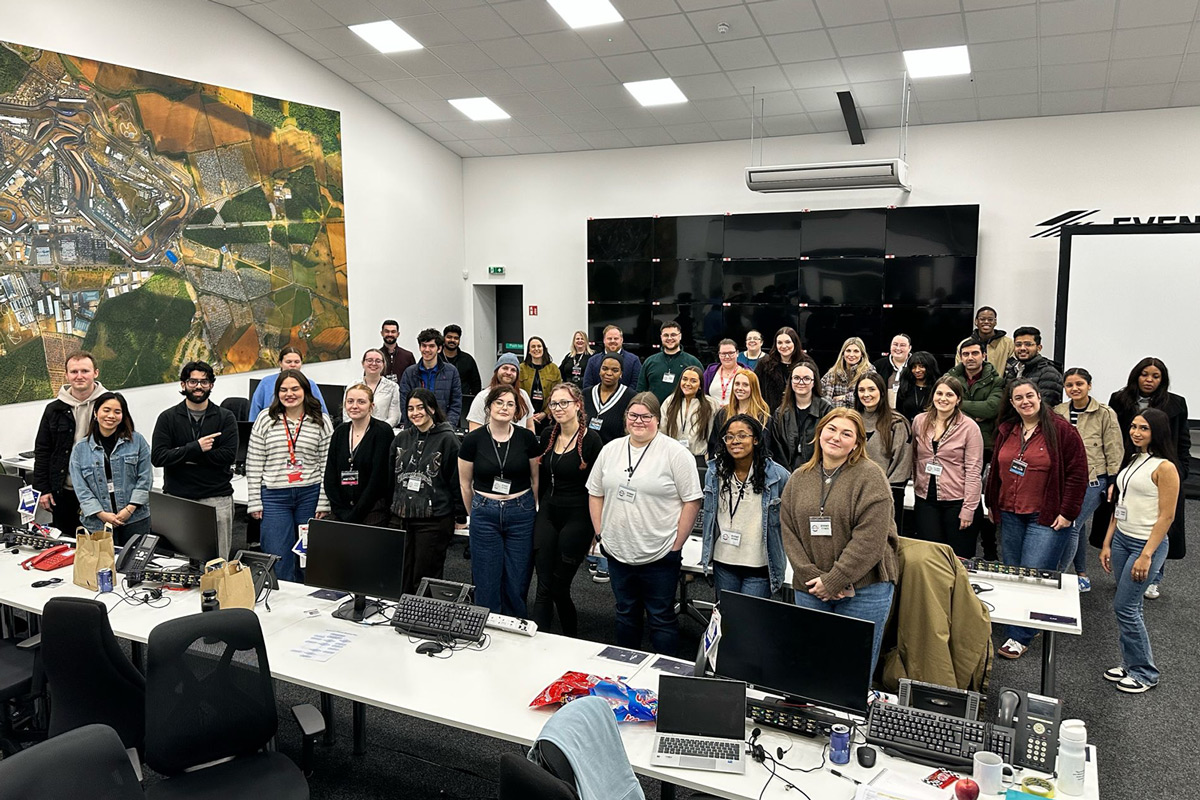
“We did it!” These were the words of tourism and event management undergraduate students as they high fived each other, following the shut-down of a very intense in person simulation event. This was the moment during Operation Nexus+, that we as facilitators realised how much the students were learning from making decisions grounded in consequences, growing empowerment and confidence building.
As first-time facilitators, we went into Operation Nexus+ thinking primarily about what the students would learn. What surprised us was how much the simulation taught us about facilitation itself, and how simulation pedagogy shares some characteristics with traditional teaching, while also differing significantly from classroom-based approaches.
What is Operation Nexus+?
Earlier this year, we had the opportunity to facilitate Operation Nexus+, a large-scale, cross-disciplinary simulation delivered at Silverstone. The simulation brought together students from Events, Hospitality, Marketing, Tourism and Criminal Justice, placing them in operational roles where they were required to communicate, make decisions and respond to interconnected challenges as they unfolded.
What made Nexus+ different from conventional teaching was the uncertainty built into the experience. Rather than discussing how they might respond to a professional scenario in the classroom, students were required to make decisions in real time, consider their impact on other teams and adapt as situations developed. For us as facilitators, this also meant moving away from the more familiar role of guiding students through a structured teaching activity.
The design, technology and student experience of Operation Nexus+ have been explored previously. Our experience as first-time facilitators, however, raised a different set of questions about what happens behind the simulation itself. Reflecting on the day, three areas particularly shaped our thinking: the role of industry in planning and preparation, knowing when to step back as facilitators, and what it means to create an authentic learning experience.
When Facilitating Means Stepping Back
As first-time facilitators of Operation Nexus+, we brought with us assumptions shaped by conventional teaching. We were used to setting the learning outcomes, controlling the pace and, to some extent, steering the direction of discussion. We assumed that effective facilitation meant keeping things on track, sticking to timings and ensuring that the intended learning happened.
But Operation Nexus+ quickly challenged that assumption.
As the simulation unfolded across the day, we witnessed what we came to see as the real ‘gold’ of simulation learning: opportunities for students to make decisions, experience the consequences of those decisions and solve problems in real time – something that simply cannot be replicated in a conventional classroom environment.
When nobody was quite sure what would happen next
During the simulation at the hotel, it took some time for students to feel confident in their roles across hotel security, guest services, operations management and VIP/hospitality co-ordination. This was fully anticipated and felt familiar to us as educators. In a classroom setting, when group tasks are first introduced, students need time to establish team roles, find their feet and find their voice.
It was during this initial phase that our expectations about control and facilitator intervention were confirmed. Students needed prompting, guidance and reassurance that they were approaching the scenarios in the ‘right way’. In conventional teaching, we often reassure students that there isn’t necessarily a ‘wrong’ answer when debating topics or critically analysing ideas, concepts and theories.
Operation Nexus+ introduced a different kind of uncertainty.
Here, decisions had consequences. A poor decision could create problems elsewhere in the hotel, and students could see those consequences unfold in real time. Understandably, students felt nervous and eager to get things right. So did we. As facilitators, we found ourselves wanting to safeguard both the success of the simulation and the students’ confidence within it.
The shift
As students settled into their roles and became more confident with using the reporting software and radio control, it became apparent that less control and input was needed from the facilitators. Our role became much simpler: present the scenarios, observe what happened and allow the students to respond.
The team began to gel. They started asking each other questions and demonstrated a more confident understanding of how one person’s decision could impact the rest of the hotel team, or even the entire event team.
Perhaps the most interesting realisation was that we were experiencing something similar to the students. They were learning to make decisions without knowing exactly what would happen next; we were learning to facilitate without knowing exactly what would happen next.
As facilitators, the temptation to step in and intervene to prevent mistakes from being made was difficult to fight off. The stakes felt high, and as the students’ confidence was building, we didn’t want to be the reason that confidence was dashed.
However, it became increasingly clear that some of the most valuable learning was happening precisely because we didn’t intervene.
At one point, the guest services manager commented:
“I shouldn’t have prioritised the VIP laundry request; it’s caused chaos with the crowd outside!”
Our instinct was to step in and help resolve the uncertainty that this had created. Instead, we resisted that urge. The team worked together, discussed the consequences of the decision and found their own resolution. A proud facilitator moment!
More importantly, it was a moment where we could see the learning happening in front of us. The student wasn’t being told that the decision had created a problem. They had experienced it. The team wasn’t being given the solution. They had to work it out.
This experience challenged our understanding of what effective facilitation looks like. We had initially equated good facilitation with maintaining control: keeping students on track, managing the timings and ensuring that the intended learning happened.
Instead, we began to see that the facilitator’s role can sometimes be to step back rather than step in.
The most authentic and rich learning experiences don’t necessarily come from creating a perfectly controlled or fully curated experience. Sometimes, they come from giving students enough space to make decisions, make mistakes and experience the consequences for themselves.
We came into Operation Nexus+ thinking that good facilitation meant being in control. We left realising that sometimes, good facilitation means knowing when to let go.
Realism matters — but perhaps realism isn’t the same thing as replicating reality
It is easy to assume that simulations need to replicate ‘real-life’ scenarios for effective learning to take place. As facilitators, we understood the value of placing students in scenarios that felt real, where realistic pressures could be created and where their decisions could have consequences.
Taking students out of the classroom and placing them within the Museum and Hotel at Silverstone therefore became an important part of the simulation. They were no longer sitting around a table discussing what might happen in a hotel or museum; they were physically in those environments, surrounded by the sights, sounds and pressures of a working venue.
But as the simulation unfolded, we began to think differently about what we actually mean when we talk about ‘realism’. It wasn’t simply about recreating a real-life scenario. There were several different elements that contributed to making the experience feel real.
Physical realism
Taking students out of the classroom and into a busy hotel conference and museum environment meant that they were immediately exposed to a professional, customer-facing setting that continued to function in its normal capacity while the simulation was taking place.
Real staff were asking questions. Real telephones were ringing in the background. Real customers were taking their luggage to their rooms. Although students weren’t directly interacting with all of these people, they were aware that the simulation was taking place within a functioning workplace. It set the tone in a way that would have been difficult to achieve in a classroom.
There was something else we hadn’t necessarily anticipated from a facilitator perspective: simply leaving the classroom changed the students’ mindset. They seemed to recognise that this was different. They were no longer completing a classroom activity; they were stepping into a professional environment, with all the expectations that came with it.
Technological realism
The use of real working radio communications and the HALO event software added another layer of realism. These weren’t simply props within the simulation; students had to learn how to use them, communicate through them and make decisions based on the information they received.
There was also an added sense of responsibility. Other teams could hear or view their communications, meaning that what one team communicated could influence the actions of another. Communication became the cornerstone of real-time decision making and, ultimately, the security investigations that took place at the end of the simulation.
Juggling different communication channels added another layer of pressure and tested students’ verbal and written communication in a way that felt particularly relevant to the hospitality and events industries.
Experiential realism
Perhaps the most interesting thing we learned, however, was that the simulation didn’t need to reproduce every aspect of working in a hotel or museum. What mattered was recreating the experience of having to respond to competing demands under pressure.
Students felt the pressure and urgency of needing to communicate actions accurately — and now. They knew that what they did could have consequences for another team. Through HALO and the radio communications, they could see and hear those consequences unfolding in real time.
That was something we simply couldn’t recreate in the same way in a classroom.
Interestingly, during the early stages of the simulation, when students were first presented with their scenarios by the facilitators, the experience could feel slightly artificial and over-constructed. But as the domino effect of decision-making began to cascade through the simulation, connecting the hotel and museum teams, something changed.
The simulation started to feel real.
The museum team leader commented afterwards that she had “never felt so stressed.”
For us, that was another simulation ‘golden nugget’. Not because we had successfully recreated every aspect of working in a museum or hotel, but because the student had experienced something authentic: pressure, uncertainty, responsibility and the consequences of her decisions.
The consequences weren’t real-world consequences, but they were real learning consequences.
Perhaps, then, realism isn’t about making a simulation a perfect replica of reality.
Perhaps it’s about creating the conditions in which students can experience something authentically.
The Role of Industry in Simulation Planning
One of the biggest things Operation Nexus+ taught us was just how much of a successful simulation happens before the students even arrive. Throughout the planning process, we realised that working within an industry environment wasn’t enough. If we wanted the experience to feel authentic, industry needed to help us shape it too.
Designing with industry, not just within it
Working with our industry partners, the Silverstone Museum and the Hilton Garden Inn, Silverstone, made us think differently about what an industry partnership within a simulation can actually look like. It would have been relatively easy for us as educators and academics to design a series of scenarios and then ask our partners to provide the setting in which to run them.
Instead, some of the most useful conversations were much simpler: Would this actually happen? Who would deal with it? What would they do next?
Those conversations helped us turn relatively straightforward ideas into interconnected challenges. Traffic congestion, Wi-Fi disruption or an operational issue might sound simple on paper, but the interesting part was considering how that problem would actually unfold. Who notices it first? Who needs to know? How would it be escalated? And what happens elsewhere because of the decision somebody makes?
Our industry partners brought an understanding of the realities of their operations, while we brought our understanding of the students, what they had learned and where they might need support. Bringing those two perspectives together became an important part of designing the experience.
Knowing the venue isn’t quite the same as knowing the reality
Before Operation Nexus+, we had toured the venues and familiarised ourselves with the environments in which the students would be working. We had also worked with Silverstone to put the resources around us that we might need. We had access to venue maps, HALO, the Serious Incident Plan and information about hazards and escalation procedures. On paper, we felt prepared.
But knowing the venue and having the resources in front of you isn’t quite the same as knowing how to respond when something actually happens.
One moment stands out. The simulation had been carefully planned to build towards a major threat, with scenarios timed to gradually increase the pressure on students. Then the call came through around ten minutes earlier than we had expected. There was no one from Silverstone in the room at that moment and the immediate thought was: I don’t actually know what the right response is here.
It was a useful reminder of what we were asking the students to do. Suddenly, we weren’t following a carefully constructed simulation plan; we were having to interpret the information and resources around us and think about what should happen next.
As facilitators, we had to keep reminding ourselves that we didn’t necessarily need to know the ‘right’ answer. Part of the purpose of the simulation was giving students the space to work through problems themselves. However, that moment also reinforced why industry knowledge around the simulation mattered. The plans, systems and resources provided by Silverstone gave us a professional reference point, even when the simulation itself didn’t unfold exactly as expected.
That professional knowledge can stretch from something as mundane as making sure the toilets are cleaned through to managing an expected celebrity arrival or responding to a serious incident. These are the operational details that can be difficult to fully appreciate from a site visit alone, but they can completely change how a scenario develops.
Preparing students for the pressure
We also learned that authenticity does need some preparation.
Much of this preparation relied on the operational knowledge and resources provided by our industry partners. For us as facilitators, this created an interesting balancing act. We wanted students to experience uncertainty, but we didn’t want that uncertainty to come from simply not understanding the tools or processes they had been given. The preparation needed to give them enough confidence to participate without removing the challenge of having to make their own decisions once the simulation began.
Looking back, one of our biggest takeaways is that industry involvement needs to extend beyond the planning stages and into the simulation itself.
We had been able to ask questions beforehand, familiarise ourselves with the venues and prepare using the information and resources provided by our industry partners. However, as first-time facilitators, there were inevitably questions that we didn’t know we needed to ask until the simulation was underway.
This became particularly apparent when comparing our experiences across the two venues. At the hotel, industry colleagues were actively involved throughout the day, meaning their operational knowledge was readily available as situations developed. At the Museum, our partners had supported the planning and provided the environment and resources needed to deliver the simulation, but their role on the day was more facilitative. This placed greater responsibility on us as facilitators to interpret how an unfolding situation might be handled professionally.
Perhaps that shouldn’t have surprised us. We were asking students to encounter uncertainty and respond to situations they had not experienced before, but as first-time facilitators, we were experiencing some of that uncertainty too. We had questions just as the students did, and not all of them could have been anticipated beforehand.
Reflecting on this experience reinforced the importance of industry engagement throughout the simulation process. The most valuable contributions were not limited to venue access or scenario design, but stemmed from the operational insight and expertise that industry partners brought before, during and around the simulation experience.
What did we learn, and how can we use this learning to shape the future of Operation Nexus+?
Facilitating Operation Nexus+ challenged many of our assumptions about simulation-based learning. While our reflections focused on different aspects of the experience, several common themes have emerged.
Firstly, meaningful learning requires space for students to make decisions independently. Some of the most powerful learning moments occurred when we resisted the urge to intervene and instead allowed students to experience uncertainty, navigate competing priorities and deal with the consequences of their decisions. Future iterations of Nexus+ should continue to build opportunities for student ownership and decision-making, while ensuring that appropriate support structures remain in place.
Secondly, authenticity extends beyond physical environments and technology. While the Silverstone venue, radio communications and HALO software all contributed to the realism of the experience, it was the pressure of managing interconnected challenges and responding to unfolding situations that made the learning feel authentic. Future simulations should continue to focus on creating meaningful experiences rather than attempting to replicate every aspect of professional practice.
Thirdly, industry partnerships should extend beyond providing a venue or authentic setting. Our experience demonstrated the value of involving industry partners throughout the simulation lifecycle, from scenario design and student preparation to providing professional insight as situations evolved during the simulation itself. Future iterations of Operation Nexus+ will continue to build opportunities for industry collaboration before, during and after the simulation.
Finally, facilitators are learners too. Operation Nexus+ has shown us that simulation offers opportunities not only for student development but also for critical reflection on our own teaching practices. Future iterations will therefore continue to build in opportunities for facilitator reflection alongside student debriefing.
Concluding remarks
When we arrived at Silverstone, our attention was firmly focused on the students and the experience we hoped to curate for them. We expected to observe learning and provide structure. What we didn’t expect was how much we would learn ourselves.
Operation Nexus+ reinforced a lesson that emerged throughout the day: authenticity comes not from perfectly replicating professional practice, but from creating conditions in which students must think, decide and respond to uncertainty.
The experience also reinforced the value of meaningful industry collaboration. Authentic learning emerged not only because students were situated within a professional environment, but because educators and industry partners worked together to design challenges that reflected the complexity of real-world practice.
Perhaps our most significant takeaway is that simulation is a shared learning process. Students learn through participation, facilitators learn through observation and reflection, and industry partners contribute insights that shape the experience and contribute to professional development for everyone involved. As we continue to develop Operation Nexus+, these lessons will remain central to how we design, facilitate and evaluate future in-person simulations.