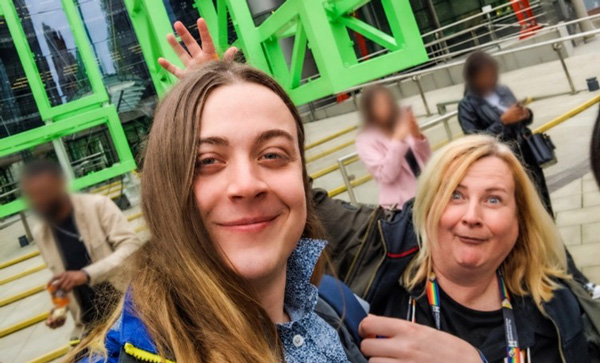
What happens when you take a group of final-year advertising students, give them a real brief from Channel 4, and ask them to pitch their campaign to industry professionals in a London agency boardroom? You find out what they are made of. And, more often than not, you find out they are made of more than they knew.
The Channel 4 Live Client Project is a 40-credit capstone module on the Advertising and Digital Marketing degree at the University of Northampton, now in its fifth year. It is co-taught by myself and Billy Little, Lecturer in Marketing, and it has become the experience that students most consistently describe as the best of their university career.
Why Channel 4?
The module was not always this. The previous version was a consultancy arrangement with a major advertising agency. It worked, up to a point, but it was overcomplicated, placed too much demand on the partner and students alike. When I took it over, I wanted something different: a partner whose values aligned with a cohort that was ethnically and gender diverse, and who would give students access to spaces they might not otherwise imagine themselves in.
Channel 4’s public commitment to diversity made them the obvious choice. I sent a cold email to a diversity lead whose details I had worked out from a Marketing Week article. They said yes. Five years later, the relationship has grown to include a pitch at Havas, one of the world’s leading media agencies, in front of a prospective commercial client.
The key to making it last is respect for the partner’s time. The teaching team exchanges perhaps ten emails with Channel 4 across the entire project year. The client sees the students twice: once for an immersive briefing day in London, and once for the final pitch. That discipline is what turns a favour into a five-year relationship.
Is it a simulation?
It is worth addressing this directly. The module is not a simulation in the sense of a fully constructed fictional scenario – the client is real, the brief is real, and the pitch takes place in an actual agency boardroom. But it is a simulation in the sense that matters most pedagogically: it faithfully replicates the conditions, pressures, and arc of a professional pitch process, and it does so in a context where students can experience the full weight of consequence without the full weight of professional risk.
The reflective assignment that closes the module is where the experiential learning cycle completes – in Kolb’s terms, the structured opportunity to make sense of what has been done, why it felt the way it did, and what it means for how the student understands themselves as a developing professional. Without that, it would be a very good project. With it, it is simulation pedagogy.
A Framework for Making It Work
This kind of project does not run itself. Over five years of doing it, I have distilled the design into six principles, published in the IDM Practitioner Workbook, that I think underpin any successful experiential learning project with an industry partner. The infographic below sets them out.
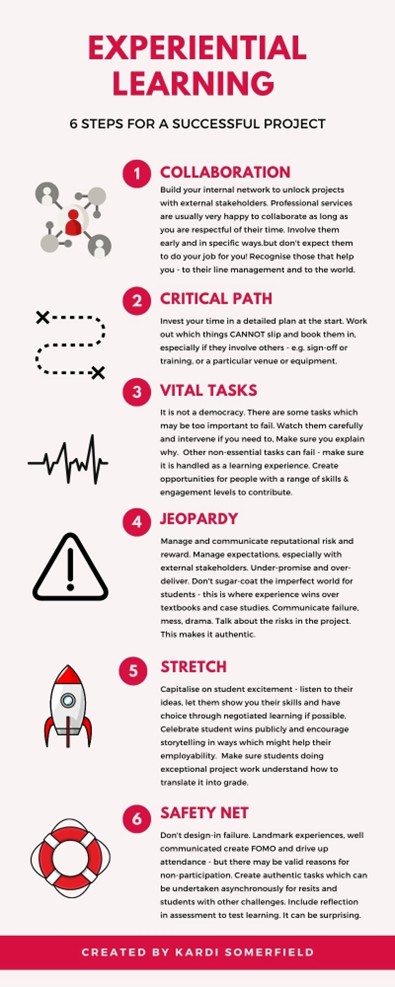
Long description: Experiential learning 6 steps for a successful project 1. Collaboration Build your internal network to unlock projects with external stakeholders. Professional services are usually very happy to collaborate as long as you are respectful of their time. Involve them early and in specific ways, but don’t expect them to do your job for you! Recognise those that help you – to their line management and to the world. 2. Critical path Invest your time in a detailed plan at the start. Work out which things CANNOT slip and book them in, especially if they involve others – e.g. sign-off or training, or a particular venue or equipment. 3. Vital tasks It is not a democracy. There are some tasks which may be too important to fail. Watch them carefully and intervene if you need to. Make sure you explain why. Other non-essential tasks can fail – make sure it is handled as a learning experience. Create opportunities for people with a range of skills & engagement levels to contribute. 4. Jeopardy Manage and communicate reputational risk and reward. Manage expectations, especially with external stakeholders. Under-promise and over deliver. Don’t sugar-coat the imperfect world for students – this is where experience wins over textbooks and case studies. Communicate failure, mess, drama. Talk about the risks in the project. This makes it authentic. 5. Stretch Capitalise on student excitement – listen to their ideas, let them show you their skills and have choice through negotiated learning if possible. Celebrate student wins publicly and encourage storytelling in ways which might help their employability. Make sure students doing exceptional project work understand how to translate it into a grade. 6. Safety net Don’t design-in failure. Landmark experiences, well communicated create FOMO and drive up attendance – but there may be valid reasons for non-participation. Create authentic tasks which can be undertaken asynchronously for resits and students with other challenges. Include reflection in assessment to test learning. It can be surprising. Created by Kardi Somerfield
The six principles are Collaboration, Critical Path, Vital Tasks, Jeopardy, Stretch, and Safety Net. All six are visible in how this module runs. Collaboration means building the kind of relationship where the partner trusts you enough to come back; Critical Path means the 13-week schedule is mapped before term begins, with dress rehearsal dates fixed early enough to book external guests. Vital Tasks means knowing which things cannot be allowed to fail – and the pitch is one of them. If the work is not ready, students do not go to London. That has never happened, but it has come close, and the knowledge that it could is what drives the preparation.
Jeopardy means not sugar-coating the imperfect world for students. On two occasions a commercial client has pulled out before the pitch; students had to adapt. That is not a problem with the module’s design; it is the design working. Stretch means celebrating what students achieve and helping them understand how to translate it into their professional identity. And the Safety Net means building in authentic alternative provision so that a student who cannot participate on pitch day is not penalised for circumstances beyond their control.
The Experience
Students receive the brief at the start of semester and work in allocated groups, sorted by academic ability and attendance so that every team has equal potential and equal challenge. There is a one-week right of appeal, but the bar is high: personal preference is not sufficient grounds. Teams that encounter genuine friction tend to produce richer reflections than teams where everything was smooth, and the forming, storming and norming of group work is allowed to be difficult.
In 2025-26, the brief was to make Starbucks culturally relevant and of the people, positioned across the Channel 4 ecosystem. Students had to understand the full Channel 4 ecosystem – linear television, YouTube channels, branded shorts – and the strategic alignment between Channel 4, Havas, and the commercial partner. When the original client withdrew at short notice due to a commercial priority, students adapted and presented to Havas instead at their offices near King’s Cross, as well as to Channel 4.
Before the final pitch, every group completes five rehearsals: an elevator pitch at the ideas stage, a first rehearsal, and three full dress rehearsals with external guests. One guest this year was simultaneously pitching against Havas commercially that same week. After each rehearsal, we use Otter.ai to transcribe verbal feedback in real time, slide by slide, and return written notes to students the same day. Students standing at the front of a room cannot write fast enough to capture everything being said; the transcript means nothing is lost and the iteration between rehearsals is rapid and comprehensive. Rehearsals address content and physical performance: positioning, pace, volume, transition management, and the small details that matter in a professional context.
AI in the Assessment
In 2025-26 we ran the initial research assignment as a Category 3 AI assessment: not just permitted, but mandatory. The brief was deliberately granular – students had to synthesise Channel 4, Havas, and Starbucks, map their strategic alignments, and contextualise the brief within coffee culture, using AI tools throughout and reflecting critically on their process. Before the assessment, the teaching team dedicated time to demonstrating and practising AI research skills: how to build a project workspace, how to interrogate outputs, how to retain authorial voice.
Students were introduced to a range of tools – Microsoft Copilot, ChatGPT, Claude, Perplexity, and NotebookLM – and encouraged to use AI embedded within existing platforms, including the university library’s search functionality, and generative AI for campaign asset creation. One memorable teaching moment involved a relevant journal article written in Turkish, which the group worked through together using AI translation and synthesis.
Grades spread from 40 to 80. Students who did well had used multiple tools, interrogated outputs, and retained their own authorial voice. Students who did less well had treated AI as a shortcut rather than a thinking partner. Channel 4 confirmed that using AI for pre-meeting research is exactly what their own teams do. The assessment is not a concession to AI; it is a faithful replication of how the industry actually works.
What Students Take Away
Students from disadvantaged backgrounds have walked into Channel 4 and Havas offices and started to imagine themselves working there. At least one has been hired through industry contacts made on the project. Many describe the pitch day – a real boardroom, a real industry panel, lunch, a winner announced – as the moment they stopped feeling like students and started feeling like professionals. The first time they walk into a boardroom in a real job will not feel unfamiliar, because they have already been there.
Channel 4 and Havas have also offered to connect the teaching team with AI leads at Dentsu and other major agencies, opening potential research and knowledge exchange pathways, including connections to doctoral work within the team on industry AI adoption. Next year, we plan to introduce AI avatars as team members with specific attributes, taking the simulation dimension of the project a step further.
The full case study, including the six-step framework, is available on the SIMSIG page. The video below tells the story of the 2025-26 project in the students’ own words.
“If anyone comes to me and says there is no rigour here, or that AI is cheating – this is literally what students are going to need to do for work. Not just acceptable: we are doing them a disservice if we don’t.”
– Dr Kardi Somerfield, Senior Lecturer in Digital Marketing