- Faculty/module/cohort: Level 5 Fashion, Textiles & Footwear – Live Industry Collaborative Project. FSH 2127 Defining Specialisms: Fashion, Textiles, Footwear and Accessories
- AI Tool(s) Used: Student-selected AI platforms (including ChatGPT Voice Mode and other conversational AI tools)
- AI mode(s) used: Voice interaction, conversational AI, collaborative
What was the challenge?
Collaborative projects often bring familiar challenges. Confidence levels vary, communication styles differ, and group dynamics don’t always support equal participation or creative risk-taking. Some students naturally take the lead, while others hold back, and those patterns can quickly become established once a project gets underway.
There was also a broader question I wanted to explore. Students are entering industries where AI is becoming part of everyday collaborative practice, yet many still experience it as something transactional, ask a question, get an answer. I wanted to see what would happen if AI was treated as part of the team rather than simply just another digital tool.
What did you do?
Students worked in teams of five or six across Fashion, Textiles and Footwear on a live industry project to develop a fashion collection.
Each team introduced an AI team member into the group. Rather than using AI as a generic LLM chatbot, students were asked to create a personality and a name for their AI team member, define its role within the team, and interacted with it conversationally throughout the project. They were free to choose whichever AI platform they preferred, although voice interaction was highly encouraged where possible.
The AI became part of brainstorming sessions, concept development, design discussions, problem-solving and group decision-making. Throughout the project, students documented their interactions in an AI Team Diary hosted on NILE. They recorded conversations, reflected on how decisions had been influenced, captured unexpected responses, and considered what collaborating with AI actually felt like in practice.
The emphasis throughout was on experimentation and critical engagement rather than simply generating answers.

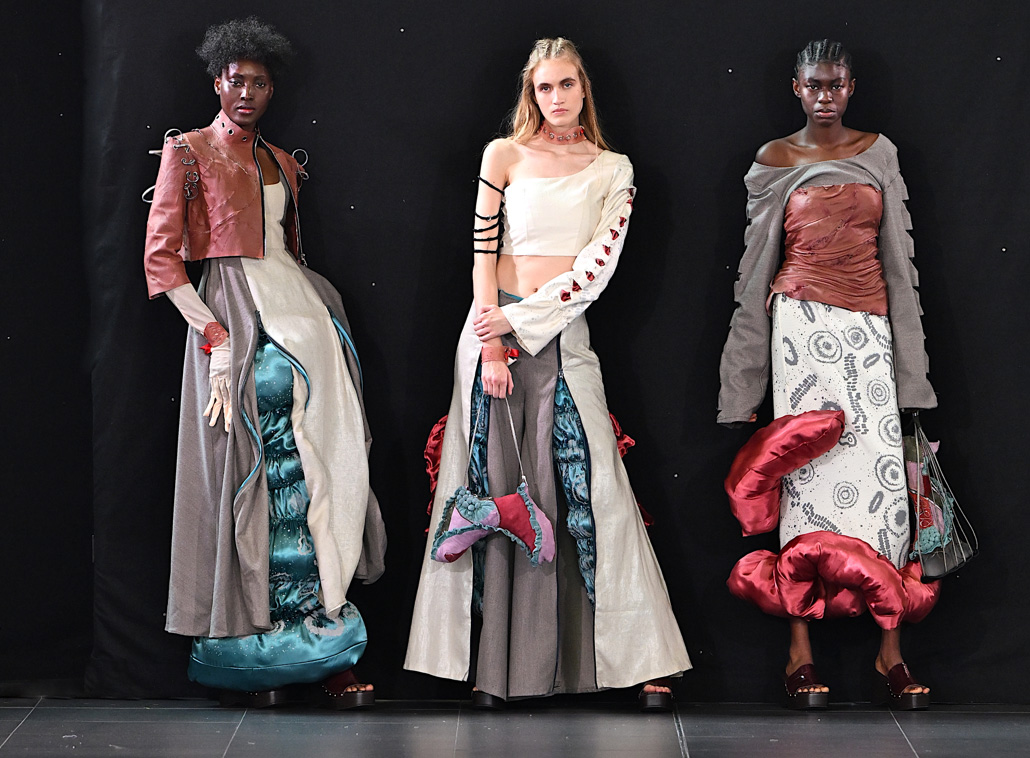
Images: Northampton Fashion Show 18th June (Team 2 YKK Collection & Award Winners). Photography: @satorialsnapper @gimferrer
Multimodal use
The project combined spoken conversation, voice interaction, text prompting, collaborative discussion, reflective writing, visual concept development and studio practice.
Voice interaction noticeably changed the dynamic. Conversations felt less transactional and more spontaneous, which changed the way students responded to the AI’s contributions. It felt less like prompting a chatbot and more like including another voice in the conversation.
Those discussions fed naturally into the wider creative process, from sketchbooks and mood boards through to concept visuals and physical design development. The AI wasn’t something separate from the workflow; it became one part of it.
What did this look like in practice?
One of the most interesting things to observe was that every team developed its own relationship with its AI team member. Some treated it as a creative consultant, while others used it more as a provocateur or a sounding board they didn’t always agree with.
Teams asked the AI to respond honestly to their design concepts, challenge assumptions, suggest alternative directions, identify gaps in research and contribute to brainstorming sessions. Because students had assigned it both a personality and a role, conversations became much more natural than traditional prompting exercises. Rather than simply asking for ideas, they found themselves having genuine back-and-forth discussions.
The AI Team Diary captured screenshots, conversation summaries and reflections on how ideas developed over time. Some students found the AI most valuable when they reached moments of creative uncertainty or became stuck.
Others became increasingly critical of responses that felt repetitive or generic. Interestingly, those frustrations often led to some of the richest discussions about the strengths and limitations of AI within creative practice.
What was the impact?
Students were noticeably more willing to experiment when AI was framed as a collaborative participant rather than an assessment tool. That shift in framing seemed to matter.
What struck me most was how quickly students started critically evaluating the AI’s contributions. Rather than accepting suggestions, groups debated them, challenged them and often rejected them altogether. In many ways, those conversations strengthened reflective thinking and team communication more than the AI’s actual responses.
Voice interaction also changed the atmosphere. Team conversations felt more fluid and immediate than text prompting tends to allow. The AI Team Diary then gave students an opportunity to step back from those conversations and reflect on what had actually happened, which encouraged a different level of critical thinking again.
Ethical or practical considerations
The project prompted valuable discussions around authorship, ownership of ideas, dependency on AI, team accountability and transparency within collaborative creative practice.
Students were encouraged to think critically about when AI genuinely added value, when its responses became repetitive or superficial, and why human judgement remained central to final creative decisions.
From a practical perspective, different AI platforms produced noticeably different experiences, and some students adapted to conversational interaction more comfortably than others. Voice interaction also prompted interesting discussions about how increasingly human like AI can influence communication and group dynamics in ways that aren’t always straightforward.
Reflections and Advice What worked well?
Giving the AI a personality turned out to be far more significant than I expected. It helped students move beyond seeing AI as simply a search tool and encouraged much more imaginative and sometimes genuinely surprising interactions.
The AI Team Diary also worked well because it gave reflection a clear structure. Rather than simply describing what they had done, students began critically evaluating both the possibilities and the limitations of working alongside AI.
What would I refine?
Next time, I would build in more structured reflection points throughout the project rather than relying mainly on students documenting their experiences afterwards. I would also encourage teams to compare different AI personalities, conversational styles or platforms.
It would be interesting to explore how those differences influence collaboration, and I think that comparison would generate valuable discussion in its own right.
What advice would I give colleagues?
Frame AI as a collaborative participant rather than a productivity tool. That small shift changes how students use it and, perhaps more importantly, how critically they engage with its contributions.
Where possible, build in voice interaction. It encourages spontaneity, discussion and debate in ways that text prompting rarely does.
Above all, keep the focus on reflection and process rather than outputs. In this project, the most valuable learning often happened in the conversations rather than in what the AI actually produced.
Any further reflections?
What this highlighted, perhaps more than anything else, was how quickly students anthropomorphised AI within collaborative settings—and how much that influenced communication, creativity and group dynamics. That’s something I think is worth paying attention to as AI becomes more embedded in higher education and professional practice.
It also reinforced something I keep coming back to helping students understand where ideas originate, and recognising that human creativity, judgement and decision making remain central, even when AI is in the room. That feels like increasingly important work.
“It supported my creative thinking by assisting with design development, reaffirming decisions I had already made, and providing alternative solutions whenever I felt unsure or confused. It also helped me explore different creative directions.” Team 2 (student team member)
Quick Start Guide for Colleagues
- Estimated time to set up: Moderate. The activity requires some planning, an initial briefing, opportunities for structured reflection, and an AI Team Diary within NILE.
- Digital skill level required: Moderate.
Common pitfalls to avoid:
- Treating AI as an answer generator rather than a discussion team partner.
- Over-structuring conversations too early, limiting exploration.
- Skipping ethical discussions around authorship, ownership and collaboration.
- Focusing too heavily on outputs rather than the collaborative process, where much of the richest learning takes place.