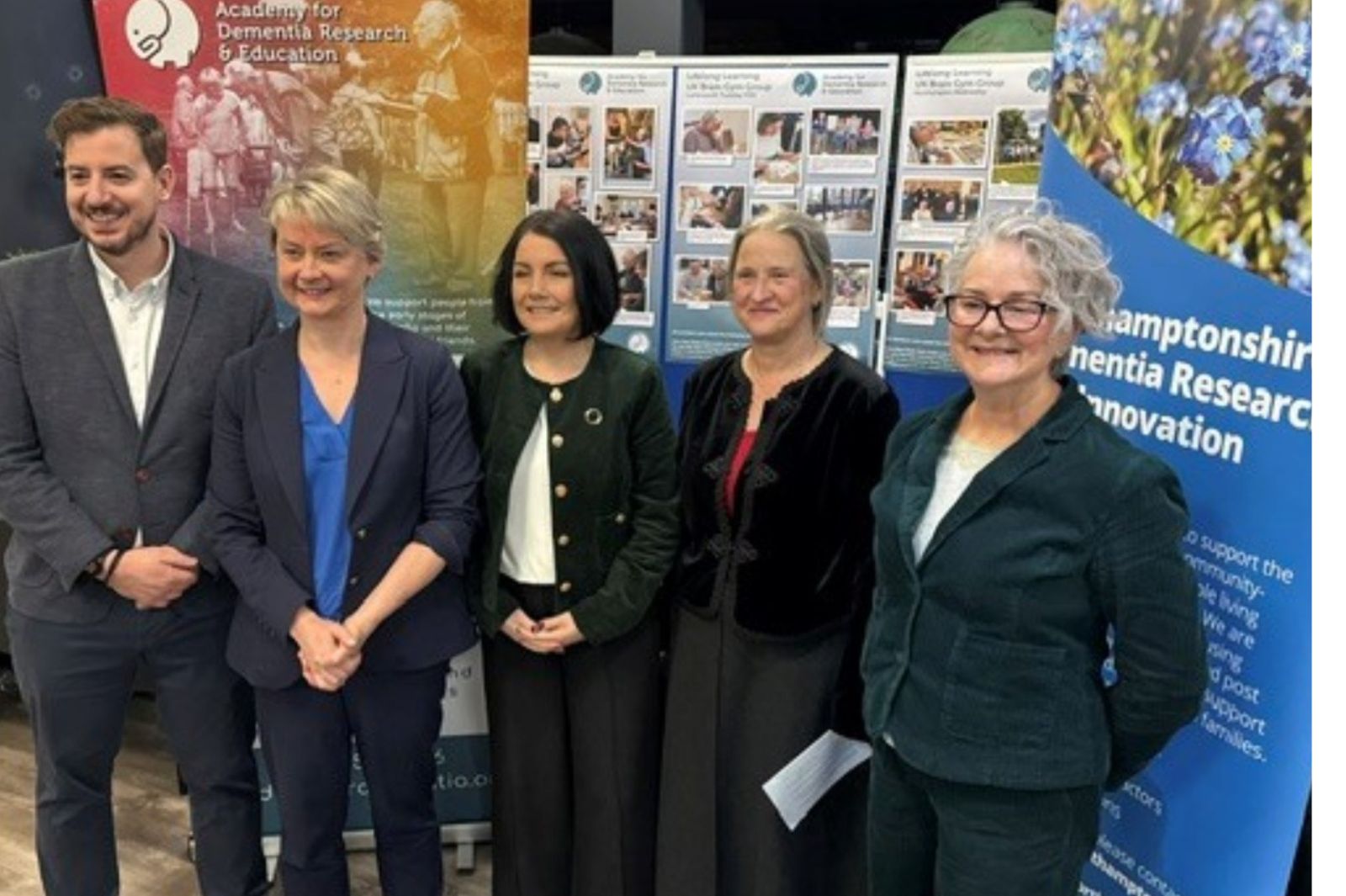
Professor Jackie Parkes (pictured at a recent Labour Party* event) and Dr Natasha Bayes from the Northamptonshire Dementia Research and Innovation Centre (NDRIC) at the University of Northampton welcome new government investment in dementia research. They argue that its benefits will only be fully realised if funding also recognises the community-connected institutions that build trust, widen participation and turn research into practice.
The Government’s commitment to accelerate dementia research through a £48 million government-industry investment supporting the BARBARA Alliance marks a crucial moment for the UK. By linking health data, research and clinical-trial capabilities, the programme aims to widen participation in trials and help promising new treatments reach patients more quickly.
This news reflects a sad and urgent reality. Dementia is one of the greatest health challenges facing our society, affecting individuals, families, communities and public services alike. Almost one million people are living with the condition in the UK today.
Universities, through our teaching, research and civic outlook, are uniquely positioned to address this challenge.
Yet alongside investment in much-needed medical breakthroughs, we should ask a crucial question: what kind of dementia research and innovation system do we want to build?
The UK’s new investment gives us an opportunity to rethink how research happens, who shapes it and who benefits from it. National data infrastructure can help connect people with research opportunities, but successful participation also depends on the trusted local relationships that allow communities to engage with research in the first place. We must therefore invest in the partnerships, relationships and community infrastructure that enable research to improve people’s lives.
Institutions such as the University of Northampton demonstrate the distinctive contribution that community-connected universities can make to answering the ‘big questions’ that matter to people and places. By connecting research with communities, public services and voluntary organisations, this work converts academic expertise into tangible social impact.
At the Northamptonshire Dementia Research and Innovation Centre (NDRIC), our work is built around a simple principle: people living with dementia should be active partners in shaping research that will benefit them and their carers and loved ones.
Our Centre works alongside health and social care providers, voluntary organisations, students and members of the public to develop impactful, person-centred approaches, with people living with dementia contributing as equal partners.
In partnership with North Northamptonshire Council and a local community centre, the Orchard Project in Corby developed and evaluated a community-based approach to dementia support that promoted positive brain health, identified cognitive decline earlier and tackled barriers to accessing services. The recently-launched Northampton Brain Health and Dementia Coproduction Forum provides another example of this approach.
Our research shows that although large, national programmes are vital, innovation often happens on a smaller scale within communities. Local partnerships create opportunities to test new approaches, understand diverse needs and develop support models that can be adapted elsewhere.
As this investment is put into practice, policymakers should look carefully not only at how much dementia research is funded but at how opportunities to participate in and contribute to that research are distributed across the country. Major medical research institutions will remain essential to scientific discovery and clinical trials. Funding models must also recognise universities and local partnerships with the trusted community relationships needed to widen participation, reach underserved groups and translate evidence into improvements in people’s everyday lives.
Government and research funders should therefore create clear routes through which community-engaged institutions can contribute to national programmes such as the BARBARA Alliance. Funding criteria should value co-production, inclusive participation, local partnerships and demonstrable pathways to adoption alongside conventional measures of research excellence.
Dedicated support is also needed for the community infrastructure that makes participation possible, including long-term relationships with carers, voluntary organisations, health and social care providers and people living with dementia.
This broader approach should encompass prevention and early interventions that help people maintain their cognitive wellbeing, alongside new diagnostics and treatments. It would ensure that national investment supports the whole pathway from discovery and clinical trials to prevention, care, workforce development and practical improvements within communities.
Effective research does not end with publication. By connecting research excellence with local partnerships, universities can turn knowledge into improved health outcomes, stronger communities and more effective public services.
This contribution extends to education and workforce development. Students entering health, social care, psychology, public health and allied professions increasingly expect their education to engage with real-world challenges. Community-based, co-produced research enables them to develop the prevention, early-intervention and partnership-working skills needed to support the NHS’s strategic shifts from hospital to community and from sickness to prevention.
Involvement in co-produced dementia research can also create graduates who are better prepared to lead compassionate and innovative services. Universities therefore have a dual contribution to make – advancing research while preparing the health and care workforce that will translate new knowledge into better prevention, support and care.
The Government should now ensure that its dementia research ambitions reach beyond laboratories and national data systems. It should ensure that community-engaged universities have clear routes into national programmes, fund the local partnerships that widen participation and translate evidence into practice and place people living with dementia and their carers at the heart of research and funding decisions.
That would create a more inclusive research system, strengthen prevention and early intervention, and ensure that scientific progress produces visible improvements in communities across the country. That is the prize worth winning together.
*Pictured are Mike Reader, MP Northampton South, UON Interim Vice Chancellor Becky Bradshaw, Professor Parkes and Jane Beaumont, Director and Project Manager of the Academy for Dementia Research and Education.