Each June, Geography classes across the UK are encouraged to take part in the Geographical Association’s National Festival of Fieldwork. Schools and colleges choose their own date and activity, and a range of ideas are provided by the Geographical Association to help inspire learning outside the classroom.
The value of fieldwork in developing skills and enhancing subject knowledge has been well-documented. It is seen as integral to Geography, Environmental Science and Earth Sciences, and is a requirement for many qualifications in these subjects.
Those studying Geography or Environmental Science at the University of Northampton take part in field activities throughout their studies. Some fieldwork is carried out on campus or in the local area. Exploring environments so close to home allows us to consider familiar environments from a different perspective. Students also attend a residential fieldtrip in the UK – this year Geography students visited London and Brighton, whilst Environmental Science students went to Shropshire or Devon. Residential trips enable students to immerse themselves in an unfamiliar location, studying particular aspects of an environment in-depth.
In May, Geography and Environmental Science students had the opportunity to attend a fieldtrip in a very different location – South-West USA. Over the course of 11 days the group visited four States and covered more than 1,500 miles.
The trip started with an early bus ride from Northampton to Heathrow, then a flight to Los Angeles, California. On arrival we picked up a minibus and drove out across the city to Pasadena, our base for the first few days. Travelling around Los Angeles by minibus and rail enabled students to critically reflect on transport issues in the city. Driving through areas damaged by recent wildfires provided insights into issues discussed in class, whilst visiting Hollywood Walk of Fame allowed us to experience a busy tourist location and think about iconic destinations. The view from near the Griffith Observatory helped us to understand the scale of the city.
Having recovered (slightly!) from jet lag, we then headed out of the city. Our first stop was Joshua Tree National Park where we explored desert ecosystems and saw a rattlesnake.
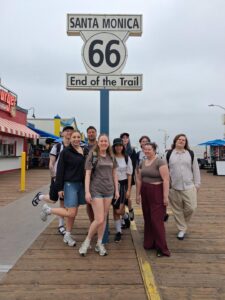
Our road trip then continued into Arizona, along Route 66. A visit to Sunset Crater National Monument enabled us to learn more about volcanoes and walk on an historic lava flow. Seeing examples of different volcanic forms in real life really helped to deepen our understanding of the processes that create these.
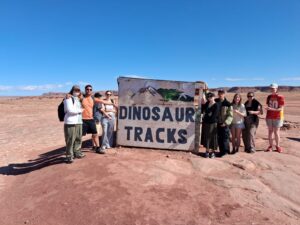
The highlight for many of those on the trip was the day spent at the Grand Canyon – an awe-inspiring place to learn about geology. Another favourite was the nearby Moenave Dinosaur Tracks.
Prior to the trip, students had been learning about the management of the Colorado River, analysing river flow and reservoir level data, and about challenges posed by population growth and climate change. Visiting Glen Canyon Dam helped bring this project to life, enabling students to see locations studied and access real-time data about the river.
The third State of the trip was Utah. Visits to Coral Pink Sand Dunes State Park and Zion National Park offered even more variety in the types of environment visited.
We then headed into Nevada and Las Vegas – a great place to learn about tourism and think critically about sustainability issues.
The trip boosted students’ subject knowledge and allowed them to connect the theories and issues discussed in the classroom to real world contexts. Students enhanced their skills of observation and data analysis, as well as key employability skills such as teamwork, flexible working practices and problem-solving. But perhaps most importantly, the trip provided an opportunity for them to explore new places with their friends. I hope all those schools engaging in the National Festival of Fieldwork this month have as much fun doing fieldwork as we did.
Find out more about studying Geography and Environmental Science at UON by visiting an Open Day.