Executive Summary
As part of the University’s ongoing exploration of artificial intelligence within learning, teaching and student support, a pilot of the Kaltura Conversational Avatar platform was undertaken. The pilot formed part of wider AI innovation activity linked to the Study Smart 3 project and sought to evaluate how AI avatars might support information provision, student engagement and access to institutional services. The evaluation combined practical testing with feedback from staff, students and project participants.
The findings demonstrate that AI avatars can offer value in specific contexts, particularly where consistent, scalable and multilingual information delivery is required. However, the pilot also highlighted important challenges regarding authenticity, accessibility, trust, accuracy and the potential impact on human relationships within higher education.
Background
In March 2026, the University began collaborating with Kaltura on a pilot of its Avatar and Genie technologies. The project team recognised that conversational avatars aligned well with the aims of the Study Smart 3 project, particularly around multimodal communication and innovative approaches to supporting learners. Staff and students participating in the project were identified as pilot users, and feedback was gathered throughout development and testing.
The initial avatar, named “NORA” (NORthampton Avatar), was configured to provide information about the University and direct users to relevant services when required. Success criteria focused on answering questions accurately, directing users to appropriate information sources and gathering engagement and performance metrics.

The pilot evolved through several iterations. Feedback from University testers influenced ongoing vendor development, including improvements to multilingual capability, refinements to visual realism and the introduction of a second avatar known as “Sam”.
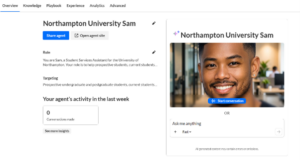
A final pilot showed the creation of an avatar using an existing University of Northampton staff member along with his voice “Rob”. Avatars which mimic exiting on ‘known’ people raised several additional factors not previously covered. For example, those using the mimic expected the tool to have similar knowledge to the person it was replicating. When it could not demonstrate this then there was a more significant drop in satisfaction (and a rise in complaints). For an example interaction you can hear the author of this paper chatting with his own Avatar:
Pilot Activities and Findings
User Experience and Interaction
Feedback from some testers was positive, particularly regarding responsiveness and ease of interaction. One academic noted that the avatar felt smooth to interact with and showed considerable potential as a future support tool, although responses were, appropriately, better suited to quick informational support than in-depth academic discussion, reinforcing the avatar’s role as a complement to expert teaching, not a substitute for it.
The Kaltura development team also responded directly to University feedback by reducing facial movements and introducing a “tap-to-talk” interaction model. Earlier pilot discussions had identified this approach as preferable in group demonstrations and noisy environments because it reduced accidental interruptions and offered users greater control over interactions. The addition of a conversation summary at the end of the interaction was felt to be valuable by the users:
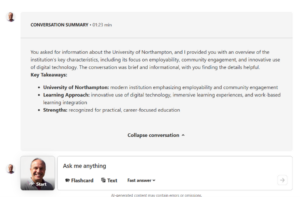
This is also an area Kaltura is actively refining as part of the Kaltura AI Labs roadmap – including emotional reactions in the correct context. The aim is not to mimic human interaction but to lead to a more natural conversation that with better deduction skills and reactions from the agent, in the belief this will unlock better conversation potential and achieve more goals for the learners long term.
Accessibility Considerations
Accessibility emerged as a significant theme throughout the pilot. During feedback meetings, participants highlighted the importance of real-time captioning as an essential requirement. Testers also specifically queried whether captioning could be enabled for users who may have hearing impairments.
The pilot therefore reinforced the need for accessibility-by-design, ensuring any future avatar deployment complies with institutional accessibility expectations and supports a diverse learner population.
Multilingual Support
One area where avatars demonstrated promise was multilingual communication. Testing showed that users could interact with the avatar in languages other than English. Testing also surfaced early-stage challenges typical of multilingual conversational AI, an area Kaltura continues to prioritise given its importance for accessibility in learning environments.
Staff and Student Perceptions
Positive Views
A proportion of student and staff feedback recognised the potential value of AI technologies when used appropriately.
Students acknowledged that AI tools could provide useful support alongside traditional teaching approaches, particularly as a supplementary resource rather than a replacement for lecturers.
Some staff also recognised benefits where students would enter industries that increasingly utilise generative AI technologies, suggesting that exposure to such tools could have employability value.
Pilot participants further observed that avatars could provide immediate information and support at scale, particularly when trained on institution-specific content and integrated with existing knowledge sources.
Challenges Raised
The strongest theme emerging from survey feedback was concern about replacing human interaction.
Several students stressed that relationships, mentoring, personal feedback and contact with lecturers were central to the university experience and should not be substituted by AI systems.
Other students expressed broader concerns about generative AI, questioning its reliability, originality and role within education. Some described AI-generated interactions as lacking authenticity and voiced worries about replacing human expertise with automated systems.
Staff echoed many of these concerns. Comments included fears that increasing use of avatars could diminish critical thinking, encourage over-reliance on technology and potentially undermine the core purpose of universities as places of human learning and engagement. Staff also highlighted the need to pay attention to emerging research regarding AI’s impact on cognition and information reliability.
Kaltura have responded to these challenges noting: “What we’re building is meant to extend what a person can do, not stand in for them. Every avatar is goal-oriented: grounded in a specific institution’s own content, scoped to a defined set of tasks, and designed to relay information contextually rather than just retrieve it. It operates entirely within guardrails we define — the moment a question moves beyond its scope, it hands off to a person, by design, not as a fallback. The aim has always been to put more of an institution’s expertise in more places at once, so the people behind it can spend their time where it matters most.” – Eylon Shoshan, SVP of AI at Kaltura
Design and Trust Issues
Visual realism remains an area of active development industry-wide, and feedback from this pilot is directly shaping design iteration with Kaltura. Eylon Shoshan, SVP of AI at Kaltura further expands on this:
“There’s a real difference between rendering a photorealistic face and generating one live, in sync with speech, at conversational latency. The offline version has been solved for years. The live version is a fundamentally different computational problem, and it’s the frontier the whole category is built on — including us. What people read as less realistic in a live avatar isn’t simply a matter of timing; it is the direct result of the strict computational trade-offs required to operate in real time. Rendering a photorealistic, high-quality avatar while maintaining instantaneous responsiveness requires a delicate, controlled balance under a live latency budget. Mastering that trade-off is exactly the engineering problem we’re built around, and that’s the next evolution in the field. Our recent work on real-time emotional intelligence, where the avatar reads tone and intent and adjusts its expression on a continuous spectrum rather than jumping between fixed states, is a direct result of optimizing this balance between rendering fidelity and conversational speed.” – Eylon Shoshan, SVP of AI at Kaltura
Potential Use Cases for AI Avatars
Based on the pilot findings, AI avatars appear most suitable when used to enhance rather than replace human services.
Potential applications include:
- Providing answers to frequently asked questions about university services and processes.
- Offering out-of-hours information and signposting.
- Supporting multilingual access to institutional information.
- Acting as an initial point of contact before escalation to human staff.
- Supporting demonstrations, orientations and information events where consistent information delivery is required.
- Providing scalable support in areas experiencing high volumes of routine enquiries.
- Delivering consistent guidance across multiple channels and locations.
- Enhancing accessibility through voice-based interaction, multilingual support and captioning functionality.
The pilot also demonstrated the value of configurable guardrails and escalation pathways, ensuring that complex, sensitive or high-risk questions are directed to appropriate staff members rather than handled by the avatar alone.
Lessons Learned
Several key lessons emerged from the pilot:
- Human-centred design remains critical. Users were far more accepting of avatars when they were positioned as support tools rather than replacements for staff.
- Transparency is essential. Users should always understand that they are interacting with an AI system, what information it can provide and where its limitations lie.
- Accessibility must be built in from the outset. Features such as captioning, alternative interaction modes and multilingual support should be considered core requirements rather than enhancements.
- Trust is influenced by visual design. Avatar appearance, voice, responsiveness and behaviour all affect user perceptions and acceptance.
- Clear escalation routes are necessary. Users must be able to access human support quickly when queries become complex, sensitive or beyond the avatar’s knowledge.
Conclusion
The University of Northampton’s exploration of AI avatars through its partnership with Kaltura has demonstrated both opportunities and challenges. Feedback showed that avatars can provide engaging, accessible and scalable methods of delivering information, particularly for routine enquiries, multilingual interactions and self-service support. Positive feedback highlighted the technology’s potential and the benefits of rapid access to information.
At the same time, survey responses revealed substantial concern among both staff and students regarding authenticity, trust, accuracy and, most importantly, the replacement of human relationships within teaching and support services. Many respondents emphasised that AI should complement rather than replace educators and professional staff. This concern reflects a broader industry conversation about AI’s role in education, which Kaltura’s own product philosophy is built around addressing.
The evidence from the pilot therefore suggests that AI avatars should not be viewed as substitutes for human interaction. Instead, they are most effective when deployed in carefully defined scenarios where they can augment existing services, provide consistent information and improve access to support.
When designed with appropriate accessibility features, guardrails and escalation mechanisms, AI avatars can offer meaningful benefits while preserving the human connections that remain central to the higher education experience. The pilot demonstrates that there is a place for AI avatars within higher education, particularly where they enhance convenience, accessibility and scalability. However, their greatest value lies not in replacing people, but in supporting staff and students by extending the reach of existing services and enabling human expertise to be focused where it adds the most value.