 How do you make safety education feel immediate, relevant and memorable? For Beth and her classmates, the answer was to move beyond posters and static messages and create an immersive virtual reality experience that placed viewers inside a carefully designed safety scenario.
Working from a live client brief from Northants Police, UON students developed a VR experience focused on violence against women and girls. The aim was to support student safety in and around Northampton town centre, particularly within the context of night-time safety and personal awareness, without relying on predictable or passive messaging.
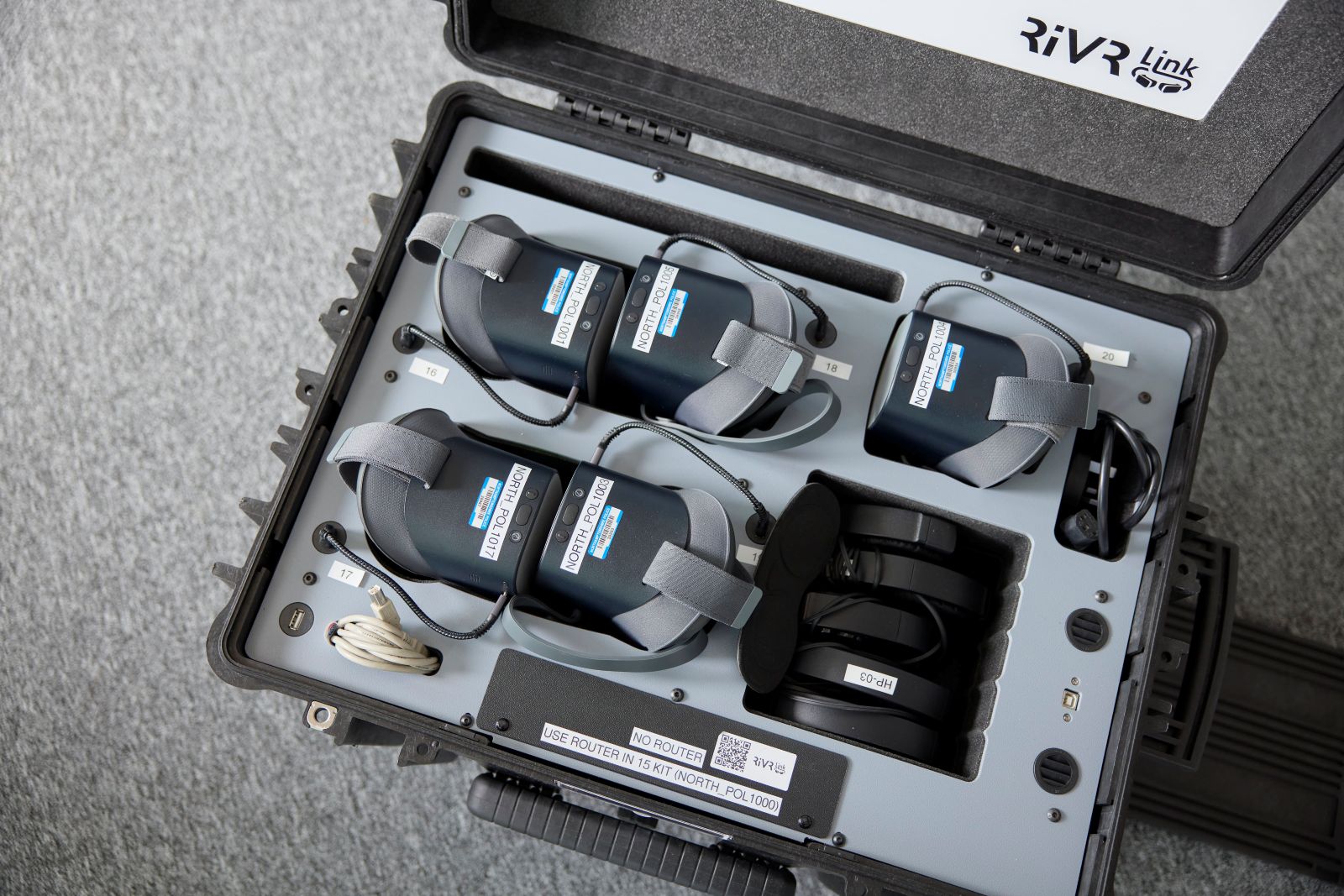
The final output was a virtual reality experience designed to be viewed through a headset. Rather than focusing on a typical nightlife scenario. The students chose to tell the story of a young woman walking home after work. This approach helped broaden the message that safety risks can arise in everyday situations, not just during nights out.
Beth’s role spanned the full creative process, she contributed as a script writer, appeared as an extra during filming, and helped with editing the final result. This gave her a view of the project from concept to completion, and helped her understand how communication, storytelling and digital production come together in a real-world brief.
She described the scriptwriting process as one of the most enjoyable but most difficult parts of the project. Writing for VR required a different mindset; the team had to think not only about dialogue and structure, but also about how the story would be experienced through a 360 camera and headset.
Storyboarding played an important role in planning the experience. The team used a shared story board to develop ideas collaboratively, map out the scenario and coordinate different responsibilities. As Beth put it, the project involved ‘hands in all pies’, with students relying on each other to bring together writing, acting, filming, production and editing.
Filming brought its own challenges. Because the project focused on safety at night, scenes had to be filmed in darkness. At one point, the team blocked out windows in a house to create the right conditions. They also had to manage approvals, locations, timing, participant availability and the practicalities of working with 360 filming equipment.
Editing was also different from a conventional video project. Beth reflected that VR is not simply a flat, 2D medium; it requires thinking spatially and considering how the viewer will look around and experience the scene. This made the editing process more complex, but also more valuable as a digital learning experience on the course.
Beth reflected that the brief was both challenging and exciting because the team were given space to interpret it themselves, rather than being told exactly what to produce. They had the freedom to conceptualise what the client needed, what the audience would respond to, and how to translate a serious issue into a VR experience that felt appropriate and useful.
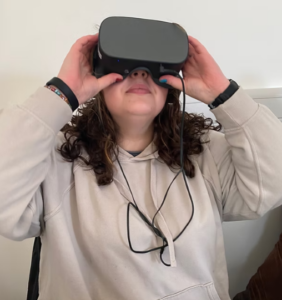
Beth compared the experience with more traditional safety messaging, such as posters or static information about apps and support services. In her view, storytelling made the message more effective. Rather than ‘shouting a message’ at students, the VR experience invited them into a situation and encouraged them to think about safety, awareness and available support in a more active way.
As a learning experience, Beth described the module as highly collaborative and more engaging than typical pedagogical methods. Attendance was strong because students needed to be present to keep up with the evolving project and the work felt purposeful because it was practical, client-facing and connected to skills that students could use beyond the classroom.
Beth also highlighted the employability value of the project. She has been able to talk about the experience on her CV and in job interviews, particularly because it gave her practical examples of scriptwriting, editing, digital storytelling, teamwork and client communication.
Whilst the self-led element was demanding, it nurtured an authentic learning experience. Students had to navigate uncertainty, make creative decisions, and respond to the expectations of an external client while keeping the safety and wellbeing of their audience at the centre of the work.
The final project was displayed at Student Futures, where people could experience the scenario using a VR headset. The police responded positively to the brief, and the final result worked well despite technical and logistical challenges along the way.