- Faculty/module/cohort: Level 5 Fashion, Textiles & Footwear – AI in Creative Practice Workshop
- AI Tool(s) Used: ChatGPT (Voice Mode), Google Trends
- AI mode(s) used: Text prompting, voice interaction, social media content analysis, multimodal discussion and presentation.
What was the challenge?
The challenge was finding a way to introduce AI into fashion forecasting without students relying on it passively or treating it as a shortcut.
At this level, students are already immersed in platforms such as TikTok, but they don’t always stop to critically analyse why trends emerge, who drives them, or how digital culture shapes consumer behaviour. That felt like the right place to begin.
I also wanted to explore whether AI could support creative intuition rather than replace it. There was something else I was curious about too. Most educational uses of AI rely on text prompting, and I wanted to see whether making interactions more conversational would change how students engaged with both the technology and with each other.
What did you do?
Students worked in small groups of three to five and explored current fashion content on TikTok using hashtags such as #OOTD, #StreetStyle and #TikTokMadeMeBuyIt.
They identified two or three emerging micro-trends, paying attention to recurring colour palettes, silhouettes, styling choices and visual themes.
Once they had something to work with, they used ChatGPT alongside Google Trends to push their thinking further. Rather than simply describing what they had found, they explored questions such as:
- Is this trend genuinely growing, or does it just feel that way?
- Who is driving it?
- Are brands responding yet?
- Is it likely to become mainstream or remain niche?
Each group then delivered a one-minute trend forecast, explaining which trend they believed would develop and why.
The final stage was the most experimental. As groups presented, I ran ChatGPT Voice Mode live in the room. The AI responded verbally, offering feedback, asking follow-up questions and occasionally challenging assumptions or suggesting connections students hadn’t considered. It didn’t always get things right, which often proved just as useful as when it did. The atmosphere felt noticeably different from a traditional critique.
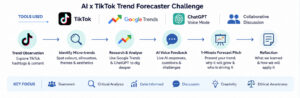
Long description: Infographic titled AI x TikTok Trend Forecaster Challenge showing a six-step workflow for analysing and forecasting TikTok trends. The process begins with observing TikTok hashtags and content, identifying micro-trends, researching using Google Trends and ChatGPT, receiving AI voice feedback, presenting a one-minute trend forecast, and ending with reflection on key learnings and application. The infographic highlights the use of TikTok, Google Trends, ChatGPT Voice Mode and collaborative discussion, with a focus on teamwork, critical analysis, data-informed decision making, discussion, creativity and ethical awareness
Multimodal use
The workshop brought together several different modes of working at the same time: short-form video, spoken presentations, AI-generated responses, live voice interaction and visual trend analysis.
Students moved continuously between observing content, discussing ideas, interrogating evidence and responding to AI, often within the space of a few minutes.
Using Voice Mode shifted something in the room. AI stopped feeling like a tool hidden behind a screen and became, at least temporarily, another participant in the discussion. Students responded more naturally to it and seemed much more comfortable disagreeing with it.
What did this look like in practice?
The workshop felt energetic, occasionally a little chaotic but also in the best possible way. Groups gathered around phones and laptops, comparing TikTok feeds and screenshots while debating whether they were looking at a genuine emerging trend or simply an algorithm showing them more of the same.
The presentations were deliberately short and informal; the aim was quick thinking and commitment rather than polished delivery. During each pitch, ChatGPT Voice Mode responded in real time, acting almost like an external commentator.
Some of the prompts that generated the richest discussion included:
- Is this micro-trend likely to move into mainstream retail?
- Which consumer groups are driving this aesthetic?
- What historical fashion references can you identify?
- What risks might brands face if they adopt this trend too quickly?
There were moments of humour and genuine surprise, but also moments when students became frustrated with the AI’s responses. Interestingly, those frustrations often led to the most productive conversations.
What was the impact?
Engagement was high, partly because the workshop connected directly with platforms students already use every day.
What I noticed more specifically was a shift in how students thought about forecasting itself. The AI kept pushing them beyond simply spotting trends towards explaining why those trends mattered and where they might go next. That distinction between trend spotting and trend forecasting became a recurring thread throughout the session.
Voice interaction also seemed to lower the threshold for participation. Students who are usually quieter during critiques appeared more willing to contribute, although I’d want to explore that observation more carefully before drawing any firm conclusions.
The workshop also gave students opportunities to develop teamwork, verbal reasoning, critical AI literacy and rapid idea generation. Those outcomes emerged naturally through discussion rather than feeling like separate learning objectives.
What mattered most, though, was that students left asking better questions than the ones they arrived with. For me, that felt like a much more meaningful measure of success than whether the AI’s predictions were accurate.
Ethical or practical considerations
Critical engagement with AI outputs was built into the workshop from the outset. Students were encouraged to question responses rather than accept them, and this became surprisingly easy whenever the AI was confidently wrong.
We also explored some of the wider issues surrounding trend forecasting. Discussions considered how TikTok’s algorithm shapes which trends become visible, who gets seen, and what the rapid acceleration of trends means environmentally and socially, particularly in relation to labour and fast fashion. Those conversations felt genuinely integrated into the workshop rather than added as an afterthought.
From a practical perspective, using Voice Mode in a shared teaching space requires a little planning. Background noise occasionally caused problems, and there were times when the AI presented speculative responses with considerable confidence.
Rather than seeing that as a limitation, I began using those moments as prompts for students to verify evidence, question sources and justify their thinking.
Reflections and Advice What worked well?
The conversational format was probably the strongest part of the workshop. Students engaged more openly than they typically do in a standard forecasting session, partly because the activity felt immediately relevant and partly because Voice Mode made AI feel less like an assessment tool and more like something they could question, challenge and occasionally disagree with.
What would I refine?
Next time, I would build in more structured reflection after the AI feedback stage. Students were highly engaged in the moment, but some of the bigger questions deserved more time than the workshop allowed.
I would also like to place AI generated forecasts alongside traditional industry trend reports and ask students to compare the two. I suspect that would generate some really interesting conversations about evidence, judgement and expertise.
What advice would I give colleagues?
Keep the prompts simple and let the discussion do the work.
The value wasn’t in producing perfect AI responses, it came from discussion, debate, disagreement and students having to justify their thinking. It also helps to frame AI as a collaborator with a perspective rather than an authority with answers. That shift in framing seemed to make quite a difference to the students.
Any further reflections?
What struck me most was how naturally students moved between visual, verbal and digital ways of thinking throughout the session. The AI became most useful not when it made the task easier, but when it encouraged students to work a little harder to explain and justify what they thought they already knew.
That feels like an important distinction. The aim wasn’t to make forecasting quicker, it was to deepen students’ thinking about how trends emerge, how evidence is interpreted and where human judgement still matters.
- Quick Start Guide for Colleagues Estimated time to set up: 1 – 2 hours.
- Digital skill level required: Low to Moderate.
- Common pitfalls to avoid:
- Overcomplicating prompts.
- Allowing AI to dominate the discussion rather than provoke it.
- Focusing on the technology instead of the critical thinking.
- Assuming students already understand how algorithms shape trend visibility.
- Best suited for: Creative practice modules, fashion forecasting, branding, media studies, trend analysis and collaborative workshops across Levels 4 – 6.